Skip to main content
Photorealism, the painting genre, came into prominence in the late 1960s and ’70s as a response to the dominance of abstract expressionism. Artists like Chuck Close and Richard Estes were making paintings that closely resembled photographs in their perspective and detail. It was a radical move to take back what photography had stolen from painting a century before: the impulse to show how things actually looked.
Though photographs are still regarded as evidence, their authority has slipped as discrete pixels have replaced the continuous grain of film and paper. What we call photographs today are actually easily manipulated grids of colored squares—an approximation of what the human eye sees that can be generated with tools almost everyone has access to. In this way, digital photos are more like paintings than their analog precursors, and the “reality” they present is anything but self evident.
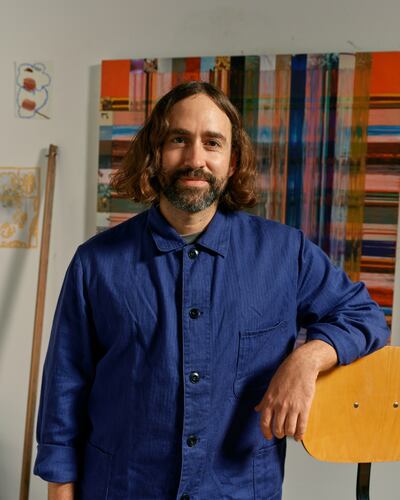
What to make of this new and mutable relationship among photography, painting and representation? The answer for Seattle artist Joe Rudko is simple. As he writes in an exhibition statement for Photorealism, his current show of collaged paintings at Northwest Portland’s PDX Contemporary: “If photographs are no longer understood as reliable records of reality, then the definition of photorealism changes.”
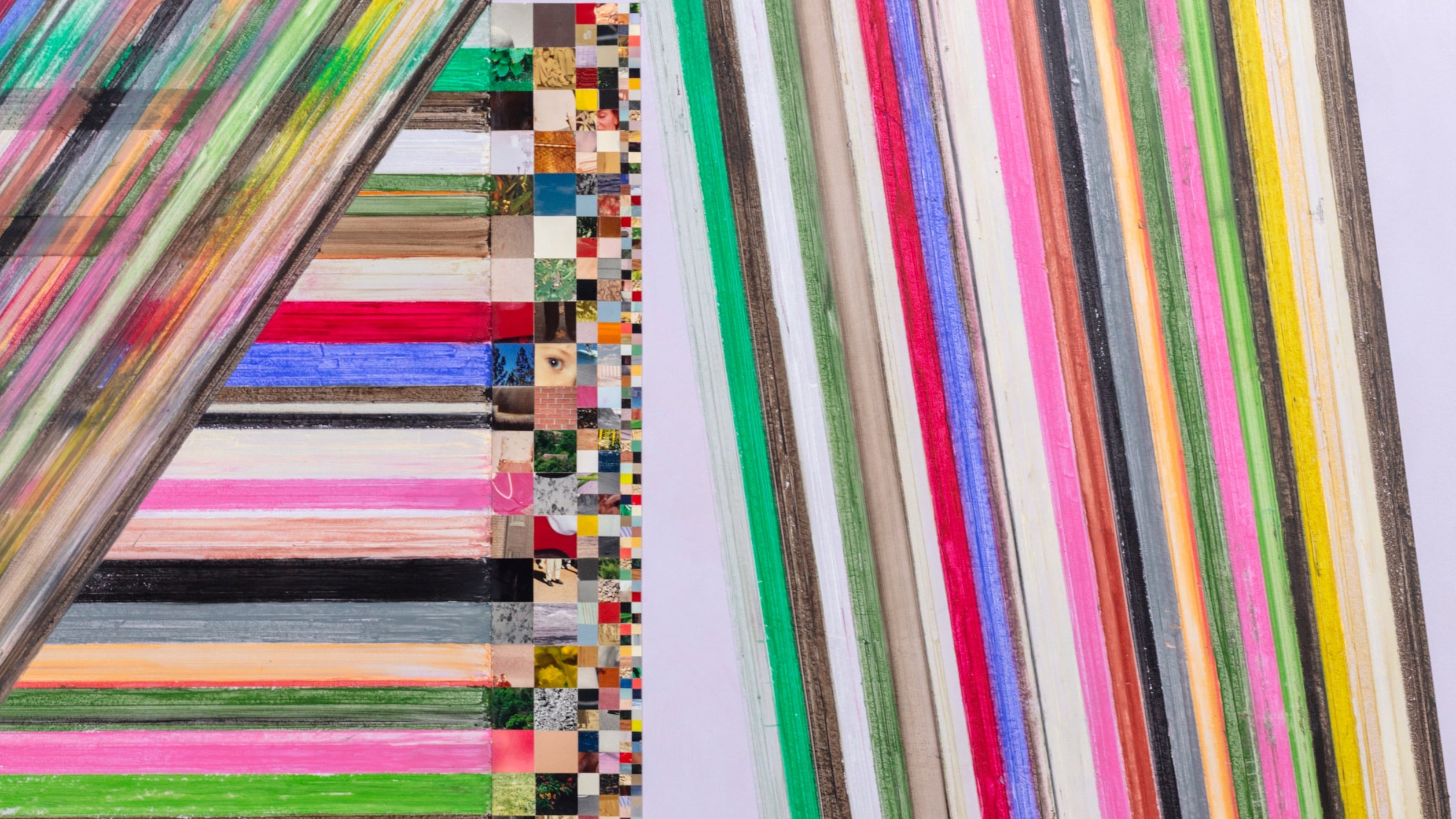
Like Chuck Close, Rudko starts with individual points—snippets of found photographs—whose shape and tone are then repeated and extrapolated into the larger painting.
Sliced up into tiny squares of emulsion, the photos mostly read as clusters of variegated tones, which Rudko has then used as the inspiration for pigments extending in linear formation from their edges. But the lines, though straight, are not clean. Colors quickly mix and bleed into each other, creating multiple parallels within each block. The effect is something like the streaks of a wonky document scanner, or the banding on a digital inkjet print: glitchlike in their seemingly uniform stuttering across the plane; beautiful when they collide to change color and layer into a chunky weave.
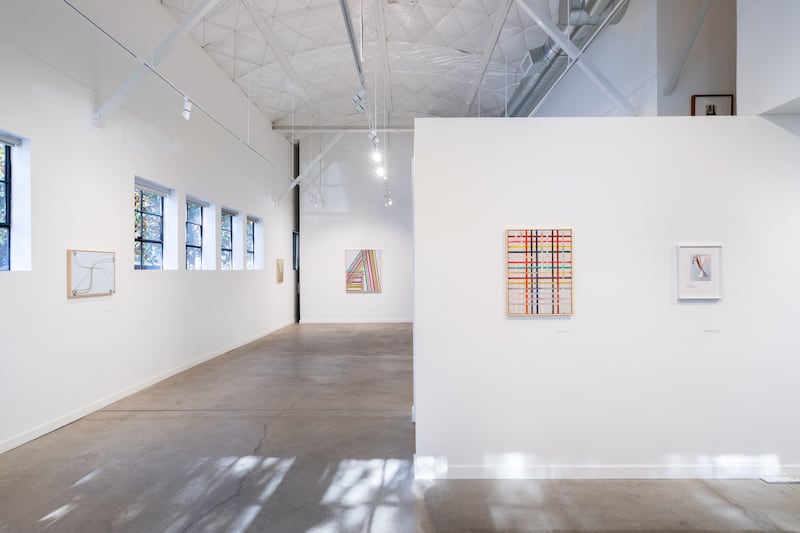
Occasionally, as in the pieces Container and Viewfinder, a series of windows wedges within yet more windows—a 90-degree spiral leading to an empty center. In others, those lines retain their directions on the Cartesian grid, pausing only to fade and cross over into each other like yarn on a loom before racing off the canvas.
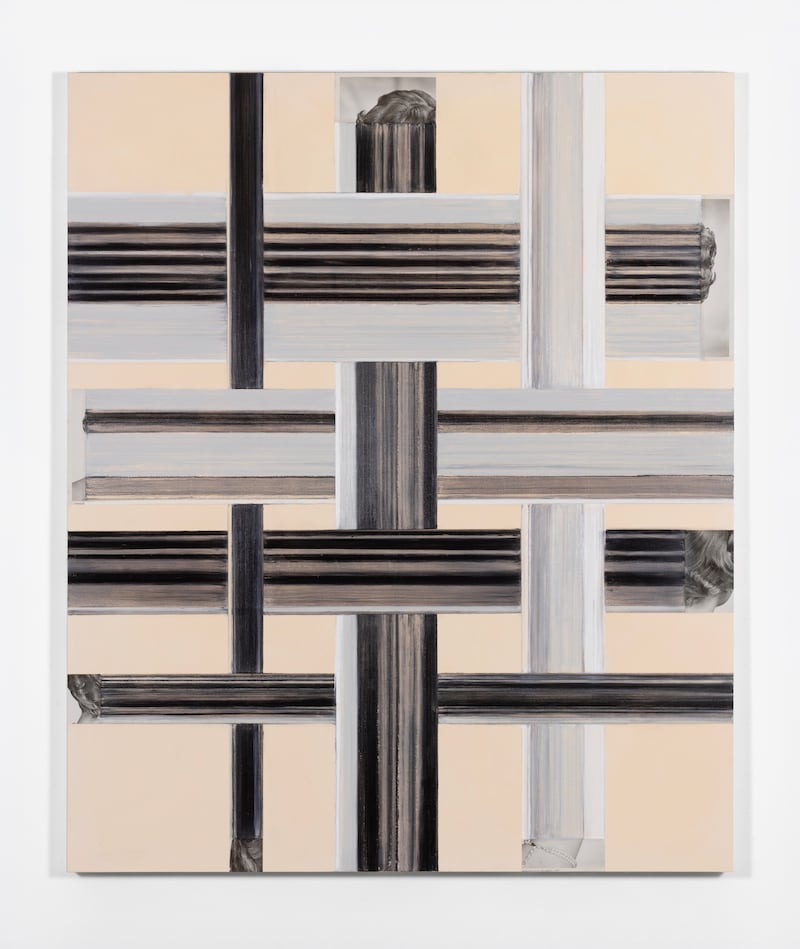
In a standout work, Reverse Portrait Weave, the edges of the piece are populated with several fragments of a black-and-white photograph, or photographs, depicting the back of a woman’s head and neck. These small snippets make it hard to glean details, but a styled haircut and a pearl necklace are visible, along with the recognizable backdrop of a photo studio. A small line of text at the bottom of one reads, in part, “National Beauty Service.” But gushing forth from those sharp glimpses of sculpted hair and neckline are smudged waterfalls of muted tone, with Rudko’s oil and acrylic paints extending the hues from the original image. These cascading stripes, which dominate the canvas as they make their way across it, evoke the stretched and muddled goopiness of digital decay.
Still, these grainy blips aren’t there to represent their subjects; they’re starting points for Rudko’s constructions (or dismantlings) of line and color. Like memory itself, these paintings are jigsaw puzzles of fragments that don’t always add up, and maybe that’s the point. Rudko’s engagement with photorealism begins and ends with abstraction. Photorealism shows that the trueness of images, be they photographs or oil paintings, has always been a fabrication.
SEE IT: Photorealism by Joe Rudko at PDX Contemporary Art, 1881 NW Vaughn St., 503-222-0063, pdxcontemporaryart.com. 10 am–5 pm Tuesday–Saturday, through Nov. 28. Free.