Skip to main content
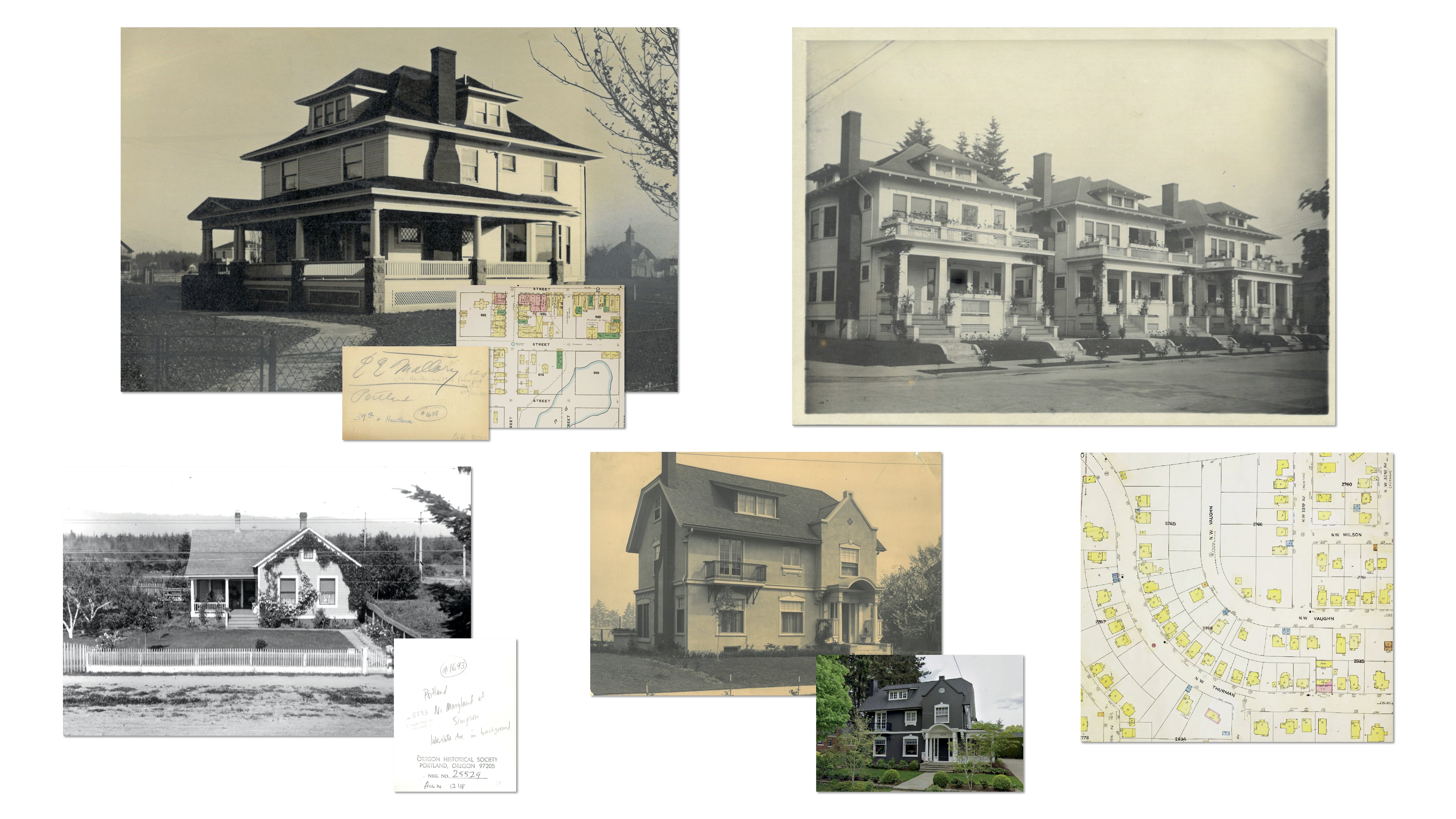
Unless you live in brand-new construction, your house has a history. Odds are, you know almost none of it. And maybe you’ve wondered. Maybe your house has a spooky vibe that makes you wonder if something terrible happened on the premises. Or you would like a word with the person who thought it would be a good idea to put carpeting in the kitchen cabinets (or contact paper on top of the carpet). Or you want to see what your neighborhood looked like when your home was built.
Odds are, too, you won’t be able to get answers to all of these questions. But there is a lot of information out there.
James Scott is a research librarian at the Oregon Historical Society who has hosted house and building history workshops in the past and who also fields inquiries from all over the state from people looking for more information about their homes or about other buildings. He walked me through some of the basics on researching the history of your house or building. I didn’t manage to get the name of the person whose kitchen-remodel choices will live rent-free in my head forever, but I did learn a few fun things about my apartment building, including the name of the original owner and the fact that the then-owner of the building in the 1950s petitioned the city to be exempt from updating the fire escapes. (Thanks, pal!)
Anyway, here’s what you need to know to get started.
You’re going to have to look in a few different places. “It’s not a one-stop experience,” Scott says. If you live in Portland, you can start with PortlandMaps.com, which usually lists the date of construction and will include recent information about permitting (starting in 2012). If your home was built before 1930, the address changed in what Scott calls the “Great Renumbering” of Portland streets; you can find the previous address at PastPortland.com, which may also list the names of previous occupants. Scott recommends checking the city of Portland’s Plumbing Permits and Building Code Appeals Search page (portlandoregon.gov/bds/plumbing_permits); plumbing is typically the last permit filed before a building can be occupied, so the name on that permit is likely the name of the building’s first owner. From there, you can check a city directory; OHS has bound copies of city directories from Portland (and some other municipalities), with the Portland directories dating back more than 100 years. If you’re looking for old photos, check Oregon Historical Society Digital Collections (digitalcollections.ohs.org) and the City of Portland Archives (efiles.portlandoregon.gov). You can also make a public records request through the city’s Public Records Request Portal (portland.gov/public-records/request). For $8, you can request the entire permitting history of your address (and sometimes also receive blueprints). You can also search your address in the archives of The Oregonian and the Oregon Journal on the Multnomah County Library’s website. You just log in with your library card; you don’t even have to get off your couch. That having been said…
A lot of information is online, but at a certain point, you’ll probably want to hit the stacks. You can also access some city directories virtually through Ancestry.com. (If you don’t have a paid account, OHS and the Multnomah County Library both offer institutional memberships, but neither provides remote access. You’ll have to visit a library in person—either OHS’s research library or a Multnomah County Library branch.) To get information about previous owners, you can access deed history on microfilm at the Multnomah County Division of Assessment, Recording & Taxation (multco.us/departments/assessment-recording-taxation).
OHS’s research library also carries the Historic Resource Inventory of Portland, a multivolume index of every property the city of Portland considers historic. And then there’s the Portland Block Book, which documents land ownership (if not occupancy) from the year 1907, and the Portland Realty Atlas, which provides similar information from 1914. OHS also has bound copies of Portland neighborhood histories that can sometimes provide leads as well as vertical files that can include “catch-all” items like photos of neighborhood events and aerial photos. “We do a lot of house histories and they’re fun,” Scott says. “It’s a lot like doing a puzzle.”
You may not find exactly what you’re looking for—but you also might hit the jackpot. Archival research involves a fair amount of luck: Sometimes you’ll find a property whose history is well cataloged, and sometimes you’ll discover only bare-bones information about the history of the house. “Every house history answer is different,” Scott says. “Sometimes we have great success, but sometimes you don’t find a lot.” Often, though, once you build momentum in your search, you’ll have more luck finding information that can inspire you—or just help you learn more about where you live. Says Scott, “It gives you a greater level of connectedness to your home.”
What’s Next?
Once you’ve learned a little bit (or a lot) about the history of your home, what can you do with that information? The answer depends on what you find—and why you were looking in the first place. For example, having a history of prior renovations can help you better understand the structure of your home, including safety issues that might need addressing before you move forward. Maybe you just want to have a better sense of connection with the place where you spend most of your time—or you want some design inspiration or cool décor. Whatever got you started on your house history search, and wherever you ended up, here are some things you can do next.
Get renovation help. The city of Portland has documented more than 15,000 locations it’s designated as “historic resources.” To see if your home is in the Historic Resource Inventory—or to get guidance from city staff on how to proceed with renovations that respect the history of your home, visit portland.gov/bps/planning/historic-resources. Restore Oregon (restoreoregon.org), a nonprofit with a statewide focus, also offers a toolkit for getting started with a historic restoration project, plus a directory of architecture and design-build firms with experience in historic preservation.
Find design inspiration. Once you’ve established what year your home was built, you can start thinking about how to use that to guide your design choices. You may simply want to research the design history of that period to think more about color palettes, furniture, design motifs and more. OHS has collections related to building materials as well as guides to Sears Roebuck’s mail-order homes (which were very popular in Portland) and a smaller 1920s-era modular home manufacturer called Redimade. Also, OHS can make prints of photos in its Digital Collections for a fee; if you’re lucky enough to find a cool photo of your home or neighborhood in your search, you can turn it into a one-of-a-kind piece of home décor.
Make connections. If you’re ready to learn more about the history of your neighborhood—architectural or otherwise—there are plenty of places to start. The Architectural Heritage Center (visitahc.org) offers regular walking tours of Portland neighborhoods—as well as tours of Native American public art and talks on Japanese architecture—and gallery shows featuring vintage building materials.
Click here for more Nester Magazine.
Nester Magazine is free, distributed all over Portland, and can be found at these locations.