Skip to main content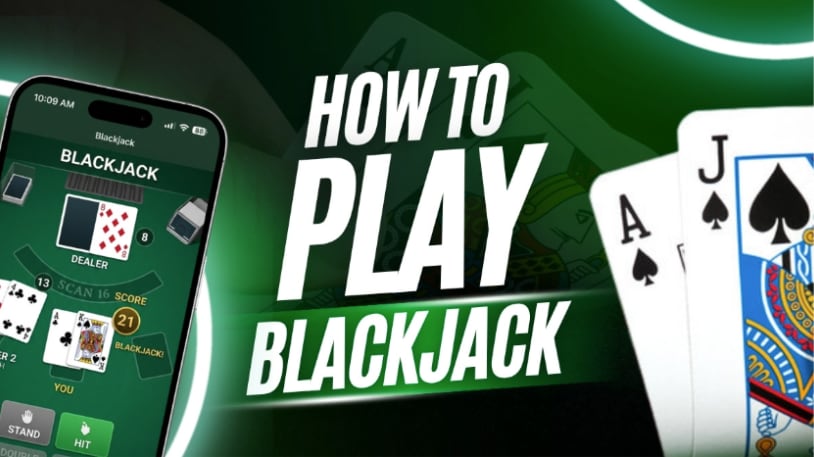
Learning how to play blackjack is easier than most casino games! The goal is simply to get closer to 21 than the dealer without going over.
What sets blackjack apart is that your decisions actually matter. The dealer follows a fixed script while you don’t. Every choice you make shifts the math in your favor or against it. This guide covers card values, hand options, payouts, and the core strategy rules that give you the best shot at the table.
The Goal: Beat the Dealer, Not 21
A common misconception is that blackjack is a race to 21. It isn’t. The goal is to finish with a higher total than the dealer’s hand without exceeding 21.
There are exactly three ways to win:
- Your final total is higher than the dealer’s without busting.
- The dealer busts and you’re still in the hand.
- Your first two cards total 21 (a player blackjack) and the dealer doesn’t have one.
And two ways to lose:
- You go over 21.
- The dealer’s final total is higher than yours.
If both totals are equal, the hand is a push and you keep your initial bet but win nothing.
One more thing worth stating upfront: in a blackjack game, you’re playing against the dealer, not the other players at the table. Their hands have no effect on yours. You’ll occasionally hear someone insist that the player at third base “cost everyone the round” by taking the wrong card. They didn’t. The math doesn’t care what anyone else does and neither should you.
Card Values
Suits don’t matter in blackjack. Only the number on the face.
- 2 through 10 are worth their face value.
- Jack, Queen, and King are each worth 10.
- Ace is worth either 1 or 11, whichever helps the hand more.
The Ace’s flexibility is what creates “soft” and “hard” hands, which we’ll come back to. You don’t need to declare anything as the Ace shifts automatically. If you hold an Ace and a 6 and draw a 9, the Ace counts as 1, landing you on 16 instead of busting at 26.
A natural blackjack is an Ace plus any ten-value card as your first two cards. That hand pays 3:2 at most reputable tables.
How a Round of Blackjack Plays Out
A standard hand at a brick-and-mortar table follows the same six steps every time.
1. Buy In
Don’t hand the dealer your money directly, place it flat on the felt. The dealer spreads it out for the cameras, calls out the amount for the pit, and exchanges it for casino chips. From that point on, you handle the chips and the dealer handles the cards. They won’t take anything from your hand, and you shouldn’t reach across the layout.
2. Place Your Bet
In front of each seat is a betting circle or square. Stack your chips inside it before the deal. Table minimums are posted on a small placard, usually around $5, $10, $15, or $25 depending on the casino and time of day. Whatever you place in the circle is your initial bet for that hand.
3. The Deal
Once all bets are placed, the dealer deals clockwise from their left: one face-up card to each player, one face-up card to themselves, then a second face-up card to each player and one face-down card to themselves. That face-down card is the hole card.
Each player now has two visible cards. The dealer has one visible card (the up card) and one hidden card. The up card is the most important piece of information at the table, as every decision you make is based on it.
4. Player Decisions
Starting with the player to the dealer’s left, the dealer works around the table. When it’s your turn, you have five options, these are covered in detail in the next section.
5. Dealer Plays
After every player has stood or busted, the dealer reveals the hole card and plays out their hand according to a fixed rule set. There’s no discretion involved, the dealer simply follows the script printed on the felt.
6. Payouts
The dealer compares each remaining hand against their own total and pays or collects accordingly. Once the cards are cleared, a new round begins.
Your Five Options on Each Hand
Every blackjack decision falls into one of five categories. At a physical table, you communicate each one using hand signals. The cameras need to see your decision, and verbal calls alone don’t count.
Hit
Take one additional card. You can hit as many times as you like until you decide to stop or your total exceeds 21.
Hand signal: Tap the felt next to your cards with one finger.
Hit when your total is low enough that another card is unlikely to bust you, generally 11 or below, or when basic strategy says the dealer’s up card is strong enough that you need to take the risk.
Stand
Keep your cards as they are. End your turn.
Hand signal: Wave your open hand horizontally over your cards, palm down.
Stand on hard 17 or higher every time. Below that, the right play depends on what the dealer is showing.
Double Down
Double your original bet in exchange for exactly one additional card. Once that card lands, your turn is over regardless of your total.
Hand signal: Place chips equal to your original wager next to (not on top of) your bet, then point one finger.
Double down when the math favors you: almost always on a hard 10 or 11 against a weak dealer up card, sometimes on 9, and on certain soft hands.
Split
If your first two cards are the same value, two 8s, two Kings, or a King and a Jack, since face cards all count as 10, you can split them into two separate hands. Splitting pairs requires an additional bet equal to your original wager. The dealer separates the cards, deals a new second card to each, and you play both hands independently.
Hand signal: Place matching chips next to your bet, then hold up two fingers.
Some pairs should always be split, like Aces and 8s. Some should never be split like 10s and 5s. The rest depend on the dealer’s up card. Note that split aces typically receive only one additional card each, with no option to hit further.
Surrender
If your hand is weak enough that playing it out isn’t worth it, surrender lets you forfeit half your original wager and end the hand immediately. This option, which is also known as late surrender, is only available on your first two cards, before you’ve hit or doubled.
Hand signal: Draw an imaginary line behind your bet with your finger and say “surrender” clearly so the dealer doesn’t read it as a hit.
Surrender isn’t offered at every table. Where it is available, the right spots are a hard 16 against a dealer’s 9, 10, or Ace, and a hard 15 against a 10. Both are losing hands more often than not. Recovering half your bet beats playing a hand you’re likely to lose. Some casinos also offer early surrender, though this is rare.
How the Dealer Plays Their Hand
This is where blackjack diverges from most other games. The dealer doesn’t strategize, they follow one fixed rule, set by the casino and printed on the felt:
- If the dealer’s total is 16 or below, the dealer must hit.
- If the dealer’s total is 17 or above, they must stand.
The one wrinkle is a soft 17. A hand containing an Ace counted as 11 that totals 17, most commonly Ace-6. At “stand on all 17s” tables (S17), the dealer stops there. At “hit on soft 17” tables (H17), the dealer takes another card. H17 rules increase the house edge by roughly 0.2%, so S17 tables are slightly better for the player. Check the felt before you sit down.
One more important moment: when the dealer shows an Ace or a ten-value card as their up card, they check the hole card for dealer blackjack before play continues. If the dealer reveals a blackjack, all player hands lose immediately, except for any player blackjack, which results in a push.
The dealer also cannot split, double down, or surrender. Whatever hand the dealer is dealt is the hand they play out, and if they exceed 21, the dealer busts and every remaining player hand wins.
Blackjack Payouts: What You Actually Get Paid
Three numbers determine what lands on your stack when you win.
Standard Wins Pay Even Money (1:1)
If your hand beats the dealer’s and you don’t have a natural blackjack, you get paid one dollar for every dollar you bet. A $25 wager wins $25, and you keep your original wager on top of that.
Natural Blackjack Pays 3:2 - or 6:5 at Bad Tables
A player blackjack, an Ace plus any ten-value card as your first two cards, traditionally pays 3:2. That’s $15 for every $10 bet, or $37.50 on a $25 wager.
Some tables, particularly single deck games on the main casino floor and many lower-limit tables in Las Vegas, pay only 6:5, which works out to $12 on a $10 bet. That sounds like a small difference.
It isn’t. The 6:5 rule alone adds roughly 1.4 percentage points to the house edge, which is more than the entire house advantage of a well-played 3:2 game. Always check the payout printed on the felt before you sit down. If it says “Blackjack pays 6 to 5,” find a different table.
Online players have the same trade-off: stick to operators that publish 3:2 blackjack and competitive RTPs. Our roundup of the highest-payout online casinos is a useful starting point.
Push
A push is a tie. You and the dealer end with the same total. No money changes hands. Your bet stays in the circle but you don’t get a payout.
Insurance and Even Money
When the dealer shows an Ace as their up card, they’ll offer insurance before anyone plays their hand. The insurance bet is a side bet of up to half your original wager that the dealer holds a ten-value card in the hole, meaning dealer blackjack.
If they do, the insurance bet pays 2:1, which cancels out the loss on your main wager. If they don’t, you lose the insurance bet and play the hand normally.
If you have a player blackjack while the dealer shows an Ace, the dealer may instead offer even money. A guaranteed 1:1 payout rather than risking a push if the dealer also has blackjack.
Mathematically, the insurance bet and even money are the same wager, and both carry a negative expected value for anyone who isn’t counting cards. Decline them, always. The math doesn’t change based on how strong your hand feels.
Soft Hands vs. Hard Hands
This distinction shapes most of basic strategy, so it’s worth being clear about it.
A hard hand is any hand without an Ace, or one where the Ace must count as 1 to avoid busting. A hard 16 can bust on the very next card.
A soft hand contains an Ace that can still count as 11 without going over 21. A soft 17 (Ace-6) cannot bust on one additional card. Even if the card you draw forces the Ace to count as 1, you’re left with a playable hard hand rather than a bust. Draw a 9, for example, and the Ace counts as 1, leaving you with hard 16.
That’s why soft hands play more aggressively than hard hands of the same value. Standing on a hard 17 is correct because taking another card risks a bust. Hitting a soft 17 is correct because there’s no bust risk, the Ace counts as 1 if needed, and you can only improve your position or land on a hard total that you continue to play from there.
Basic Strategy in Plain English
Basic strategy is the mathematically optimal play for every possible combination of your hand and the dealer’s up card. It was worked out in the 1950s by four U.S. Army mathematicians who calculated the numbers by hand, then refined over decades with computer simulation. Played correctly, basic strategy brings the house edge on a standard shoe game down to roughly 0.5%.
You don’t need to memorize the entire basic strategy chart on day one. These five rules cover the majority of situations you’ll face at the table:
1. Always split Aces and 8s.
Two aces together count as a soft 12, a weak starting total. Splitting gives you two fresh chances at 21. Two 8s is 16, the worst hand in blackjack. Splitting trades one bad hand for two that each start at 8.
2. Never split 10s, 5s, or 4s.
Two 10s is a 20, which only loses to a 21, don’t break it up. Two 5s is a 10, which is better played as a double down. Two 4s is an 8, splitting creates two weak hands instead of one decent starting total.
3. Double down on 11 against any dealer up-card except an Ace.
A hard 11 becomes 21 roughly 30% of the time with one more card. Doubling down captures the full value of that advantage.
4. Stand on hard 17 or higher. Hit on 11 or lower.
Always stand on hard 17 or higher. Always hit on 11 or lower. For hard 12 through 16, the dealer’s up card is the deciding factor. Stand if the dealer shows 4 through 6, they’re likely to bust. Hit hard 12 against a dealer 2 or 3, and hit anything from 12 to 16 when the dealer shows 7 through Ace, since their strong position means you need to make a hand.
5. Never take insurance. Never take even money.
Both are losing bets for anyone not counting cards. Decline them every time.
A simplified strategy table for the most common decisions:
| Your Hand | Dealer Shows 2–6 (Weak) | Dealer Shows 7–Ace (Strong) |
|---|---|---|
| Hard 8 or less | Hit | Hit |
| Hard 9 | Double if 3–6, else Hit | Hit |
| Hard 10 | Double | Double vs 7–9, Hit vs 10 or Ace |
| Hard 11 | Double | Double vs 2–10, Hit vs Ace |
| Hard 12 | Stand vs 4–6, Hit vs 2–3 | Hit |
| Hard 13–16 | Stand | Hit |
| Hard 17 or more | Stand | Stand |
| Soft 13–14 (A-2, A-3) | Hit (Double vs 5–6) | Hit |
| Soft 15-16 (A-4, A-5) | Hit, Double vs 4–6 | Hit |
| Soft 17 (A-6) | Hit, Double vs 3-6 | Hit |
| Soft 18 (A-7) | Stand vs 2, Double vs 3–6 | Stand vs 7–8, Hit vs 9–Ace |
| Soft 19 or more | Stand | Stand |
| Pair of Aces | Split | Split |
| Pair of 8s | Split | Split |
| Pair of 10s | Stand | Stand |
| Pair of 5s | Double | Hit |
For the complete basic strategy chart, look up the version that matches your specific table rules, number of decks, S17 vs H17, and whether the casino allows doubling after splitting pairs. Rule variations affect the correct play more than most people realize. Most casinos will let you bring a printed strategy card to the table. They’d rather you play well and stay all night than play poorly and leave early.
Rule Variations to Watch For
Not every blackjack table is the same game. These are the rules that move the house edge most.
- Number of decks - Single deck and double deck games carry a lower house edge than 6- or 8-deck shoe games, all else being equal. But “all else equal” rarely holds in practice, single deck games on the casino floor often pay 6:5 on blackjack, which more than cancels out the advantage of fewer decks.
- Doubling after splits (DAS) - When this rule is in play, you can double down on a hand formed after splitting pairs. It saves the player roughly 0.15%. Most casinos allow it.
- Re-splitting Aces (RSA) - Some tables let you split again if you draw another Ace after the initial split. Where available, it’s worth about 0.08% to the player. Most casinos do not offer it.
- Continuous shuffling machines (CSM) - Some tables use a device that continuously reshuffles dealt cards back into the shoe. CSM tables are slightly worse for the player than standard shoe games; there’s no deck composition to track, and they run more hands per hour, increasing your overall exposure to the house edge.
- 6:5 blackjack payouts - Already covered; avoid them.
- Surrender - Late surrender (available after the dealer checks for blackjack) saves the player about 0.08% when used correctly. Early surrender, where you can forfeit before the dealer checks, is more valuable but extremely rare. Most tables offer neither.
Common Mistakes Beginners Make
A few of these come up at almost every table.
1. Standing on 16 Against a Dealer 10 Because Hitting “Feels Bad”
A hard 16 is the worst hand in blackjack. Standing loses approximately 77% of the time against a dealer 10. Hitting loses around 76%. Neither outcome is good, but hitting gives you a marginally better chance of making a hand. If surrender is available, that’s the correct play. You get half your original bet back rather than playing out a hand you’re likely to lose.
2. Taking Insurance Because the Dealer “Probably Has It”
A ten-value card is in the hole roughly 30.8% of the time when the dealer shows an Ace. Insurance pays 2:1, which means you’d need the dealer to have blackjack at least 33.3% of the time just to break even. The math is clear: the insurance bet loses money in the long run. Skip it every time.
3. Splitting 10s Because Two Hands Is Better Than One
Two 10s is already a 20, a hand that only loses to a 21. Splitting takes a near-certain winner and turns it into two hands that are good but not guaranteed. Don’t do it.
4. Mimicking the Dealer
Many new players assume the dealer’s fixed rules must be optimal and try to copy them. They aren’t optimal. The dealer’s rules are designed to give the house an edge, in part because the player acts first and can bust before the dealer’s hand is even played out. Following dealer rules instead of basic strategy costs roughly 5% per hand.
5. Playing Without a Budget
This is the most expensive mistake at any casino. Decide before you sit down what you’re willing to lose for the session, and walk away when you hit that number. The house edge in blackjack is small, but variance is real, even a player following basic strategy perfectly will have losing sessions. The budget protects you from turning a bad run into a serious loss.
Games That Look Like Blackjack but Aren’t
Walk through any casino and you’ll see tables labeled with names that sound like blackjack. Most of them are worse bets than the real thing.
- Spanish 21 - Plays like blackjack with several player-friendly rules added but all the 10s have been removed from the decks while face cards remain. That single change does more damage than the extra rules recover. Players who apply standard blackjack basic strategy will face a significantly higher house edge.
- Super Fun 21 - A single deck game with extra player options, but blackjacks pay only 1:1 instead of 3:2 (with a narrow exception for a suited blackjack in diamonds). The reduced blackjack payout outweighs every other benefit. Avoid it.
- Free Bet Blackjack - The casino offers free doubles and free splits on most hands; no additional bet required. The catch: when the dealer busts with a 22, every remaining player hand pushes instead of winning.
- Blackjack Switch - You play two hands simultaneously and can swap the top cards between them. That’s a powerful option but again, dealer 22 pushes, and blackjacks pay even money instead of 3:2. The variant has its own basic strategy, and the house edge is competitive only if you’re playing it correctly from the start.
As a general rule: if a blackjack variant looks more generous than standard blackjack, look for the catch on the felt before you sit down. It’s always there.
Bankroll and Responsible Play
Even with perfect basic strategy, blackjack combines luck and skill in a way that guarantees short-term variance and a long-term house edge of around 0.5% that never disappears. Short-term swings can be steep in either direction.
A reasonable session bankroll for a $10 table is 40 to 50 minimum bets. Enough cushion that a normal losing streak doesn’t end your session in the first 15 minutes.
A few simple rules keep things manageable:
- Set a loss limit before you sit down. Walk away when you hit it.
- Don’t chase losses. Increasing your bet after a losing streak because you “need to win it back” is how a $200 night becomes a $2,000 night.
- Drink slowly. Most casinos offer free alcohol while you’re playing for a reason.
- Move winnings off the table and into your pocket so you’re not playing with them.
- Take breaks. Blackjack rewards focus, and focus fades after a couple of hours at the felt.
If gambling stops feeling like entertainment and starts feeling like a problem, the National Council on Problem Gambling runs a 24/7 helpline at 1-800-GAMBLER (1-800-426-2537). It’s free, and worth a call before things get worse.
Playing Blackjack Online vs. In Person
The blackjack rules are identical across formats. The differences come down to atmosphere, pace, and exposure.
Online RNG blackjack uses software-generated card draws. There’s no physical deck, no shuffle, and no dealer to watch. Hands resolve in seconds, and it’s easy to play 200 or more hands per hour. That pace is useful for drilling basic strategy decisions and dangerous for bankroll exposure if you’re playing real money without a clear plan.
Live dealer blackjack streams a real dealer at a real table via video feed. You bet through the interface, the dealer deals real cards, and the pace is closer to a casino floor, roughly 50 to 60 hands per hour. For players who want the closest online approximation of an in-person blackjack game, live dealer is the standard choice.
At a physical table, the social element changes the experience. You can watch other players’ decisions, ask the dealer to clarify rules, and observe how the game flows in real time. Minimum bets are typically higher than online, the pace is slower, and casinos reward extended play through their comp systems. It’s also the only environment where card counting is a realistic option for those pursuing a more professional blackjack approach.
For learning, RNG is the fastest classroom as you can work through hundreds of basic strategy decisions in an hour with no pressure. For the full experience, a real table is hard to replicate. Access depends on where you sit down. Most US states lack regulated online casino markets California is one example, where players rely on offshore-licensed operators. Our guide to online casinos in California covers what’s actually playable for CA residents.
Things to Know on How to Play Blackjack
Here are some questions (and their answers) that you’ll find on most forums about how to play blackjack:
Is Blackjack the Easiest Casino Game to Win At?
By the numbers, yes. The house edge on basic strategy blackjack is around 0.5% at a 3:2 table, among the lowest house edges in the casino. Lower than baccarat, craps, and roulette, and dramatically lower than slots, keno, or most side bets. “Easiest to win at” doesn’t mean you’re favored (the house still has an edge) but blackjack gives you the best odds available without any special skill beyond following a strategy card.
Can You Count Cards Online?
Not effectively. RNG online blackjack reshuffles the deck after every hand, so there’s no count to track. Live dealer games shuffle frequently and limit penetration, so even a perfect counter can’t get much of an edge. Card counting is a brick-and-mortar skill, and casinos there are very good at spotting it.
What’s the Worst Hand in Blackjack?
A hard 16. It loses more often than it wins no matter what you do with it, but the right play depends on the dealer’s up-card. Against a dealer 2 through 6, stand. Against a 7 through Ace, hit (or surrender if the table allows it against 9, 10, or Ace).
Should I Tip the Dealer?
If you want to. The standard is a small bet placed for the dealer (called a “toke”) every so often during the session, or a few chips slid forward when you cash out. Dealers earn most of their income from tips and remember players who treat them well.
How Long Does It Take to Learn Basic Strategy?
A few hours to get the broad strokes (when to hit, stand, double, split), and a few weeks of casual play to make it automatic. Strategy cards are legal at almost every U.S. casino, so you don’t have to memorize the chart before you sit down, just bring it with you and refer to it as needed.
What’s a Good Starting Bankroll for Blackjack?
A reasonable rule of thumb is 40 to 50 minimum bets per session. At a $10 table, that’s $400 to $500 which is enough cushion that a normal losing streak doesn’t end your night before it gets started. If you’re planning a longer session or prefer more breathing room, err toward the higher end.
Final Hand
Blackjack combines luck and skill in a way that rewards three things: knowing the rules, following basic strategy, and staying composed when the cards run cold. Do those three things and you’ll play one of the best games on the casino floor.
The rest is variance, and variance is part of the game. Some sessions you’ll walk away ahead.
Some you won’t.
The real win is in playing well, picking your tables carefully, and treating time at the felt as entertainment with a known cost rather than a way to make money. Sit down, place your bet, get your two cards, and play the hand the math tells you to play. That’s the whole game.
DISCLAIMER: The information on this site is for entertainment purposes only. Online gambling comes with risks. There’s no guarantee of financial gain, so you should only gamble with what you can afford to lose.
While gambling can be fun, it can also be addictive. If you or anyone you know suffers from a gambling addiction problem, we recommend you call the National Gambling Helpline at 1-800-522-4700 to speak with an advisor. Please remember that our guides and all gambling sites are 21+. Also, check with local laws if online gambling is legal in your area.
For free online gambling addiction resources, visit these organizations: