Skip to main content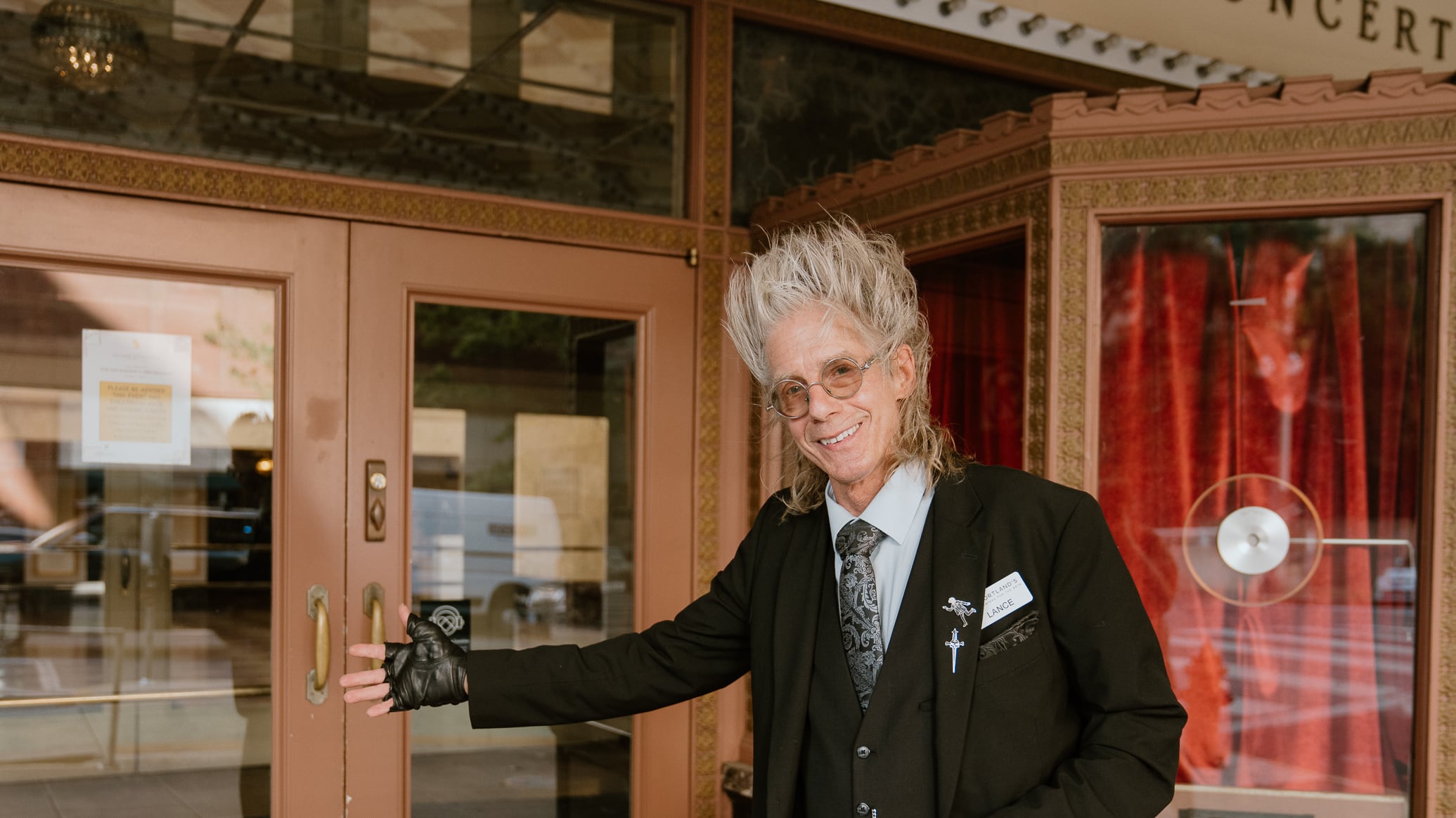
There’s a lull in the minutes before doors open at the Arlene Schnitzer Concert Hall. Hundreds crowd the main entrance, eyeing the dozen uniforms that stand in their way. But Lance McNamara, a local usher, has his own way of breaking through the buzz.
“Welcome to the theater,” McNamara announces, throwing his hands out like a ballroom dancer. He pronounces “thee-ay-TRAY” in the most flamboyantly sophisticated way he can muster, insisting until he gets a few smiles and laughs from the crowd.
McNamara is instantly recognizable. His three-piece suit, vintage spectacles and leather fingerless gloves contrast the simple vest, button-up and slacks other ushers wear. But his hair is his true calling card. It’s windswept, half of it sticking straight up as if interminably stuck in a powerful gust. In fact, he keeps a portable leaf blower and a can of hairspray in his car in case of emergencies.
Ushering is synonymous with theatergoing, a role dating back centuries for greeting and seating church congregants. Though they blend into the velvet curtains by design, ushers serve as the public face of the theatrical institution. McNamara, through his eccentricities, is changing that face and, in doing so, changing who recognizes it, and who feels like there might be a place for them at the city’s fancier theaters.
If you haven’t seen him on the job at a Portland’5 venue—the Schnitz, the Keller and the Newmark, Winningstad and Brunish theaters—or at the Oregon Convention Center, you may recognize him from his Instagram account, @PDXusher, where he posts near-daily video updates about his life and trade.
His Instagram, at just above 9,000 followers, collects fan art, work updates and videos of him posing in the yard of his rural Washington home. McNamara, 66, has posted over 630 times since launching his account 16 months ago. He says he gets recognized “all the time on the streets,” including once on a New York City subway.
In real life, even off the clock, McNamara is a near exact reflection of his presence online. He occasionally slips into an English accent, laughs out loud at himself and makes elaborate hand gestures to illustrate his points. Asked if there were any differences between him and the PDX Usher character he’s created online, McNamara pauses before saying that if you want to be a gentleman, you have to be a gentleman all the time. “I don’t pretend to be anything,” he says.
McNamara spent most of his adult life working construction. As he tells it, he “beat rocks to death with a sledgehammer” while helping build a good chunk of the city, including OHSU and Pioneer Courthouse Square.
But six years ago, he began accompanying his mother to the theater, after her husband could no longer attend shows.
“I was so impressed, not by the place so much, but by the people,” McNamara says. “They dress differently. They act differently. And I thought, ‘I want to be like that. I want to be a part of this.’”
Soon he was volunteering to usher at smaller venues. At one event, a fellow usher mentioned an opening at Portland’5, and McNamara’s been living the dream ever since—or perhaps he’s spent the past five years building a dream.
While McNamara reveres his colleagues, some of whom have spent 40-plus years on the job (“I ask them to critique me,” he says), he has a new vision for what ushering can be. “I want to be the best usher ever,” McNamara says. Figuring out what that means has involved a mix of research and experimentation.
“When I first started with the wild hair, people seemed to be aghast and looked at me as though I was some sort of oddity,” McNamara says. “Now it’s much different.” The audience loves to see him, and he them.
Recently, he took a trip to New York City to interview 25 different ushers, studying the ways they stood, dressed and directed people.
“Well, there is no PDX Usher in New York City,” he said in an Instagram video recapping the trip. “I’m really grateful to be here in Portland, where they allow us to bring our personalities to the theater, which makes our patrons have a more delightful experience, in my opinion.”
For every show he works, McNamara and his fellow ushers can tell audience members the ins and outs of the event: run times, intermissions, opening acts, seating holds and the exact attendance of the night. He rehearses his spiel, nailing down as much information as he can fit in the short walk to a ticketholder’s seat.
The long version is for once seating slows down. The first part of the night, “ingress,” is strictly business. Ushers hand out playbills while shepherding the hoards through confusing alphanumeric seating arrangements and navigate any seating mix-ups, whether from confused patrons or the rare duplicate ticket.
“We can’t just arbitrarily say, ‘Oh, just go sit over there,’” McNamara says. “It doesn’t work like that.”
Responsibilities don’t stop once the show starts. At a venue like the Keller, ushers remain on the inside, monitoring for photo and food policy delinquents and opening doors for guests headed to the restroom. Outside the doors, an usher might have to enforce a seating hold—a period of time, usually during quiet, dark scenes or big reveals, when coming and going into the theater is forbidden—to the chagrin of tardy guests.
It’s not until “egress,” the exit phase, is complete and all floors are cleared that the night of an usher finally ends.
Between research travel, suits and dry cleaning, parking and his two-hour commute, McNamara says he’s spent more money on the act of becoming an usher than he’s made actually working as one. (While jobs provide a uniform and a small stipend for expenses like pants, he insists on tailoring his vest and splurging on wool.)
Ushering is also very seasonal. Summer months are especially slow for the performing arts. According to a recent job listing, a Portland’5 usher makes just under $22 an hour. To account for the fluctuation, McNamara says most of his colleagues usher as a second job.
For McNamara, though, the experience is priceless.
“It’s almost therapeutical,” McNamara says. “No matter what kind of a day I’ve had, when I get to the theater and see those people coming in the doors all of a sudden, I’m energized. And it’s very much reciprocal. I pick up great energy from them. And I give back the same energy.”
See the rest of the 2026 Fall Arts Guide here!