Skip to main content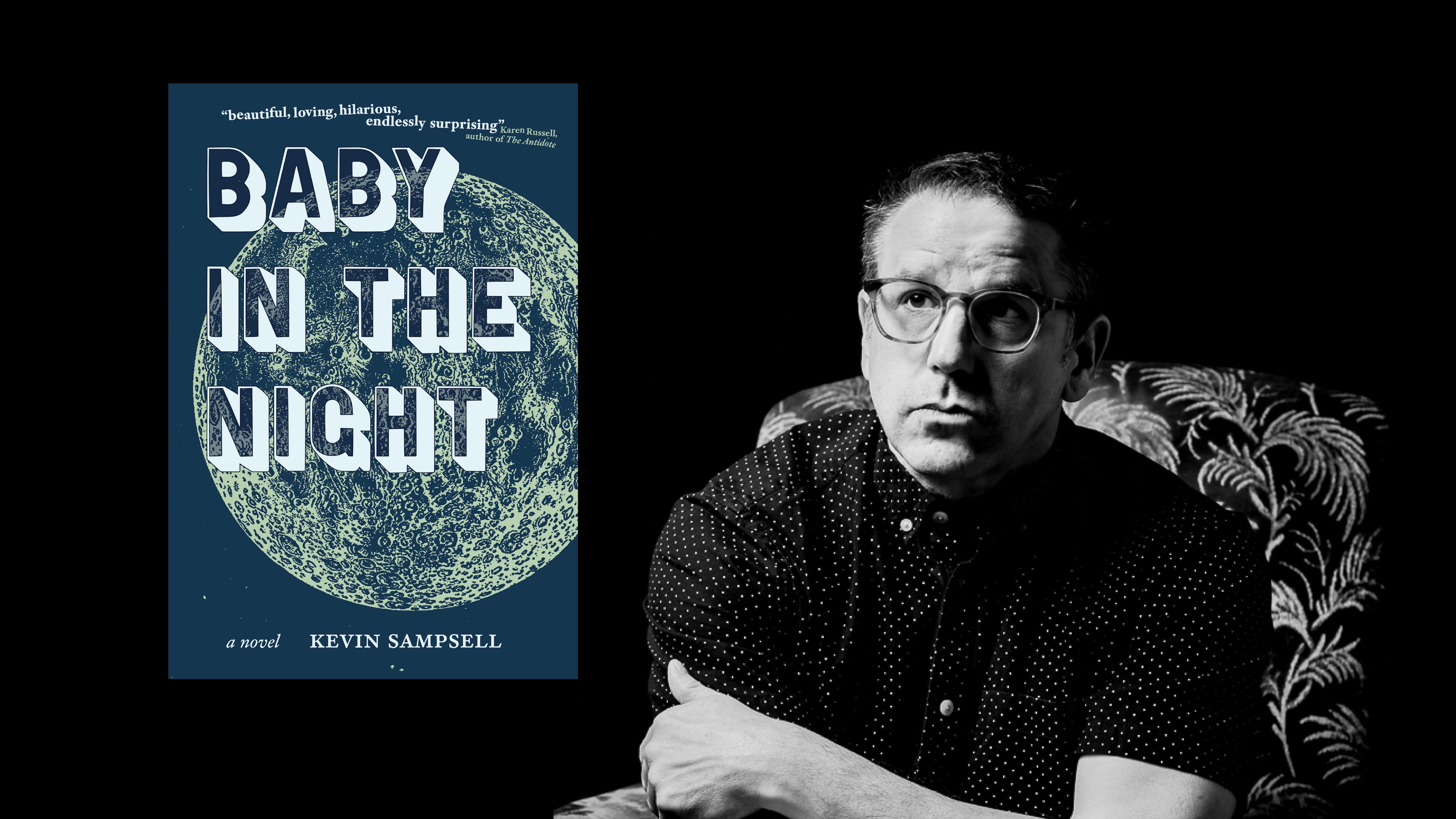
Tony Volcano Ventura is just a baby.
But despite his tenuous grasp on speech, coordination, and stranger danger, he has an intuitive understanding and compass to guide him through the moonlit streets and alleyways of his skid row/tenderloin neighborhood with the dexterity of a well-seasoned urchin. Yet Tony is only 2 years old when we first join him on his mission, and so these are the musings of an actual baby. An internally articulate baby, that is.
Baby in the Night (Impeller Press, 240 pages, $20), published March 17, is by Kevin Sampsell, a low-key Portland literary icon who founded the small press Future Tense Books, and whose other works include the memoir A Common Pornography (2002), the novel This Is Between Us (2013), and the illustrated zine The 24 Days of Christmas (2025). Anyone familiar with Sampsell’s work will recognize the delicate walk the author takes between the absurd and the familiar, the terrifying and the tender, the obtuse and the pointed—which tracks, considering Baby in the Night is written from the perspective of a semiverbal baby whose interior world is as vast, complex and strangely coherent as any misanthrope’s. The concept of a toddler narrator who’s eloquent, insightful, and even deep may feel surreal to the edge of absurdity, but it unfurls with surprising ease.
While Tony is the center of Baby in the Night, he’s orbited by a cast of characters that includes, along with his mother, a teenage junkie named Dylan whom Tony befriends in a seedy alleyway while looking for his father, who he believes to be the moon. A tight cavalcade of denizens of the night, Tony’s precocious playmates and his mother’s suitors play satellites. Meanwhile, Tony narrates with the precision of a master and the whimsy of, well, a baby.
Uniquely compelling in this way, Baby in the Night turns the idea of the unreliable narrator on its head, because Tony is far more relatable than a reader could reasonably expect (do we not have in common that we were all babies once?). Tony’s interior untangles the language, emotions, and expectations of adulthood through the sweetly naive lens of childhood, but his focus never wavers from his father, who is most assuredly, as far as Tony is concerned, the whole moon. Sometimes wide and bright, inviting Tony into the darkest hours of predawn, and sometimes a sliver Tony must strain to find in the infinite black skies.
Omnipresent in the dark hours, elusive in the day, the moon is a main character here as well. When Tony evades babysitters and resting guardians, he does so to roam the streets of his rough neighborhood in search of the messages his father guides him toward with his bright white light; the sun on a different temperature setting. During their day walks, Tony’s mother instructs him not to stare into the sun—but in the dead of night, Tony can stare into the moon for as long as he wants.
Tony’s mother, while loving and tender, is also carrying shades of destitution that Tony does not quite comprehend, chasing connection and romance in a dystopian landscape populated with all manner of dark-sided men. Tony, however, sees his mother with the innocent eyes of a 2-, 3- and 4-year-old, witnessing her without the layers of experience that color adult perceptions; unaffected by a lifetime of experience, he perceives his surroundings with a purity and malleable logic that Sampsell has managed to capture effortlessly.
To that end, Tony sees people living on the street and does not define them by their economic state (what are economics to a baby?), but by their appearance, their energy, and their actions. A man with green hair, another wrapped in a purple blanket, one who always sports a helmet, another who wields a tennis racquet weapon. Even the inside of a dilapidated, junk refrigerator is covered in what Tony perceives as baby food, but what the reader can assess immediately as human waste.
Such is the conceit of Baby in the Night, this strange journey through one child’s most precious years of toddlerhood, sometimes spent in the company of street hustlers, junkies, criminals and the assorted riffraff of a familiar rough-and-tumble neighborhood, sometimes coddled and comforted by the warm breast of his mother, sometimes chauffeured through the dark of night in a stroller, other times wandering diaperless through a maze of the destitute.
The simple juxtaposition between innocence and corruption opens a window into a world many readers might never otherwise consider, but for anyone who’s ever spent any time in a real ’hood, seeing a baby in the night is par for the course. Sampsell finally gives us the insight into that night baby’s head, and it’s far more expansive than we could have imagined. Because frankly, in any other instance, a lone baby in the night is shocking—full stop.
GO: Kevin Sampsell discusses Baby in the Night with Kimberly King Parsons at Powell’s City of Books, 1005 W Burnside St., 800-878-7323, powells.com/events. 7 pm Wednesday, March 18. Free.