Skip to main content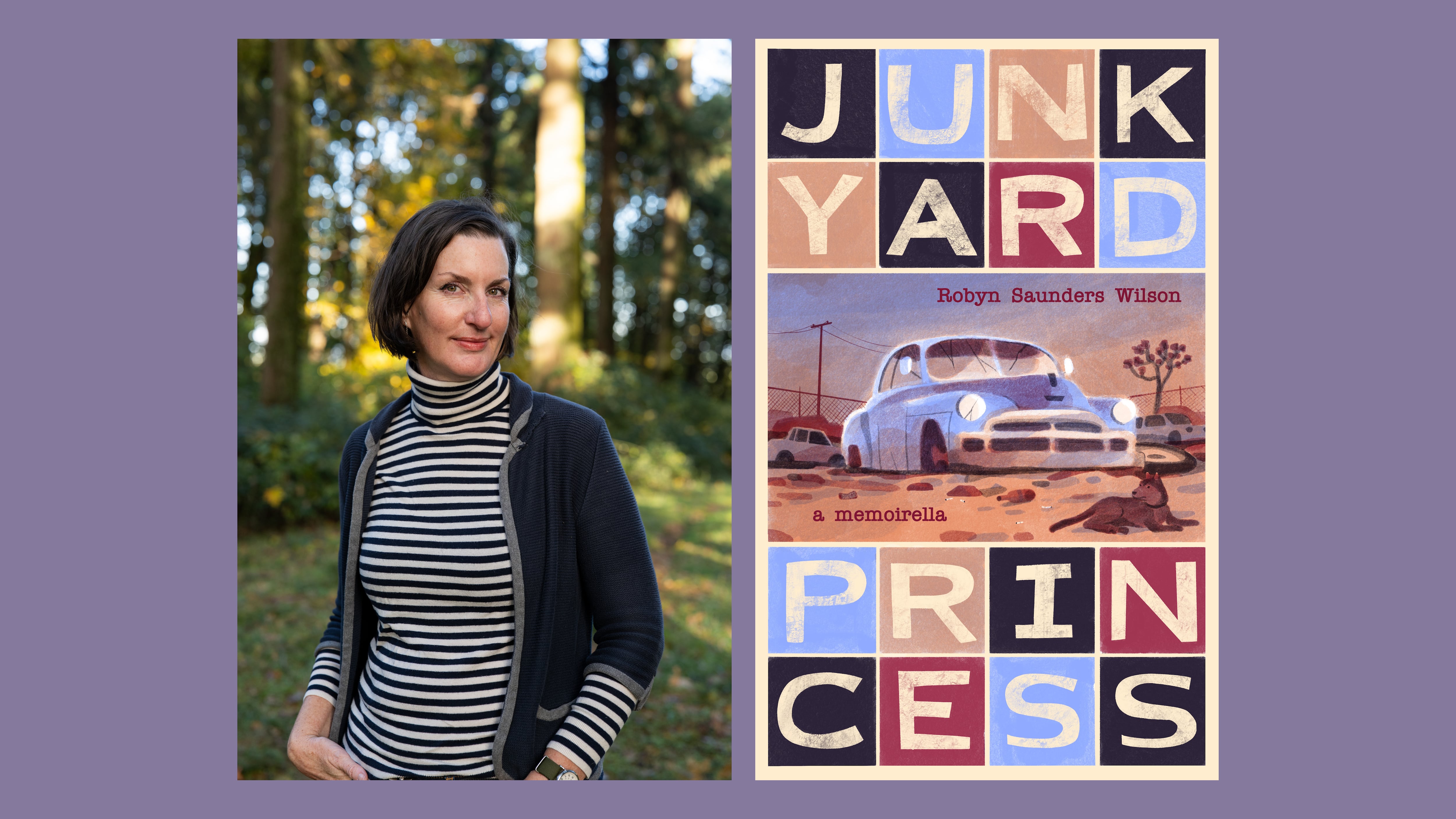
When Harry Saunders buys a junkyard in Hesperia, Calif., displacing his small family in pursuit of his lifelong dream of lording over a wrecking yard, his daughter Robyn adjusts accordingly. And despite some remarkably sketchy, rusty, and methy odds, lives to tell the story in Junkyard Princess (Banana Pitch Press, 204 pages, $16), a new memoirella by Robyn Saunders Wilson.
Junkyard Princess begins when Saunders is 12. As a privileged Orange County suburbanite on the cusp of adolescence, attending a well-funded school, playing on clean, unmuddied avenues and gazing across uncannily verdant, manicured lawns, the horizon of Saunders’ future seems basic but bright—straightforward, uncomplicated and, as Saunders writes, “vanilla.” Her father’s decision to uproot her, her mother, and her younger brother for the dustier, working-class farmlands of Hesperia transforms Saunders in ways that feel familiar (growing up is weird and hard) and unique (growing up in a junkyard is wild work) in equal measure.
Hesperia is a high desert town plunked down in the vast emptiness between Los Angeles and Las Vegas—a dry and dusty, blue-collar community that could prove challenging to a privileged kid from the OC. Saunders instead leans in with a calculated ferocity that, despite gnarly odds, capably embraces the shift.
This is the central conceit of Saunders’ debut, a short-form collection of coming-of-age essays and vignettes that follow the narrative of Saunders’ development from naive suburban honor roll kid to precocious car expert and junkyard princess. On its face, Junkyard Princess is a tapestry of short threads that weave together the story of a girlhood navigated in a dystopian labyrinth of crushed steel, shattered windshields, and sometimes bloodied remains. But through Saunders’ lens, the landscape becomes less a graveyard of machinery and more a trove of stories to be uncovered, a fantasy world she can create at will, and a deep well of lore told in a language of raw machinery with which she might never have otherwise become fluent.
Twelve-year-old Saunders can locate a mystery auto part from a catalog of American cars she’s steadily mastering as well as she can act as a cash register for the junkyard’s cash transactions—keeping the profit in one pocket and the tips she collects in the other. Which is to say, she does them both very well, and we see how these interactions shape her and her family’s development: a working family business that must function and thrive amid an ephemeral backdrop of misanthropy that, unsurprisingly and inevitably, permeates the wrecking yard.
The levity with which Saunders turns her lens inward is what makes Junkyard Princess so compelling. There is a distinct Gen X sensibility to Saunders’ prose; it’s cutting and direct, with a rhythm that has the push and pull of a staccato arrangement. In this format, her punchlines are punchier, her introspections land with laser precision, and her reflections shimmer especially bright.
Throughout Junkyard Princess, moments of utter terror mingle with tender portraits of family; Saunders describes in graphic detail her 5-year-old brother being mauled nearly to death by the yard’s pack of vicious guard dogs, balancing this horror with lovingly rendered memories of the relationship she shared with her brother before their age gap became too narrow to discern.
Saunders deftly traverses the real effects of an upbringing surrounded by the motley scrappers, buyers, and sellers within her father’s junkyard universe, and the drug addiction, violence, and echoes these traumas produce.
Junkyard Princess resonates deep and hits hard for its relative brevity. It’s a memoir of adolescence and the trappings therein, but the book also paints a sweeping portrait of a multidimensional landscape, piecing together past lives of long-lost kin and examining the ripple effects of familial trauma by couching them in a precise snapshot of an especially unique era seen through an especially unique lens.
SEE IT: Robyn Saunders Wilson in conversation with Michelle Kicherer at Literary Arts, 716 SE Grand Ave. 503-227-2583, literary-arts.org. 6:30 pm Wednesday, April 8. Free.