Skip to main content
Grief is as central to Russian theater as realism, complex characters, and a gun on the wall, introduced early on. But Russian theater has another side.
A silly side.
Humor is, after all, a common and, some would say, healthy response to grief.
“Absurdism attracts me because it creates a strange, uneasy feeling that goes straight from the text to the body,” says Irina Lavrinenko, co-founder of Fool House Art Collective, a Russian-language experimental theater troupe that claims around three dozen members of Portland’s sizable Slavic population. “Words stop explaining the world clearly and begin to flicker with uncertainty. I am drawn to this because I am more interested in living with that uncertainty than in finding clear answers.”
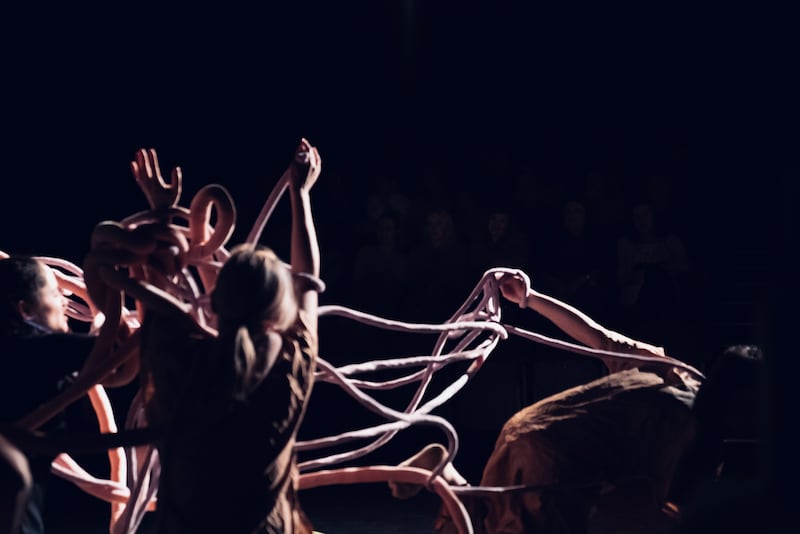
Five years ago, looking to start something avant-garde, Fool House members broke away from Scarlet Sails, a more traditional Russian theater and cultural organization. Lavrinenko and co-founder Astra Davalos say they were seized by stress and COVID boredom. That their first performance was staged in a dog park owed as much to social distancing as it did Fool House’s nonsensical directive. It’s fitting also that its final performance in a dog park ended with a stranger’s call to police and performers fleeing the scene. Russian avant-garde theater has a subversive streak, after all.
“We managed to not get in trouble,” Davalos said.
Since the dog park, Fool House has staged an assortment of inventive presentations around the Portland area. A “site-specific” Hitchcockian mystery in an out-of-use gas station. A “documentary” play composed of monologues derived from interviews with real people.
The growing all-volunteer troupe now holds regular classes in a dedicated studio space in a shopping center off Southwest Beaverton Hillsdale Highway. It recently raised $9,000 from small donors to buy wood floors and mirrors, and secured $10,000 in grants, including $8,000 from the Oregon Cultural Trust, for professional lights and other improvements. The troupe’s next big project is to convert the studio into a black box theater.
Davalos and Lavrinenko say Fool House serves a population hungry for culture and community. All its performances sell out. Classes are commonly full.
Russian is the third-most-spoken language in Oregon after English and Spanish. The state’s estimated 50,000 Slavs include communities of Old Believers (aka Russian Amish) who’ve called the Willamette Valley home for more than a century, thousands of highly educated software developers recruited by tech companies starting in the 1990s, and waves of refugees of various human and environmental catastrophes in the former Soviet Union, the latest of which fled Ukraine after Putin’s 2022 invasion.
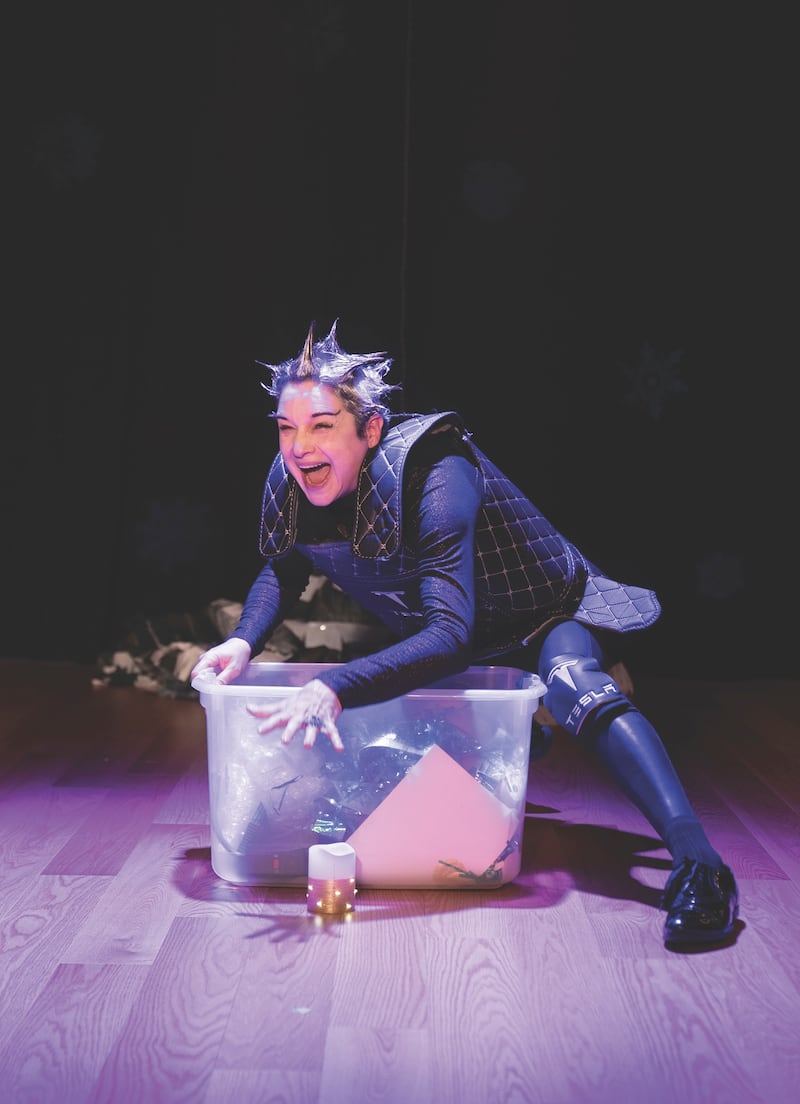
That’s all to say, Fool House has a deep talent pool to draw from. One talent is Kirill Nikitenko, who prior to the war was a prominent voice actor in Ukraine—the Ukrainian dub voice of stars like Sylvester Stallone, Morgan Freeman and Samuel L. Jackson. Nikitenko now teaches a weekly Ukrainian-language improv workshop.
Russian humor is cynical, self-deprecating, often subtle. Native speakers attest that much of it doesn’t translate. But comedy remains as central to the Russian experience as tragedy, and an outlet for release in a country where political satire has been off the airwaves since Putin’s ascension in the late 1990s.
A native of Siberia, Andrei Karyukin likes to ask, “What’s the worst thing they could do to me—send me to Siberia?” The Fool House regular and Intel software developer says humor sometimes is necessary to survive.
“You don’t have to be critical to go in crazy directions. You can, obviously, but if you’re not direct with it, you can still do absolutely innovative and crazy ideas,” he tells WW.
At a recent rehearsal, Fool House members learned a song for their upcoming play, which was to be a Russian interpretation of the Japanese absurdist play The Friends. Seated at a keyboard with a guitar in his lap, Moscow music producer Anatoly Machulenko crafted—on the spot—a melodic theme that combined aspects of Russian and Japanese folk music. By the end of rehearsal, the dozen or so actors from the Soviet diaspora—Ukraine, Belarus, Kazakhstan and Russia—were singing Machulenko’s high, haunting melody. Some seemed surprised how good they sounded.
“It’s like teaching children,” Machulenko says in English following rehearsal. “But no child is ordinary. Every child has talent. Every child loves art.”
A few days later, the troupe’s board of directors opted to cancel work on The Friends. One of its lead actors, Christina Arefeva, was detained by U.S. Immigration and Customs Enforcement. Davalos says she was recently released from the ICE detention facility in Tacoma, Wash. Thanks to legal aid afforded by funds raised by Fool House’s extended community, Arefeva is back with her family as her case is still pending. Because of the lost rehearsal time, Fool House pivoted to the children’s puppet show Pillows, banned in Russia in 2014 for promoting the “homosexual agenda.”
SEE IT: Pillows at The House Studio, 6677 SW Beaverton Hillsdale Highway, foolhouse.online. 7:30 pm Thursday and Friday, April 16, 17, 23 and 24; noon and 2 pm Saturday and Sunday, April 18, 19, 25 and 26. $25, $20 seniors and students. In Russian with English audio translation.