Skip to main content
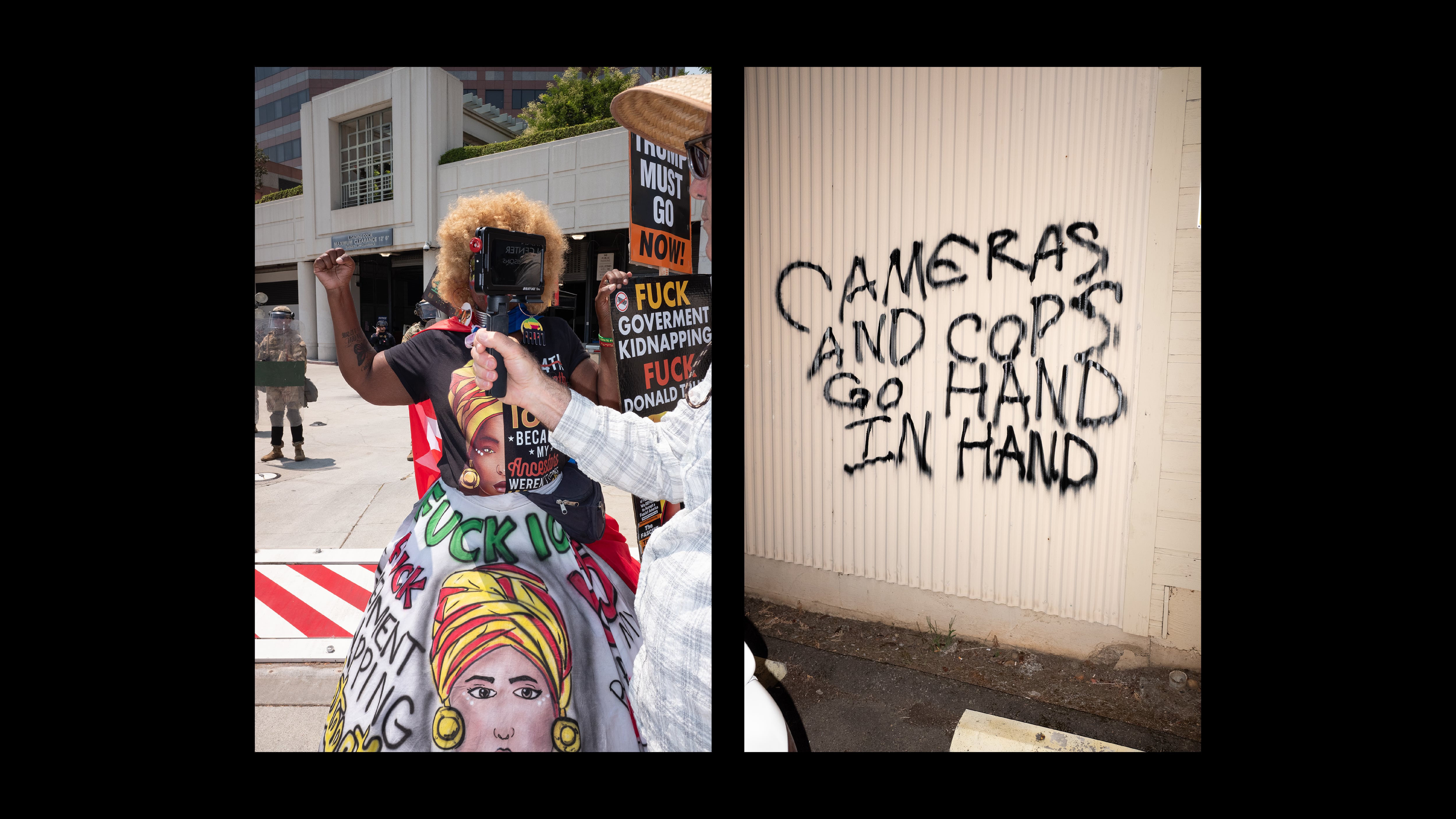
As a photographer of protests, it happens fairly often to Rian Dundon.
His lens finds another, pointed right back at him. It might be a GoPro strapped to the helmet of a faceless, black-clad figure sporting a homemade press pass.
There they are—two journalists, ostensibly—“imaging” each other for personal gain.
“Every photo is in some way a self portrait,” says Dundon, who favors a nondescript ballcap and light jacket when he works—anonymous, just in a different way. “I’m trying to approach this with more than a little self-awareness because, in the end, yes, I am doing the same thing. And so is anyone else—Tom Brokaw, you know, or Mr. Twitter.”
Around the time the world shut down in 2020—and thousands crowded downtown Portland in an extended season of political conflict—Dundon began to notice how everyone else seemed to have a camera, too. Beside the professional news media were amateur photographers, indie filmmakers and smartphone-wielding activists.
But Dundon’s frequent muse is the breed of activist who photographs political protests to feed the parallel battles that rage online. Their audiences see them as intrepid reporters delivering the images the mainstream won’t show. Some earn a good living this way, capitalizing on conflict and violence. Portland is a ripe environment to find these characters, though this culture now pervades everything. We mediate the world through our phones, through screens and camera lenses.
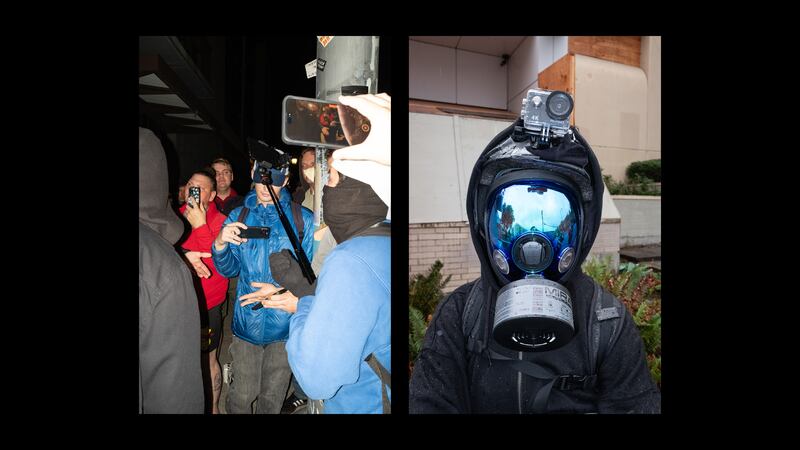
A collection of Dundon’s work taken since 2020, Streamers, shows next month at the ascendant St. Johns community darkroom and gallery Franklin Foto. It will be the first local showing of Dundon’s protest photos—thread he’s been gathering for some time. The work highlights the increasingly porous distinction between professional journalist and activist observer, and the question of who really is a journalist these days.
It’s a question Dundon sometimes finds himself asking. That’s despite The New Yorker calling his 2023 book Protest City, which chronicles the Portland protests, “a welcome counterpoint to the so-called protest photographer, and a powerful defense of photography as a craft rather than a weapon or a tool for political activism.”
In the course of his career, the role of the photojournalist has changed drastically, says Dundon, 45. “It’s become less clear. I’m published and continue to be, but there isn’t, like, a whole lot of difference.”
A longtime freelance photojournalist, documentary photographer and Portland State University photography instructor, Dundon has shot for mainstream outlets like The New York Times, Mother Jones, Rolling Stone, The New Yorker and Harper’s, and has authored four books (two about protests). But it’s a tough business. He still works part time at a pizza shop.
What’s important, Dundon has found, is how a shooter sees themself. Agency and his subject’s awareness that the image is being taken is another important idea in his protest work.
“I’m not just walking around snapping photos like the fly on the wall. That’s really important to me. It slows things down in the way I work,” he says. “A big part of photographing a protest, for me, is getting permission from everybody I photograph.”
Dundon’s interest is more sociological than political. He’s not amplifying a specific message. He’s exploring the difference between participant, observer and journalist. Between blue, red and the different shades in between. Between activism and voyeurism.
Nowadays, the odd right-wing streamers bubble up to provoke at the Portland ICE facility or a women’s sports bar. A few dozen people might be confined to one overpass or intersection. But everyone will have a camera; even the buildings now capture our image. “Everybody is just in some kind of fishbowl,” Dundon says.
SEE IT: Streamers by Rian Dundon at Franklin Foto, 8953 N Lombard St., franklinfoto.org. Opening reception 5–8 pm Saturday, Oct. 3; through Oct. 31. Free.