Skip to main content
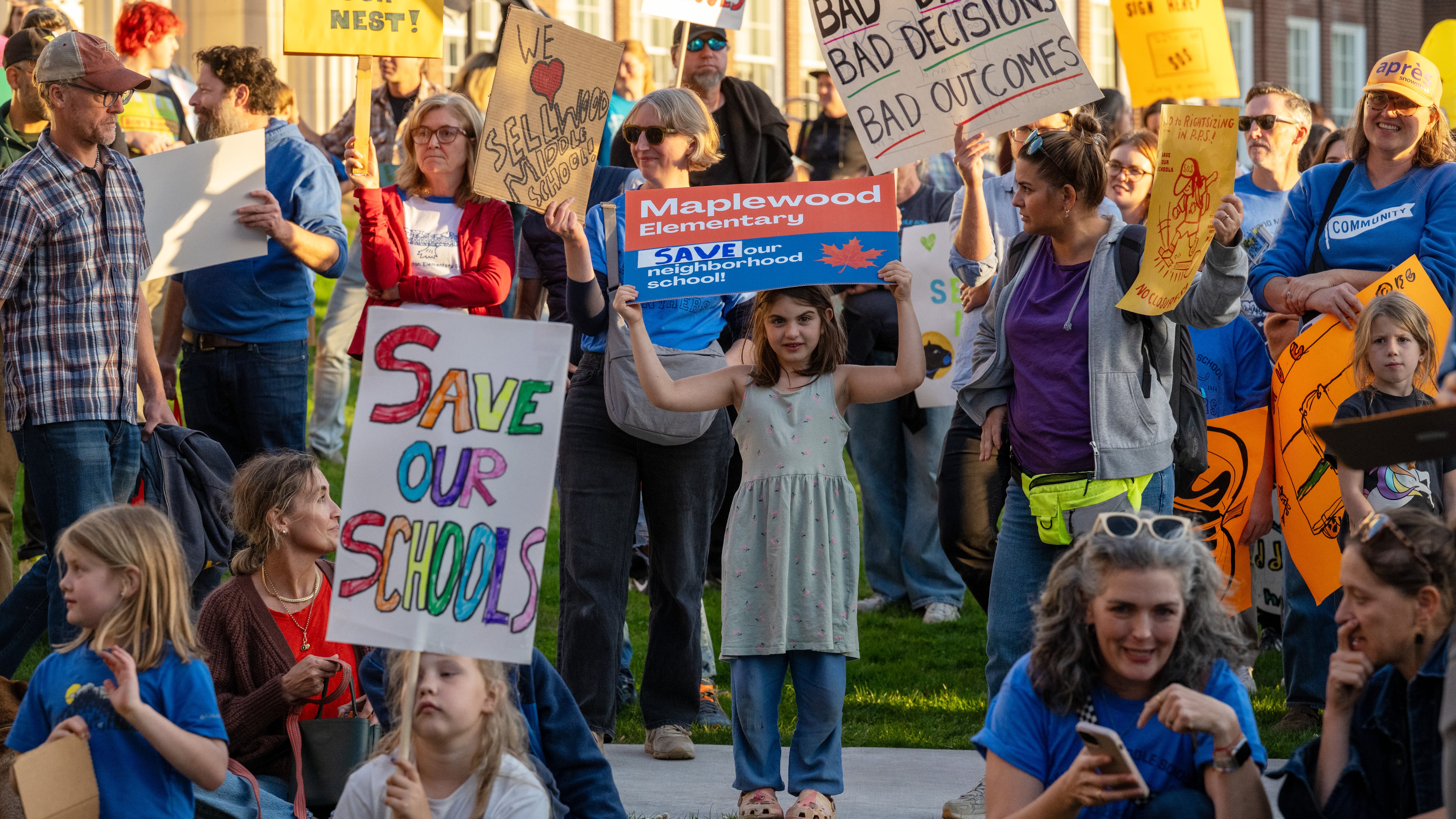
Portland Public Schools Superintendent Dr. Kimberlee Armstrong recommended on Friday closing 10 elementary schools. It is her final recommendation in a school closure process that has sparked sadness and outrage across Portland.
If the Portland School Board approves Armstrong’s recommendation with no changes in December, five elementary schools would close beginning in fall 2027. They are Beach, Buckman, Creston, Peninsula and Sabin.
Fall 2027 would also include the conversions of six K-8 schools into K-5 schools: Beverly Cleary, César Chávez, Faubion, Laurelhurst, Sunnyside and Vernon. The high school at the Metropolitan Learning Center, an alternative school in the district, would close, and dual language immersion programs would undergo a number of changes.
The remaining five schools Armstrong has chosen would close in fall 2028. They are Irvington, Lewis, Marysville, Rose City Park, and Woodmere. (Irvington is in a unique situation in which it would fuse with Beverly Cleary, which is set to undergo a seismic retrofit. All students would attend at Irvington in 2027 before moving to the retrofitted Beverly Cleary building in 2028.) Also in 2028, Bridger K-8 would convert to a K-5 school, the Odyssey K-8 choice program would move to Forest Park Elementary School, and those in the Clark Elementary Mandarin DLI program would move to Woodstock.
The proposal by Armstrong fuses two scenarios the district floated in early October, labeled Scenarios A and B. The two scenarios would have closed 14 and 11 schools, respectively. Armstrong said in a press release that she made a number of changes in the wake of the district’s community engagement process.
Notably, Sellwood Middle School, which appeared in both scenarios as the only middle school targeted for closure, was spared from Armstrong’s final recommendation. So were James John and Maplewood elementary schools, which had originally appeared on both as well. Stephenson Elementary, which appeared in Scenario A but not B, is also off the table.
“These changes reflect the voices of the families, students and staff who participated in this process,” Armstrong said. “We know that closing or consolidating schools is deeply personal and difficult. We have taken that feedback seriously while remaining focused on the long-term needs of all PPS students.”
Of the schools Armstrong spared in her recommendation, Sellwood, Maplewood and Stephenson organized robust community protest efforts. The latter two communities had argued that their schools stood in remote parts of Portland that were difficult to access. Representatives of those three schools previously told WW they had outperformed metrics of student performance and they raised concerns about the district’s reliance on enrollment forecasts (“A Is for Anger. B Is for Backlash. C Is for Closure,” WW, Oct. 28).
James John is the sole Title I school spared between the initial proposal and Armstrong’s recommendation. Its community objected in a different way. Specifically, Latino parents at the school worried that long commutes to César Chávez for its Spanish dual language immersion students, and Sitton for its neighborhood students, would risk exposing families to federal immigration enforcement. Several advocates for the school also said the district had not done a good enough job engaging Latino families, especially those who speak Indigenous languages.
The district is still moving forward with condensing DLI programs, however, including at James John. Spanish DLI will be condensed into four regional hubs at Ainsworth, César Chávez, Lent and Rigler. Mandarin will be condensed into two, one at Dr. Martin Luther King Jr. Elementary and the other at Woodstock beginning in fall 2028. With the proposed closure of Rose City Park, neighborhood students would move to Scott Elementary, while those enrolled in Vietnamese DLI would move to Vestal Elementary.
Some advocacy groups’ demands were not met by the superintendent’s recommendation. A prominent example is the group of parents who branded themselves as the Title I Coalition, aiming to distribute the consequences of closures more equitably across the district by sparing more schools that receive extra federal funding for serving high percentages of students from low-income families. Of the 10 schools targeted for closure, half are Title I schools. (Currently, 43% of elementary and middle schools in the district are Title I schools.)
At Creston Elementary School, an effort to keep students enrolled in the Columbia Regional Inclusive Services Deaf and Hard of Hearing program together with their fellow Creston students who can hear does not come through in Armstrong’s recommendation. The elementary school would feed into Atkinson Elementary, while the roughly 30 CRIS students would split off and move to Glencoe Elementary.
Some schools would see both wins and losses. Sunnyside K-8 would become an elementary school under Armstrong’s recommendation, but would retain its environmental focus, a big point advocated for by community members.
Special education focus classrooms would, under Armstrong’s proposal, transition from relying primarily on regional assignments to bringing “focus classrooms closer to students’ homes,” according to a district press release. The district would provide individualized transition support through closures.
The district is considering school closures with the primary motivation of better condensing its limited resources across fewer buildings. (PPS has struggled with persistent declining enrollment, and has axed millions from its budget in recent years.) The district insists it will still face a $65 million deficit in the upcoming year even with closures, largely driven by rising pension costs.
“Maintaining the status quo will not protect our students from the financial challenges ahead,” Armstrong said. “We cannot continue spreading limited resources across more buildings than our enrollment can sustain. Our responsibility is to make the difficult decisions necessary to protect the quality of education and opportunities available to every student.”
District officials will formally present Armstrong’s recommendations to the Portland School Board on Nov. 17. The board will vote on the recommendations Dec. 15. At a special meeting earlier Friday, board members unanimously approved an inquiry into Signal use among district leaders. That resolution asks that independent counsel produce a report directly to the board with findings by Dec. 11, shortly ahead of the big vote on school closures.