Skip to main content
A new show at the Portland Art Museum centers on a collection of tiny 19th century portraits. Set in elaborate leather, brass and papier-mâché cases are rare depictions of loved ones at a time when photography was only just becoming accessible to the masses. Though their poses are rigid (partially necessitated by long exposure times), the stoic gazes coming from the people in these photos still penetrate more than a century later. Victorian formality could mask a reservoir of emotion.
In A Brief History of Photography: The Portrait, these one-of-a-kind keepsakes kick off a tidy survey of the genre drawn from museum holdings by PAM photography curator Julia Dolan. Attempting to wrangle over a century of photography into a smallish space tucked under a stairwell on the museum’s second floor would seem impossible, but then photography is accustomed to being put into a box.
The rest of the exhibition brings us up to speed on what’s been going on since pocket lockets went out of fashion. Which is a lot. Yet, in hardly a room’s worth of pieces, the show manages to give an impression of what portraits can be, while stressing the way our hunger for “self-fashioning” has driven the medium’s evolution. This matters at a time when photography plays an ever increasing role in daily life, when photos don’t just show us who we are, but help shape what we become.
In the show, soft-eyed pictorialism leads into socially conscious interwar reportage and eventually into the 21st century, where contemporary artists like Katy Grannan and Melodie McDaniel are challenging the portrait genre and its legacies. Grannan, a standout, uses harsh midday sun and the stucco-white exteriors of generic California architecture to mimic a portrait studio for her real-life subjects. Across the room, Joe Rudko’s 2016 collage Curtain layers vintage family snapshots whose subjects have been cut away, leaving only the repetitive backdrops of uncannily similar living rooms.
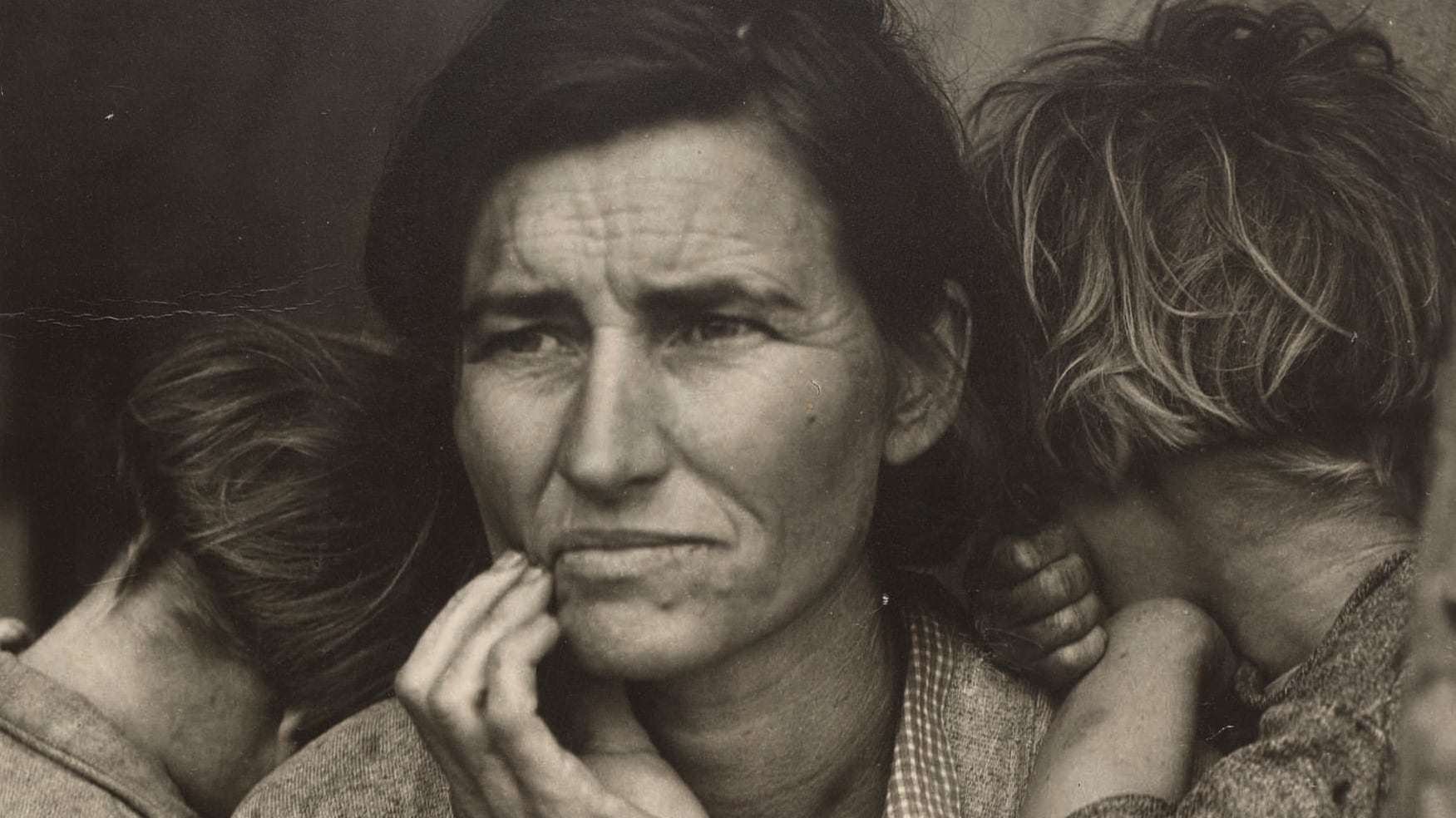
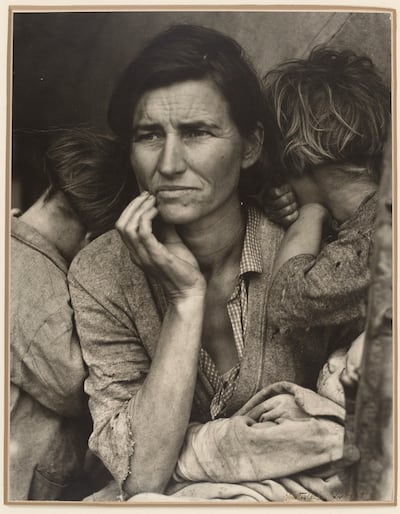
Elsewhere is Dorothea Lange’s 1936 Migrant Mother. It’s an iconic depiction of poverty embodied in the anxious gaze of farmworker Florence Owens Thompson, her hand raised to chin in trepidation, two children shielding their faces from some unseen approach. Widely circulated by the government agency for which it was commissioned, the image was christened “immortal” by Farm Security Administration director Roy Stryker. But years later, Thompson herself criticized its deployment, which glossed over the specifics of her story in favor of broader propaganda narratives. Of course, that was the point. “You can see anything you want in her,” Stryker once said of Migrant Mother.
The history of portrait photography as outlined by curator Dolan is “marked by rapid and ongoing changes in equipment and chemical processes,” e.g., the technological advances that made pictures like Migrant Mother possible. A person once had to commission and sit for a portrait; within a few decades, unbeknownst to you, any stranger in the street could take your picture with a click. With that accessibility came the potential for reinterpretation and appropriation we see in the story around Migrant Mother.
Still, for all the ways the portrait has changed throughout photography’s young history, it has largely stayed the same. It’s still a picture of a person. What has changed is what we want out of this kind of picture.
Are portrait photographs a representation of individuality (the miniature Victorian keepsake, the photo of your kid in your wallet), or merely a symbolic nod to personhood (one woman living through the Dust Bowl leveraged to represent every woman living through it)? Are they supposed to record a singular likeness or fit every person into the visual sea of faces? Does a good portrait prove that its subject is unique or show the ways we are all alike, or both?
A Brief History locates the crux of the genre in our essential need to “harness aspects of a sitter’s humanity.” For Dolan, it seems the portrait is mostly an exchange between photographer and sitter.
The question of anonymity and representation, which, especially in our post-COVID world of masks and facial recognition software, has entered the discourse, is left mostly unacknowledged. But a small allusion can be spotted in a pair of early postcards near the bottom of a display case. Each shows two adults with their backs to the camera. We can see their clothing (well fitting) and hair (nice), but nothing much else can be known about them other than their togetherness, their proximity to each other, perhaps their refusal to engage. One man casually grips his hands behind his back while his partner appears more tense and alert to whatever the pair are looking at. Their subtly dissonant postures could be setting the stage for some kind of conflict. But there is nothing. Just the wall of a photo studio in Troy, N.Y. It’s 1885 and these forgotten souls are standing on the brink.
SEE IT: A Brief History of Photography: The Portrait at the Portland Art Museum, 1219 SW Park Ave., 503-226-2811, portlandartmuseum.org. 10 am–5 pm Tuesday–Sunday, through March 14, 2027. Access included with museum admission, $27.50; 17 and under free.