Skip to main content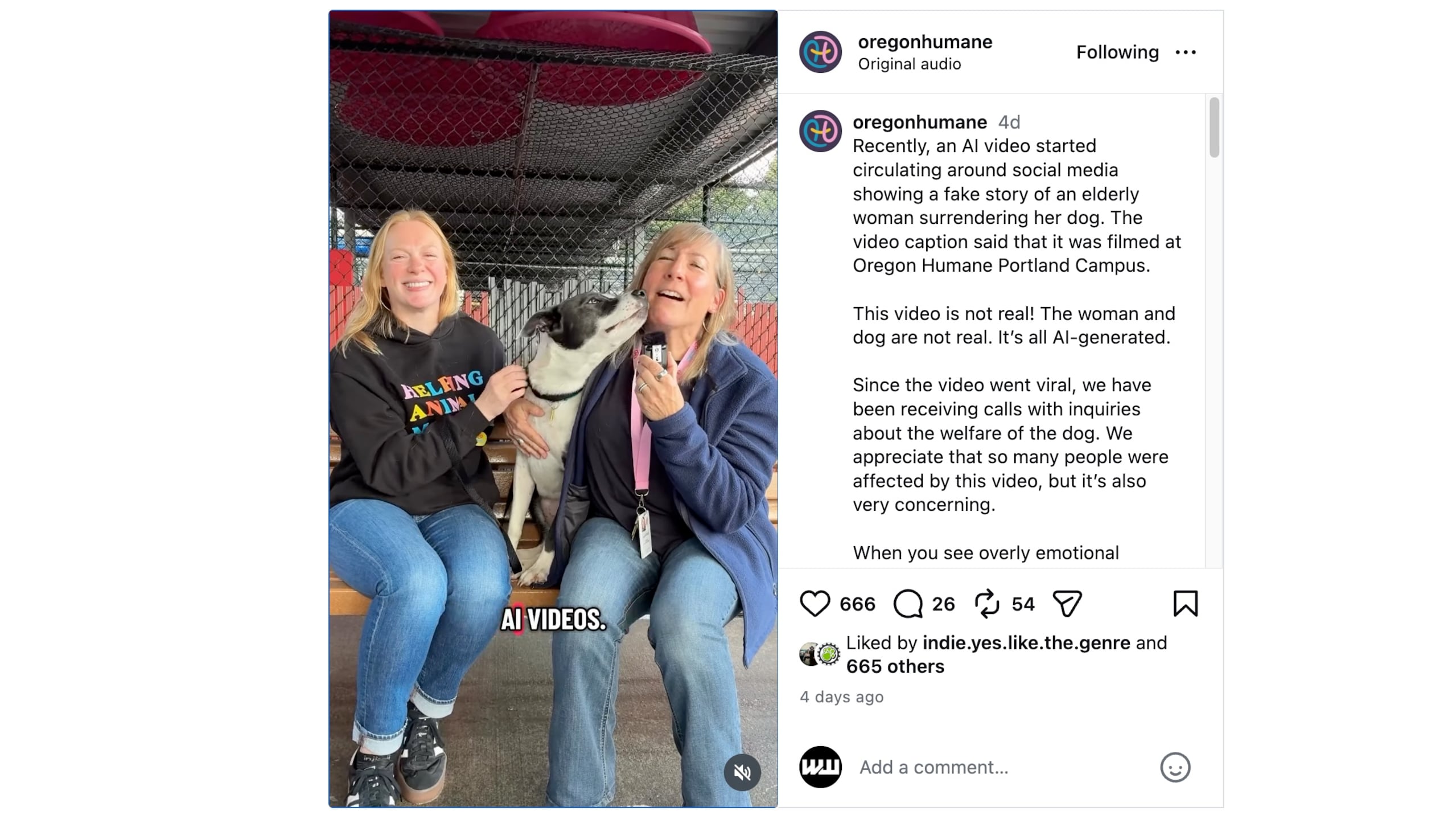
AI slop is wrecking the cute animal internet for all of us—and so far, there’s little formal recourse.
There’s no getting away from AI slop. The robots want to insert nonsense into your emails and texts and “summarize” one-page documents with three lines of text on them. And now they’re trying to break your heart with stories about fake animals and fake people—and they’re dragging real animal welfare organizations into the sludge.
In a video shared on social media last week, Oregon Humane Society communications staffers Laura Klink and Sarah Yusavitz said they’d become aware of a video purporting to show an older woman surrendering a golden retriever at an OHS shelter.
“This video is heartbreaking, and it’s 100% fake,” Yusavitz says.
Klink tells WW that OHS staff began receiving calls early last week from people who were “concerned about the situation,” many of them asking if the dog in question was up for adoption.
“We live in an age when it can be hard to tell what’s AI and what’s real,” Klink says, adding that even her husband asked her about a video he’d seen of a golden retriever being surrendered at OHS.
WW found videos from nine Instagram accounts that match the still shown in OHS’s response video. Two of the top-ranked videos, from accounts called @truthsphere4u and @pinkup01, are dated Aug. 29. Both feature a lengthy caption beginning with the claim that the video was filmed on “a Wednesday afternoon at Oregon Humane Portland Campus” and portrays “Eleanor,” an 81-year-old woman, with Duke, a 7-year-old golden retriever. The caption goes on to explain that Eleanor’s health was in decline, and that she was on a waiting list for a care facility that does not accommodate pets.
“Eleanor told the intake coordinator that she had been awake most of the night before. That she had sat with Duke in the kitchen and tried to explain it to him. She knew he didn’t understand. She talked to him anyway,” the caption reads. The @pinkup01 version of the video has 62,700 likes and nearly 4,000 comments, many from people indignant about the care facility’s policy.
Just a few years ago, AI-generated images had some pretty obvious tells: nobody had the right amount of fingers, and the images often had a slick, hyperreal look. That’s no longer the case, but there are some odd things about the video of Eleanor and Duke. The biggest tell is the premise of the video itself. Why would someone film and share the distressing scene of an animal being surrendered to a shelter?
“What really was especially frustrating for us was just this idea of this type of emotional moment that was being exploited,” Klink says. “Part of what we do is tell stories about the services we would provide and the difficult situations people are in—but in that moment, we would never show that.”
While OHS’s social media accounts often share difficult stories, the images featured are always of animals themselves (and not their former owners), either those up for adoption or those enjoying happy lives after finding new homes. The public is either alerted to the presence of adoptable cuties in their area, or learns what’s possible when animals get the help they need. The slop video, by contrast, says nothing about whether or how the dog will be helped; it seems to exist just to arouse the viewer’s emotions.
A recent Wired article reported that as AI imagery has become more realistic, it’s created real headaches for animal rescue organizations and even for individual pet owners. The article opens with an anecdote about a woman who received a text message from someone claiming to have found her lost cat, and sharing photos as proof—only to realize the photos she received were AI-generated and that she was being scammed by someone requesting money for the missing cat’s care.
Klink noted that last year, phone scammers purporting to represent OHS reached out to owners who’d posted missing pet notices and they, too, said they were seeking money for the animal’s care.
Whatever the motivation for this fake content, Klink says, the creators of these videos are preying on the public’s compassion for animals.
The aim of fake animal videos on social sites seems to simply be to collect views, likes and ad revenue. @pinkup01, for example—one of the accounts linked to the video of Eleanor and Duke—posts multiple videos a day involving animals and people in heartwrenching situations. Other videos on the page include a blind dog befriended by a rescue cat; an older Labrador comforting a puppy rescued from neglect; and at least two other older women surrendering dogs, one in Virginia and one in Kentucky. There are certain recurring themes: the name “Duke” is popular for dogs in these videos, and there are multiple videos showing veterans being comforted by rescue dogs after waking up from a nightmare.
Klink says OHS has encouraged staff and volunteers to report fake animal videos they see on social media. California and the EU currently require the most popular image generators to embed invisible tags signaling that they were made by AI, and last month Jeff Sebo, director of the Center for Mind, Ethics, and Policy at New York University, released a brief pushing AI developers to develop guidelines for AI models that take animal welfare into account.
But for now, at least two versions of the video that raised OHS’s alarm bells are still online—along with plenty of others like it. So it’s viewer beware.
“It’s very frustrating,” Klink says. “This detracts from the work that we do when we have this kind of thing that we have to deal with.”