Skip to main content
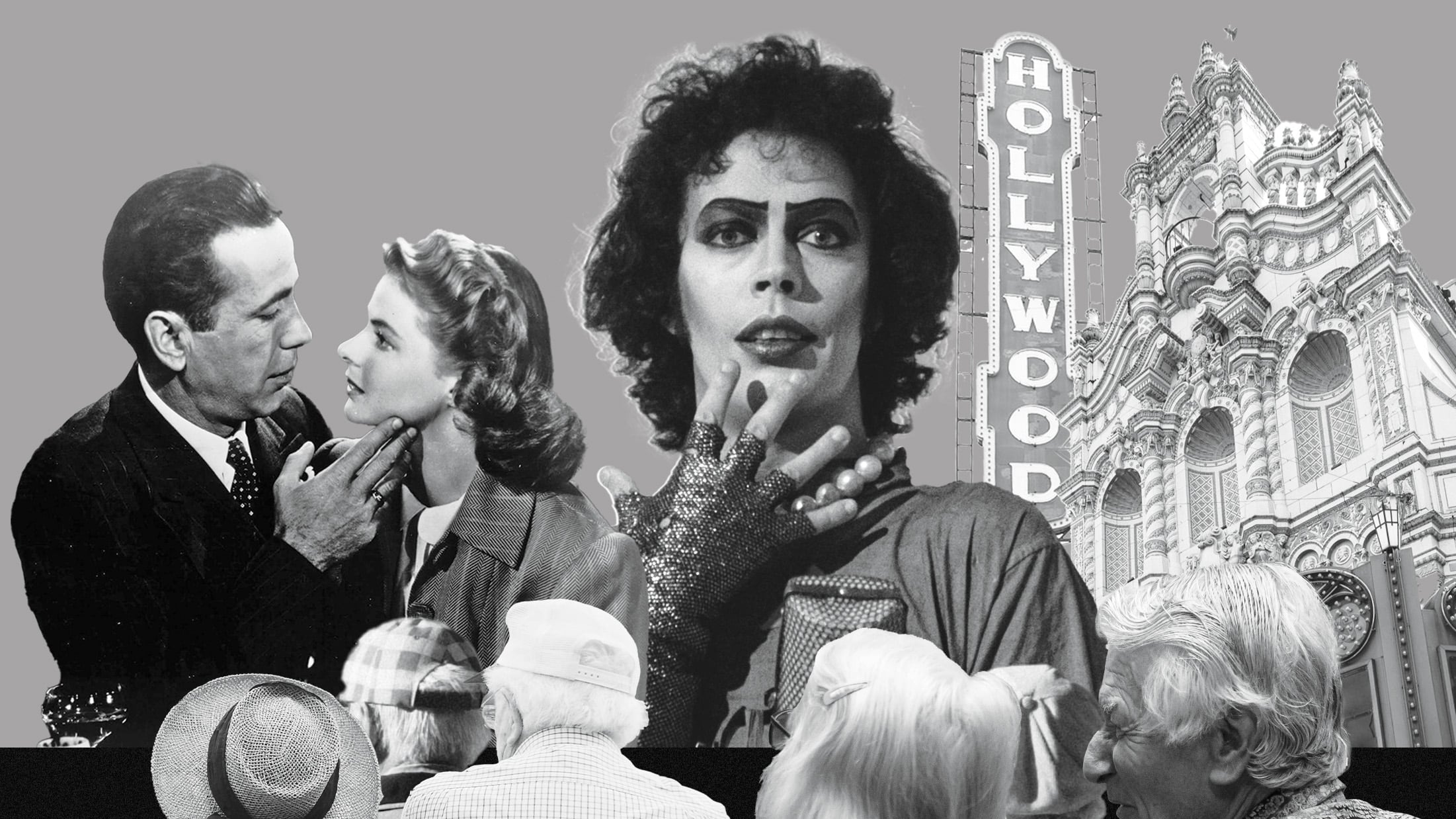
The Hollywood Theatre is on a mission to bring the people of Stumptown together around movies, and as the theater’s grown into a collection of movie-related businesses in recent years, it’s proven that it’s not afraid to step out from behind its historic marquee to do so.
Since 2017, the organization has run a microcinema playing locally made documentaries and shorts at Portland International Airport. In 2018, it took over Movie Madness, the long-standing video rental spot that’s soon to move across the street from the theater itself. This fall, the theater launched a new kind of roadshow spreading the gospel of movies: taking them inside retirement communities.
The Hollywood Theatre Classic Film Club brings Ted Hurliman, the theater’s director of education and special projects, to retirement communities to screen movies and facilitate in-depth discussions among residents.
“Sometimes a person who lives in a place like this won’t have a place to come together with other people and have discussions,” Hurliman explained at an October meeting at The Watermark at the Pearl, a luxury senior living community.
Like much of the Hollywood’s programming, the ambition behind the Classic Film Club is as much about creating points of connection for people as it is about movies. “We’re just hoping it gives them a little bit of pleasure and a chance to speak to folks that maybe they haven’t spoken to before,” Hurliman says.
The Film Club functions as a nonprofit kept afloat by donations and grants. It launched as a pilot program, scheduling four monthly screenings at three different retirement communities, but two months in, it has already spread to seven locations with more on the way. With that expansion comes the challenge of meeting the club’s needs—so far Hurliman and Madeleine Criglow, the Hollywood’s development coordinator, are the only hosts and have to share screening equipment (a projector and speakers) with other theater programs.
“I think it’s a good problem if we have to figure out how to scale,” Hurliman says. “That means people want the program and they want to participate.”
When Hurliman began the project, the curriculum was hits from the Golden Age of cinema like The Lady Eve (1941) and his own all-time favorite, Casablanca (1942). However, he soon expanded to include more modern fare, such as Hidden Figures (2016), a biopic on the Black female mathematicians who worked on the space program in the 1960s. That screening prompted a discussion with one filmgoer who herself worked on wiring for lunar landers a decade later. “Even though we weren’t talking about the movie, she got to talk about her history,” Hurliman said. “It’s just nice to get people talking—and exciting.”
At the Watermark, the subject was The Rocky Horror Picture Show (1975)—more of a cult favorite among filmgoers than a blockbuster classic, but an appropriate choice given its proximity to Halloween and the recent passing of its star, Tim Curry. Of the 15 attendees at the screening, most hadn’t yet seen the film, dashing hopes that the audience might sing and dance along or throw toast at the screen. Though one familiar viewer showed up in a red satin ensemble, the rest came dressed for an ordinary Friday afternoon. Those that stayed to the end seemed to enjoy their trip to the Frankenstein Place, and may even find it in themselves to do the Time Warp again someday.
Hurliman opened the screening with a primer on Rocky Horror’s history, hot on the heels of the repeal of U.K. laws banning same-sex relations and growing from a small London stage to a counterculture phenomenon. He asked the audience to consider the camp value of the film and whether its point of view still resonated in the modern age. During the post-film discussion, one member of the audience remarked, “David Bowie in 1972 was wearing his dresses and velvet and playing with gender, so I think [Rocky Horror] really is quite of its time, like on the edge of the revolution of sexuality. It seems like we’ve only gone through it today with nonbinary and all that.” As long as there are people questioning the norms and pushing boundaries of gender and sexuality, Dr. Frank N. Furter will be there saying, “Don’t dream it, be it.”