Skip to main content
Portland Book Festival is coming off a hot year. Last fall, the event sold out for the first time in its 21-year history, with 8,000 readers packing the South Park Blocks for a one-day blitz of readings and author events. This year, the fest is expanding to a weeklong affair, running Nov. 2–8, and bringing musicians, visual artists and chefs into the mix.
The full lineup will be revealed Sept. 16. But one big change has already been announced and, among a certain subset of Portland writers, it’s the most relevant one of all.
In June, the nonprofit that puts on the festival, Literary Arts, announced the Eberwein family as this year’s title sponsor. Bart Eberwein was executive vice president at Hoffman Construction for more than three decades and has been on the board of Literary Arts. In this context, however, the family is notable mostly because it’s not Wells Fargo or Bank of America.
Those two banks had been the title sponsors of the festival almost every year for the past decade. But at the 2025 festival, a group that has since named itself Literary Portland for Palestine protested the Wells Fargo sponsorship, starting with an open letter by Portland writer David Naimon calling for the festival to drop the banks as sponsors.
“We ask you to say ‘no’ to sponsorship from banks that profit from and facilitate the destruction of Palestine, that are deeply implicated in the global arms trade overall and which go against the spirit of the work of the writers you otherwise center,” reads the letter, which was published on the website Literary Hub. Hundreds of writers signed, including Omar El Akkad, Naomi Klein, Viet Thanh Nguyen, Leni Zumas and Lydia Kiesling. Pro-Palestine activists worldwide have been protesting banks such as Wells Fargo and Bank of America for their financial ties to companies that supply Israel, such as weapons manufacturers.
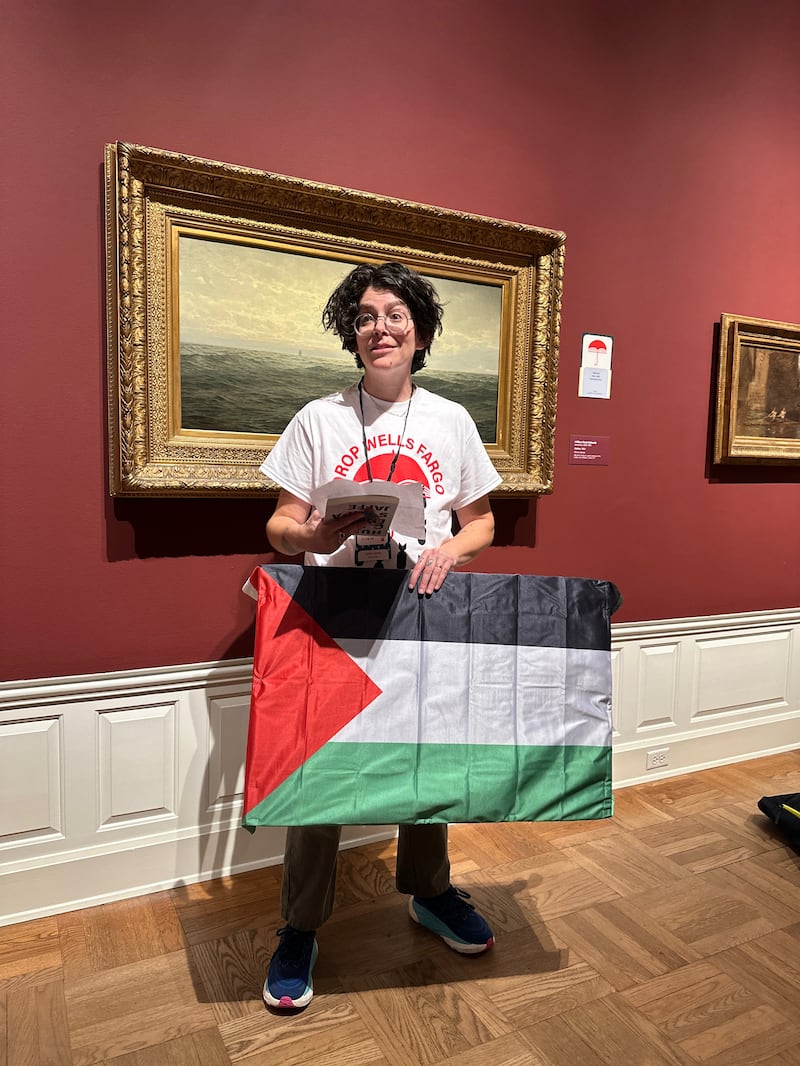
At last November’s festival, some authors wore T-shirts that read “Drop Wells Fargo” and sported a graphic of Literary Arts’ red umbrella logo dropping bombs. Others took time out of their author talks to make statements about the sponsorship. Literary Arts made no effort to silence the statements that day or prevent anyone from wearing the shirts or giving them away at the accompanying book fair.
Almost a year after the pro-Palestine protests threatened to overshadow the book festival, Literary Arts has done exactly what the protesters hoped it would and moved on from Wells Fargo as a sponsor. But it’s done so quietly, without explaining any motives to the community or, now, the media.
Literary Arts declined to explain whether Wells Fargo saw the 2025 fracas and pulled out, or whether Literary Arts asked the bank to step aside, or if the sponsorship ended for unrelated reasons. Wells Fargo did not respond to a request for comment.
Literary Portland for Palestine, an informal collective of about a dozen writers, is tentatively taking credit either way.
“We can’t help but draw the conclusion that our community showed that Portlanders really want our literacy to align with our values to not support or make excuses for genocide,” says Hurricane Envy author Sara Jaffe of Literary Portland for Palestine. “It really made a difference. We will take the win even if Literary Arts won’t officially give it to us.”
The new sponsor, Bart Eberwein, went into the gig with his eyes shut. Eberwein was on the board of Literary Arts in the ’00s but had drifted away from volunteering with the organization.
While touring the Literary Arts headquarters at 716 SE Grand Ave. a few months ago, Proctor asked Eberwein to introduce him around because he was looking for a sponsor for the book festival. The seed was planted, and Eberwein later called Proctor to say he’d do it himself.
“I wasn’t smart enough to say, ‘What happened to the last guy?’” Eberwein says with a laugh.
Eberwein heard about Literary Portland for Palestine for the first time on the interview call with WW. Until then, the most notable thing about his sponsorship was that he and his family had to wear makeup for a photo shoot for the sponsorship announcement. (“This isn’t the Literary Arts I remember,” he says.) Literary Arts didn’t run Portland Book Festival back when Eberwein chaired the board; the organization acquired Wordstock, as it was then known, in 2015.
He is happy to be back in the fold with Literary Arts after many years of enjoying the festival as an attendee. Portland Book Festival brings big-name authors from across the country to the city each fall. Last year’s guests included novelist and politician Stacey Abrams, fantasy author Rebecca Yarros, and New Yorker staffers Susan Orlean and Jill Lepore.
“It feels like something our family could do to help with making Portland the cool place that we love,” Eberwein says.
Eberwein would not disclose how much the title sponsorship cost, only that it was a one-year deal with the door open for it to go multiyear. A peek at Literary Arts’ publicly available tax documents gives an idea of the scale. The nonprofit organization declared $4,152,349 for all contributions and grants in the fiscal year ending in 2025, down from $7,681,785 in 2024; it’s not broken down into individual contributions versus corporate grants. (Those numbers both started with 1’s in 2018 and 2019 when Bank of America was the title sponsor.) But big things have happened in the organization in recent years—in addition to hosting the festival, the Oregon Book Awards, the Portland Arts & Lectures series and more, Literary Arts opened its Southeast Grand Avenue headquarters, cafe and bookstore in December 2024.
While Literary Arts declined a full interview, Proctor did provide a statement thanking the Eberwein family for being the title sponsor this year, and for all donor support that helps expand access to the festival. He continued:
“Literary Arts recognizes that there are many complex and layered issues facing our community and the world. We remain committed to programs like Portland Book Festival that bring people together to foster nuanced dialogue in open and public spaces. The exchange of differing perspectives is vital to the health and well-being of our community.”
Despite an October ceasefire, Israel has continued with almost daily attacks across the Gaza Strip in a war that has killed more than 70,000 people and been called a genocide by groups such as Amnesty International and the United Nations Human Rights Council. Boycotts and divestments are a top tactic in resisting Israel’s military action.
At the 2025 festival, I moderated a book talk called “American Reckoning” between Karen Russell, author of the novel The Antidote, and Omar El Akkad, who was weeks away from winning the National Book Award for One Day, Everyone Will Always Have Been Against This, about the war in Gaza.
During that talk, Russell identified the tension between loving Literary Arts and wanting the bank sponsors out.
“I support divestment from Wells Fargo, and I say that as somebody who also deeply loves Portland Book Festival as a participant and as an attendee,” Russell said onstage. “What’s come out of these conversations is that so many of us want to have a book festival that isn’t dependent on taking money from Wells Fargo.”
A transcript of that event aired on OPB in January as an episode of Literary Arts’ The Archive Project. Russell’s comments from the stage regarding the festival dropping Wells Fargo were edited out. Under pressure from Jaffe and others, Literary Arts released the full transcript on its website, noting that “an earlier version of this episode omitted a portion of the conversation, as well as the audience Q&A.”
David Naimon, host of the literary podcast Between the Covers and author of the open letter, calls Literary Arts a “vital part of the Portland literary ecosystem” and says the city would be much poorer without it. But last year, he felt like Literary Arts treated his group as “something to be managed” rather than peers in conversation, at the cost of the relationship.
“There is a cost to being unwilling or unable to turn and face the community and simply say ‘We’ve listened,’” Naimon says, “‘and this is how we are moving forward.’”