Skip to main content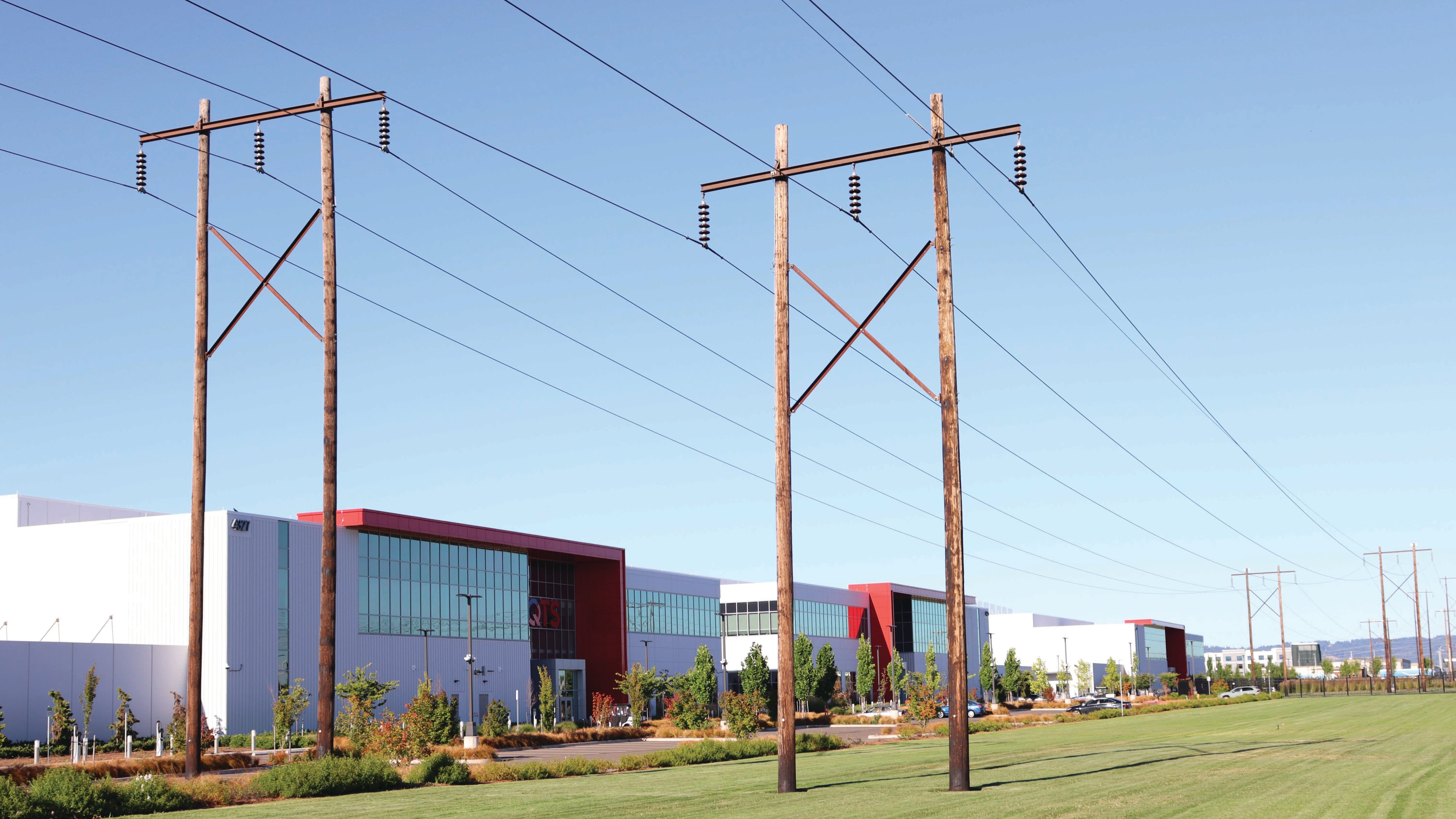
This summer, the International Brotherhood of Electrical Workers Local 48 has jammed its finger into the socket of Oregon politics. It has done so in ways that seem curious, if not a little foolhardy.
Why in June did it make the largest single contribution in its history, $400,000, to Gov. Tina Kotek?
Why the following month did it publicly rescind its endorsement of Portland City Councilor Mitch Green, ostensibly for his opposition to two huge—and somewhat unpopular—public projects, the $2.5 billion Bull Run Water Filtration Project and $600 million Moda Center remodel?
Why does IBEW Local 48 continue to swim publicly against the current in its support of one of the lowest-polling institutions in the country, data centers?
The answer, it turns out, lies in Idaho.
There’s an exodus of sorts happening in Portland. Over the past few years, union trade work in the metro area has dwindled to a handful of major projects, and work has slowed to a trickle at Intel—long a stable source of well-paying jobs in the electrical subfield. Now, around 1 in 6 members of IBEW Local 48 is out of work. And with hundreds of apprentices off the job, the project pipeline doesn’t inspire confidence, either.
So Portland-area union electricians by the hundreds are packing up their steel toe boots and conduit benders and moving to Boise, where the multiyear Micron Technology fabrication campus expansion—the largest private construction project in Idaho history—offers $65 an hour plus a daily stipend of $200. Foremen in Portland tell WW they have difficulty hanging onto apprentices enticed away by checks of $5,000 a week.
And it’s not just Boise. Major data center projects are drawing IBEW members—on a temporary and permanent basis—to Reno, Nev., and Kennewick, Wash. Closer to home, geothermal projects near Bend are keeping electricians busy.
Union leaders are desperate to stem the exodus of apprentices from Portland. To IBEW, data center construction is one obvious solution. But that viewpoint puts Local 48 at odds with other key members of the Democratic Party’s base.
Data centers, which represent an abundant source of jobs for electricians, are increasingly unpopular in Oregon, a onetime hotbed of data center development. The political mood has shifted such that union leaders are accosted by left-wing protesters outside public meetings.
Local 48 political director Chris Carpenter declined numerous requests over several weeks to comment for this story. Last month, however, he told the Hillsboro City Council that his members had “serious concerns” with the city’s plans for a temporary data center moratorium.
“Seeing opportunities like this where we know we can get hundreds of people on the job in their backyard is something we can’t overlook,” Carpenter said at the time.
Considered among the most politically influential of Oregon’s building trade unions, Local 48 has long been a heavy hitter in Salem. And with only around 6,000 members, the union punches above its weight, contributing tens of thousands of dollars each election to local and statewide candidates. Over the decades, it’s helped shape policy in areas like prevailing wage, worker safety and green energy construction. But this election season, they’ve flexed more muscle than ever before.
In June, Local 48 gave $400,000 to Gov. Kotek’s reelection campaign—the union’s largest contribution ever and among the largest the Dem governor has ever received from a union. The timing of the gift is noteworthy, as well—one day after Kotek rolled out her Prosperity Council agenda, a high-level plan to kick-start Oregon’s flagging economy and add jobs.
Local 48’s contribution might not feel surprising. Democrats have long been regarded as the party of organized labor, and Local 48 has supported Kotek in the past. The trades also tend to support pols who promise big new construction projects—and Kotek’s new “Prosperity Roadmap” does just that through expedited permitting, expanded industrial sites, and other approaches.
In early July, IBEW Local 48—along with Ironworkers Local 29—rescinded its endorsement of Councilor Green over his opposition to two massive public projects certain to yield hundreds of trade union jobs—the $2.5 billion Bull Run Water Filtration Project (the largest public works projects in the city’s history) and the proposed, ultra-controversial $600 million Moda Center remodel.
Garth Bachman, business manager of Local 48, called Green’s opposition to the projects a “betrayal of the working class” for the son and grandson of union plumbers, and “an unfortunate indicator of the councilor’s values.”
Around the country, building trade unions tend to want the same three things, year in, year out: more jobs, more hours and safer conditions. For the IBEW in Oregon, home of the Silicon Forest, corporations like Intel—but primarily Intel itself—keep electricians workers busy year-round. And for the past decade or so, IBEW members have wired Oregon’s data centers (around 45% to 70% of a data center’s cost goes to the electrical subcontractor, according to IBEW).
For his part, Green says Bull Run and the Moda Center remodel lost his support as costs exploded. He cited numerous reasons his constituents don’t like data centers, including environmental impact, poor return on tax incentive investment, and a close connection to the nebulous and destabilizing impact of AI. And, critics of data centers note, once construction wraps, data centers don’t tend to employ many people.
“You can’t ignore these issues,” Green tells WW. “Yes, there are definitely jobs to be created by ramming through these unpopular positions. But you have to balance it with recognizing that voters out there are watching every move we make, and they’re going to ask whether we care about affordability.”
Green retains the support of a number of public sector unions, including the American Federation of State, County and Municipal Employees and the Portland Association of Teachers.
Though they share many similar interests, there’s long been a divergence between public and private sector unions, and there’s talk the gap may be widening in Oregon. In terms of membership, the public sector dwarfs the private sector, and a much smaller percentage of private sector workers belong to unions—somewhere south of 10% compared to around 50% in the public sector. And contrasted with the private sector, public sector workers have more protections to go on strike, meaning some public sector unions feel more free to express their political positions.
On Tuesday, the executive board of the Oregon Labor Federation, AFL-CIO passed a resolution in support of high-road standards for data center development in Oregon.
“Data centers are going to be a significant part of Oregon’s economic future, and the labor movement is committed to ensuring that future truly works for working people and our communities,” said Graham Trainor, Oregon Labor Federation president. “When companies spend billions of dollars in Oregon and rely on public infrastructure and resources, Oregonians should see a meaningful return.”
Another factor in 48’s declining fortunes is 47—that is, Donald Trump. The 47th president’s One Big Beautiful Bill cut green energy tax credits of the Biden administration, which had fueled hopes of a green energy building boom in the Pacific Northwest.
The union also put a lot of hope in the recent $253 million bond-funded rebuild of Beaverton High School, but the Beaverton School District ultimately went nonunion. The district tells WW around 70% of its construction work goes to union contractors.
With opposition to data centers sky-high, IBEW’s gift puts Kotek in a tough spot as she pursues reelection against strong populist headwinds. Carpenter says Local 48’s contribution was intended to help a longtime friend to labor defeat her Republican opponent.
Asked about this, Kotek recently told KATU-TV her office is working to get advanced manufacturing and Intel “back up and running.” She’s supported local moratoriums on data centers and terminated the sale of land in Salem that would have gone to a “hyperscale” data center. But not before a union leader was allegedly shoved by a protester after a verbal confrontation outside Salem City Council chambers.
Police were on hand to provide security at the tense meeting, which was attended by dozens of anti-data center protesters. Officers arrested a 33-year-old woman on suspicion of harassment and disorderly conduct and took her to jail, according to the Salem Police Department.
“They want their folks to work,” Kotek said of IBEW. “In the meantime, when data centers do come back in development, they are going to be done right. That means the jobs will be union jobs. That’s where we align on those issues.”