Skip to main content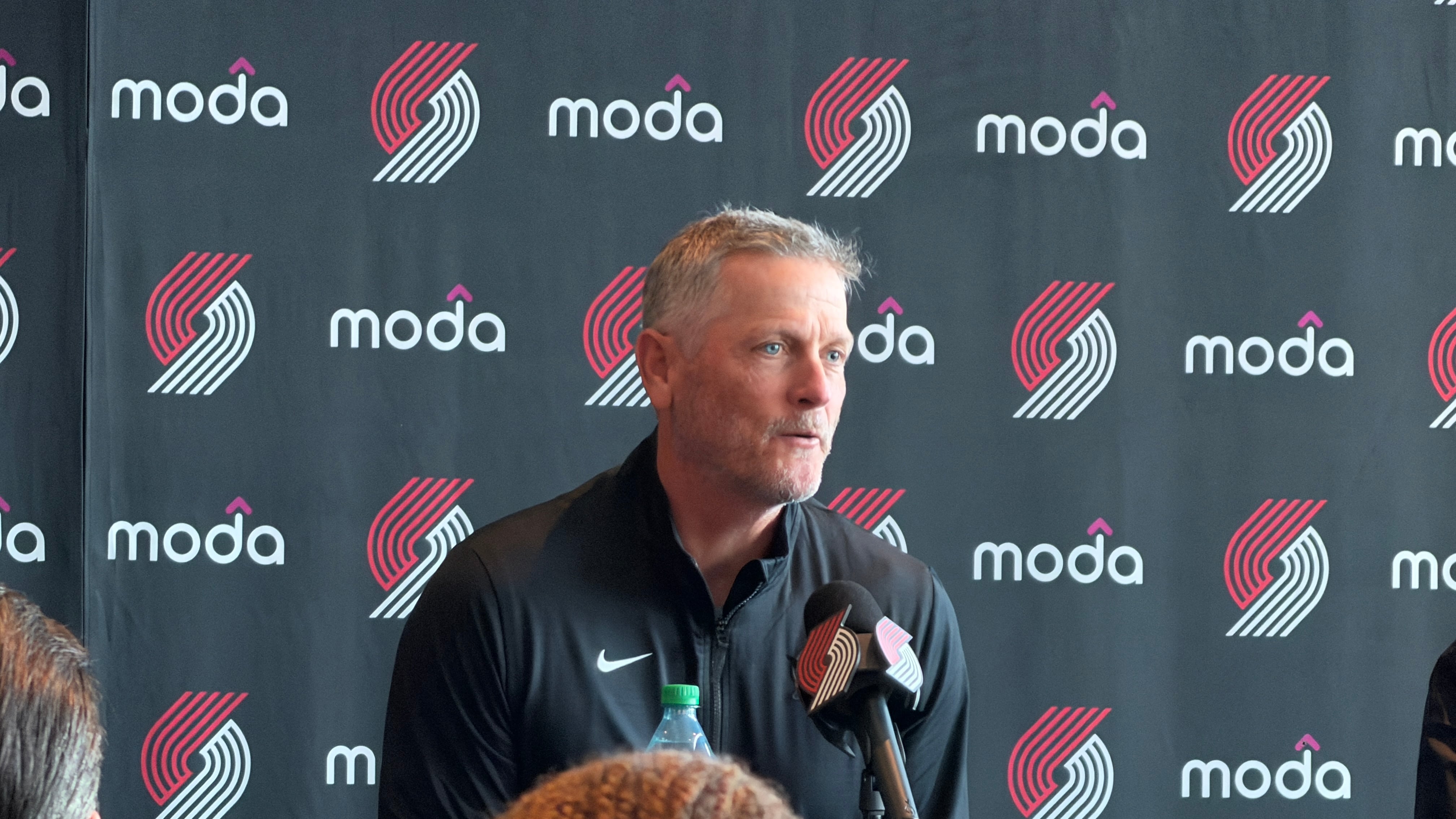
Trail Blazers employees, sports media and various rich folks packed inside the Rose Room at the Moda Center this afternoon for the first press conference held by new Trail Blazers owner Tom Dundon—a man who many have feared will move the team out of Portland.
Joining Dundon on the dais were two of his “alternate governors” (that is, minority-stake owners): venture capitalist and recent Portland transplant Sheel Tyle, 34, and Andrew Cherng, 77, the cofounder of Panda Express. (Dundon, 54, is the owner of the NHL’s Carolina Hurricanes and the focus of a past lawsuit filed by Oregon and multiple states alleging predatory subprime auto lending at the Texas business that made him a billionaire.)
Once the press started asking questions, Dundon bristled at the notion that there was ever a threat of him moving the team, and implied that this storyline was an invention of the media.
“I haven’t spent any time on anything other than trying to figure out the renovation and the lease,” he said. “And that’s kind of all I focused on. So anybody who would—you’re welcome to write what you want because if we get attention for the Portland Trail Blazers, I appreciate it.”
Tyle, who moved to Portland in 2024 when his wife, Dr. Sejal Hathi, became director of the Oregon Health Authority, added: “Tom would not have asked me to join this group had [relocation] been on the table.”
This version of history is, let’s say, somewhat curious.
Last July, it was reported that Dundon had purchased the franchise for $4.25 billion. In the ensuing months, Trail Blazers officials and a slew of lobbyists led by CAA Icon’s Dan Barrett—the man who more or less wrote the book on publicly financed arena deals—worked to cultivate lawmakers across the state.
Barrett has represented both franchises and public entities alike in the past, and negotiated on behalf of the state of North Carolina when Dundon sought public money for a renovation to the stadium housing his NHL franchise, now known as the Lenovo Center; the deal ended with $300 million in public financing and none of Dundon’s own money, though he later announced an $800 million investment in the land surrounding the arena. (Despite this being a core feature of all arena deals of the past few years, Dundon stated that he hadn’t yet considered such an arrangement when asked about it on Thursday, though alternate governor Marc Zahr—who has mastered the art of the “triple net lease” through his work at Blue Owl Capital—was not in the room.)
Barrett’s work culminated March 6 with the passage of Senate Bill 1501, a bill introduced a week into the Oregon legislature’s 35-day short session which allocated $365 million in bonds towards renovation of the Moda Center. This amount is higher than the total that Dundon was able to get in Raleigh — the final figure was $330 million after lawmakers decided to add an additional $30 million — and is itself contingent on “binding and substantial” subsequent financial commitments made by Multnomah County and the City of Portland. The county is said to be considering an $88 million allocation, while the city is good for up to $175 million according to mayor Keith Wilson. (This includes a controversial $75 million portion from PCEF, the city’s clean air fund designed to help communities disproportionately affected by climate change.)
The bill did not call for any money from Dundon or his fellow investors, a detail which has generally rankled the public.
Shortly after the passage of SB1501, longtime friends U.S. Sen. Ron Wyden and NBA Commissioner Adam Silver flew to Oregon to take a victory lap and smooth out public opinion. Twelve days later, the NBA announced it would begin the process of expanding into two cities: Seattle and Las Vegas.
Sen. Rob Wagner (D-Lake Oswego), who introduced SB1501, had specifically cited both cities as threats to steal the Trail Blazers if Dundon wasn’t able to see that the state would play ball.
With both cities off the table, Dundon’s leverage to get “binding and substantial” sums from the county and city would seem to shrink.
Tyle, via comments made in an interview with The Athletic’s Jason Quick published Wednesday, seemed to chip away at their remaining leverage.
“I don’t want people to be concerned or scared,” Tyle said. “We are committed to Portland, 100 percent. Full stop.”
He also professed hope that the Trail Blazers will become “Asia’s team,” a sentiment echoed at Thursday’s presser by Andrew Cherng.
“I love the fact we have a prospect in [Yang] Hansen, you know? And the NBA is a popular sport in China. There’s a lot more influence we can make. I’m excited.”
Quick appeared to draw Dundon’s ire on Thursday when he addressed the “elephant in the room.”
Quick asked: “Who’s going to pay for the arena upgrades? And so far it doesn’t look like you have much skin in the game; you know, it’s all public funding. Is it your position that you’re not going to pay rent on this or there’s going to be no relocation penalties? Can you answer to the public that you will have some skin in this game?”
Dundon replied, “Sure. No one’s ever told me I didn’t have skin in the game before. We don’t know each other very well. So, look, we’re going to negotiate and do a market deal.”
Absent from Dundon’s remarks are a recognition of the idea that he—and especially Barrett, who will sit across a negotiating table from a joint authority set up with the state and the city—has himself helped create the market deal he seeks.