Skip to main content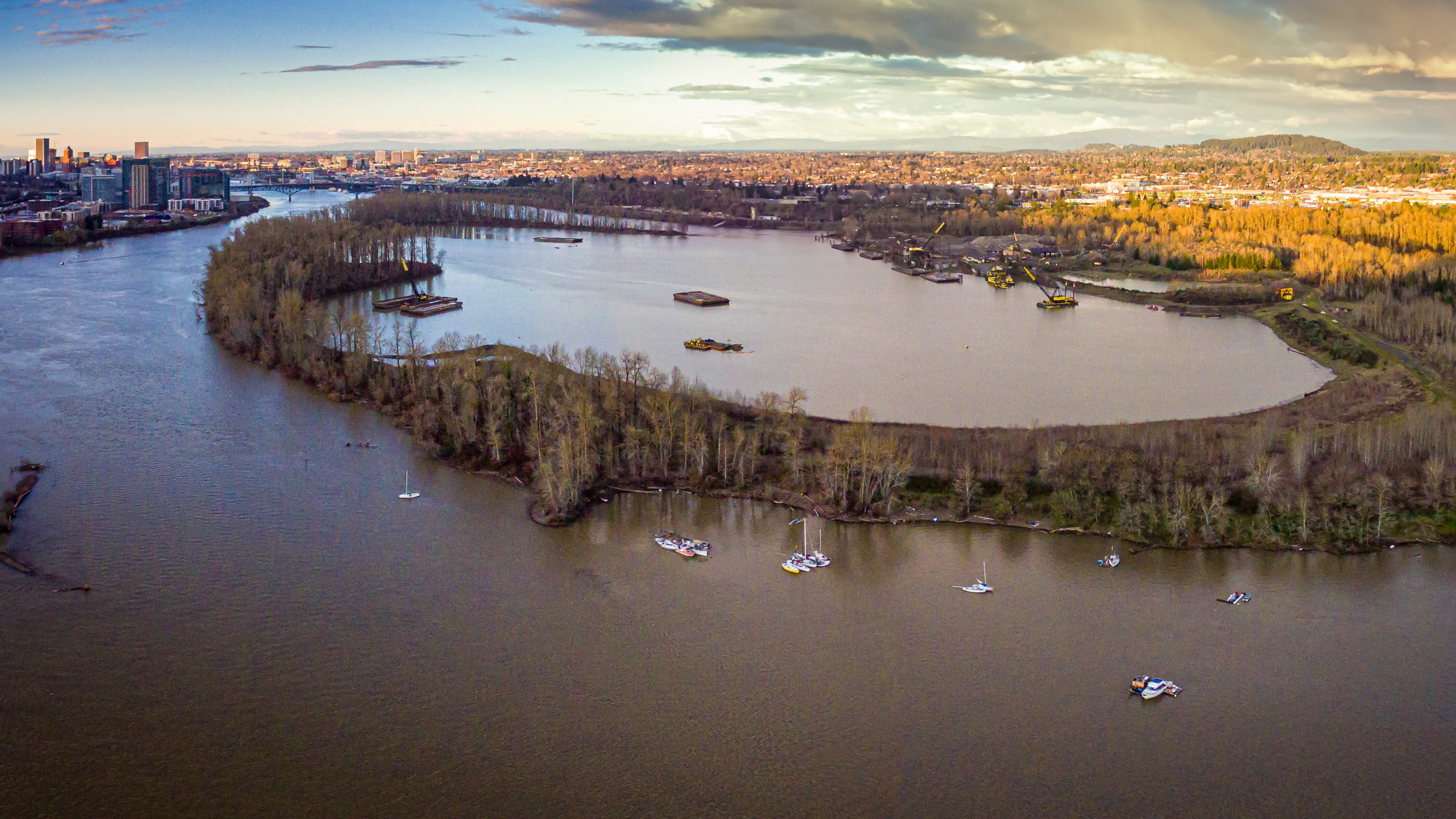
This story was produced by the Oregon Journalism Project, a nonprofit newsroom covering the state.
More than a quarter century after the U.S. Environmental Protection Agency named the Portland Harbor a Superfund site, OJP has learned that a proposed solution could save polluters hundreds of millions of dollars and leave a despoiled Portland landmark relatively pristine—and in public ownership.
Although the Superfund site is in the Willamette River in Portland, nearly every Oregonian has a stake in the cost of the cleanup.
That’s because the more than 150 parties responsible for the river’s pollution include not only private industry, but the state of Oregon, the Port of Portland, the city of Portland, and the state’s largest utilities.
That means Oregonians are on the hook for a substantial portion of the cleanup cost—which Alan Sprott, the top environmental manager at Vigor Industrial, which operates a shipyard on Portland’s Swan Island, says could run $4 billion or more.
“The public is going to be paying for part of it through taxes, water rates and utility bills,” says Sprott, whose company is one of those responsible for cleanup.
The operating assumption has been that the responsible parties would pay to remove about 3 million cubic yards of contaminated sediment in the riverbed and banks and send the material more than 100 miles to landfills in Central Oregon.
But last July, Vigor and other companies proposed to EPA an audacious alternative: Why not use most of the material to refill the gaping 130-foot-deep hole that 75 years of mining by Ross Island Sand & Gravel left in downtown Portland’s Ross Island Lagoon?
Instead of building a new terminal and moving dirty sediment from Portland to Central Oregon, a private operator could simply move the soil a few miles up the Willamette to the hole in the lagoon.
Placing the sediment there would comply with the state-ordered reclamation of Ross Island, which sprawls across 400 acres in downtown Portland.
“It could be an incredibly elegant solution, based on the information I have at this point,” says Mike Houck, executive director of the Urban Greenspaces Institute in Portland.
If the state of Oregon and other stakeholders approve, a private company backed by a consortium of the polluters would purchase Ross Island from the financially troubled industrial tycoon Robert Pamplin Jr.
The new private company, subject to state approval, would fill the hole in the river bottom in the island’s lagoon with most of the material removed from the Superfund site.
Burying and capping the material just upriver from the site (which runs 10 miles from the Broadway Bridge nearly to the confluence of the Willamette and Columbia rivers) could result in big transportation savings for the responsible parties. It could also get Pamplin off the hook for a legal obligation he appears unable—or unwilling—to fulfill.
Why might environmentalists go along with the plan?
Mary Lou Soscia, who retired after 38 years at EPA and now sits on the boards of two Portland nonprofits that have examined the idea, Neighbors for Clean Air and the Human Access Project, says such in-water burial (with sophisticated engineering and impervious caps) is increasingly common across the country. Soscia says it has proven successful in Tacoma, Boston Harbor and New York’s Hudson River, among many other places. “I think it’s settled science at this point,” Soscia says.
Houck says if the idea gains traction, a big chunk of the savings could go to restoring Ross Island to preindustrial condition and placing it in public ownership as a nature reserve.
That outcome would save the polluters money, return a vital greenspace to health, and get Pamplin out of a jam.
Pamplin, the former owner of 24 Oregon newspapers, once occupied a spot on the Forbes list of the 400 wealthiest Americans. But today, he appears to be in serious financial trouble.
Records show his companies regularly fail to pay bills and taxes; his massive ranch in Jefferson and Wasco counties is currently on the market (for $54 million); his Willamette Valley farmland and wineries are also being sold by a court-appointed trustee—the result, as Willamette Week first reported, of Pamplin bilking his company’s pension fund out of tens of millions of dollars.
Ross Island also figures in his difficulties. In 2024, after a federal Department of Labor investigation found Pamplin had violated pension fund laws, he agreed as part of a legal settlement to take back the island from his company’s pension fund, to which he had improperly sold the troubled property in 2022 for $10.8 million.
The Department of Labor found the sale of the island so unfair to pensioners it ordered Ross Island Sand & Gravel to undo the sale and give the pensioners their money back.
As previously reported, Ross Island Sand & Gravel has signed a series of agreements with the Oregon Department of State Lands to repair the damage its aggregate mining and processing business did to Ross Island. But the company has failed to comply with the most recent agreement, signed in 2023, resulting in the state seeking a $13.9 million penalty against the company.
That means the island is a large liability for Pamplin, 84. An opportunity to sell it to a new company that would fulfill the reclamation obligation to the state could be a godsend. (Pamplin’s attorney declined to comment.)
Houck, who first got involved in negotiations over Ross Island’s future in 1979, when the company signed its first reclamation plan with the state, says his initial reaction to the idea of making Ross Island a repository of Superfund spoils was disbelief. “I said hell no,” Houck recalls.
That response stemmed in part from a previous environmental fiasco. About 30 years ago, Pamplin’s Ross Island Sand & Gravel, with regulatory approval, accepted contaminated spoils created from the Port of Portland. It used the material to help fill in the hole it had mined below the Willamette’s riverbed. But the company then accidentally breached caps it had placed over the dirty soil, releasing contaminants. Environmentalists are eager to avoid another such mess.
To be clear, not all the material that would be removed from Portland Harbor is clean enough to be buried in the river bottom.
EPA says two categories of sediment will be removed from the Superfund site: nonhazardous sediment, which comprises 93% of the 3 million cubic yards; and hazardous sediment, 7% of the total, which must be removed from the Willamette and its banks and buried in special landfills.
The estimated cost of digging up all 3 million cubic tons and moving it to landfills is a large number. In 2017, EPA placed it at about $1 billion. Vigor’s Sprott thinks it could cost $4 billion to $7 billion today.
In January, 10 environmental groups, including the Northwest Environmental Defense Center, Neighbors for Clean Air, and the Portland Harbor Community Coalition, felt comfortable enough with the concept to write to Gov. Tina Kotek, urging her to move the process forward.
“We view this moment as an opportunity to imagine a creative public ownership and stewardship model whereby Ross Island can be held in perpetuity to ensure environmental protection,” the groups wrote.
Laura Knudsen, an EPA spokeswoman, says it’s up to the polluters to propose where the Superfund material goes and how it is transported to its final destination, subject to agency approval.
“EPA is responsible for ensuring any disposal facility used during the cleanup of the Portland Harbor Superfund site is in compliance with applicable federal or state requirements,” Knudsen says.
Time is running short to work out a deal. “EPA plans to have remedial action agreements complete in 2027 and start in-water construction (implementation of the remedy) in 2028,” Knudsen adds.
Houck knows plenty could still go wrong with the novel plan to reclaim Ross Island, but he’s cautiously optimistic. In addition to confirmation that in-water burial is safe, Houck and his allies want financial guarantees that ensure maintenance of the reclaimed island, including remediation if caps over the buried material fail.
Getting to such a deal, he says, would be “mind-boggling.”
Sprott, who started working on his company’s response to the Superfund listing in 2000, agrees.
“We could shorten the time frame, cut costs down, and we get something positive out of it rather than just exporting Portland’s waste to Central Oregon,” he says. (The Columbia Community Connection recently reported that trucking contaminated Superfund materials to Central Oregon landfills would put enormous pressure on local roads.)
“It would be a significant new asset in the middle of a major American city,” Sprott adds. On March 19, Gov. Kotek responded in a letter to the 10 environmental groups that the state hoped to help facilitate an “elegant solution.”
Added Kotek: “I can assure you that DSL, DEQ, and other relevant state agencies will collaborate and work together on these matters.”