Skip to main content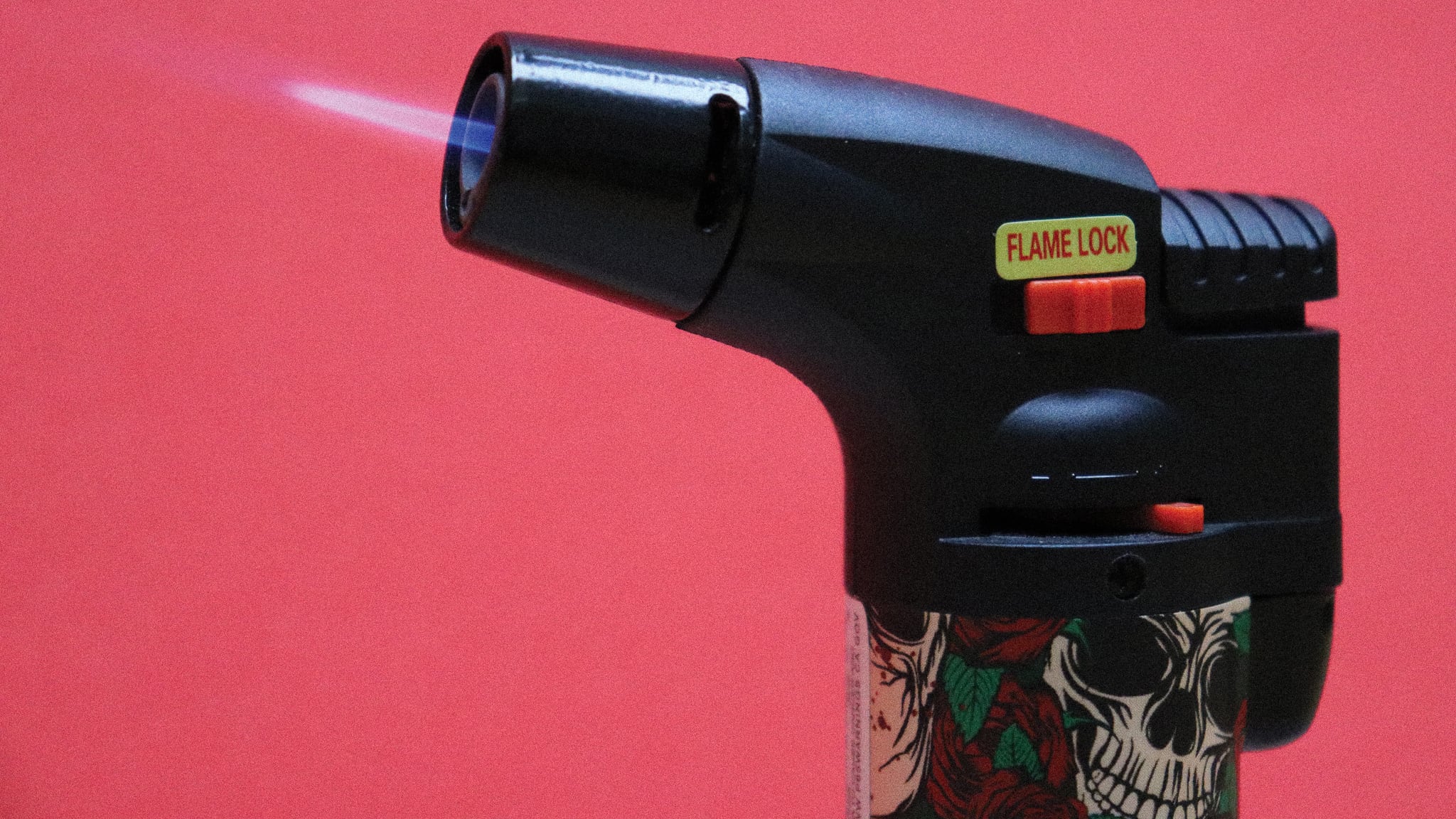
Last year, Dr. Mark Thomas, a surgeon at the Oregon Burn Center at Legacy Emanuel Medical Center, had a hunch. More and more, he noticed, patients were coming in maimed by nasty, hyperfocused burns—a “catastrophic injury pattern” that offered little if any prospect of a full recovery.
Now, after looking into the matter further, he’s launching something of a public health crusade. “I’m tired of cutting off arms and legs,” he tells WW.
The objects of his ire are the little butane torches that have become ubiquitous implements for drug smokers in Portland and beyond.
Burns are not the only damage these cheap miniature flamethrowers have caused; the blaze that recently closed the flagship Elephants Delicatessen on Northwest 22nd Avenue began, the suspect told police, when she was seeking food scraps in a trash bin and attempted to use one such torch as a flashlight.
But according to Thomas and other researchers, the devices have also in recent years been melting Portland-area flesh at an alarming rate. It’s a part of a broader pattern they observed in a new study on the links between Oregon drug use and acute burn injuries that shows that—though widely considered safer than injecting drugs—smoking them has perils of its own.
Between early 2016 and early 2024, they found, 12,304 Oregon Medicaid members were treated for acute burns—four-plus people per day. Notably, people who use smokable drugs comprised more than half of those people—a rate of two acute burns per day—despite making up just 15% of the state’s Medicaid population.
Thomas says the numbers match what he sees at the city’s go-to burn unit. He describes a common scenario: A man prepares to smoke some fentanyl. The classic Bic lighter may be ready at hand, but it proves less convenient than the torch. (“We have, you know, a windy environment,” Thomas says. “You can just leave these things on. You can smoke hands-free.”) Thus, the man turns to his torch. He pulls the trigger and toggles the “flame lock,” securing the trigger in such a way that he can release it but the flame continues to shoot out.
The flame lights the fentanyl, which does its work. The man dozes off, but the flame continues to burn near, say, a hand or lower leg. The flame burrows into the skin, deeper, deeper, deeper, down to tendon and bone.
Thomas says the pattern sends burn victims to his operating room with relentless, dark consistency. “We’ve had three this past week,” he says.
Like pretty much every smoke shop in town, ASAP Smoke and Vape on Northeast 8th Avenue stocks on its shelves a diverse array of torches. Fancier ones like the Ion Lite Torch run close to $20, but there are lower price points too.
The other day, I purchased a “Sky Torch” adorned with roses and skulls for $6, and stepped into the balmy warmth outside. It came preloaded with butane, and I pressed the trigger, unleashing the sound of whizzing, pressurized gas, though in the saturated daylight I saw no flame. Thinking my torch might be defective, I drew my finger toward the space where the flame should be, then thought better of it. Later in my living room, it was easier to make out the flame’s blue halo—and within it, a long, sharp and pulsing cone of iridescent blue.
These devices are not new. A decade ago, torches like these brought innumerable dab rigs at my college aglow. But researchers say they seem to have become more common on the streets of Portland when hard drugs that were usually injected—like heroin—gave way to smokable varieties, from uppers like methamphetamine to downer opioids like fentanyl.
Thomas has been working for some seven years at the Oregon Burn Center. It was three or four years ago, he says, that he noticed more of the burns were deeper, isolated to a particular patch of flesh—the product of a durable, pointed flame. The wounds were horrific, and he was getting fed up.
One day last year, he recalls, he was venting in the operating room to an anesthesiologist colleague, who happened to be married to Dr. Honora Englander, an addiction medicine specialist at Oregon Health & Science University.
Soon, Englander and Thomas were on the phone. “There was really nothing in the literature about this,” Englander tells WW. They started talking to drug smokers—a population she often sees at OHSU—and examined Oregon Medicaid data for empirical clues as to what was going on.
The initial fruit of their labor was published this week in JAMA Internal Medicine. Titled ”Burn Risks Among People Who Use Smokable Drugs in the Era of Butane Torches,” the study found that people who use smokable drugs comprise about 15% of Oregon Health Plan members, but more than 50% of all hospitalizations and emergency department visits for which the plan is billed—suggesting wildly disproportionate burn rates among people who smoke drugs.
“That’s a really striking number,” Englander says.
Rates were highest among users of opioids and stimulants in particular. Still, not all of their burns may be attributed to the grisly scenario described above. Some victims touch hot equipment. Sometimes torches simply explode. And it stands to reason that someone addicted to drugs might tend to be less mindful around a flame.
Also notably, the rate of acute burns—both among the general Medicaid population and the higher rate among consumers of smokable drugs—remained fairly constant in Oregon since 2016, the earliest year the study examined.
But Thomas says the team is writing another paper that will show the nature of these burns have changed—they’ve been getting more acute and exorbitantly costly, requiring several operations and longer hospital stays. And qualitative data in the initial study supports the hypothesis that butane torches are a major reason why.
In addition to the data analysis, the study recounts interviews with 19 drug users who primarily smoked fentanyl and methamphetamine. Most carried conventional lighters, noting the low price and the fact that they won’t burn through foil. But all 19 said they use butane torches too.
One reason was wind. But also, the torches burned hotter, vaporizing the drugs and delivering a “crisper, cleaner hit.” Another factor was the locking function, which 11 of 19 interviewed reported using at least sometimes. Reasons, the study said, “included needing a constant hot flame; wanting hands free; convenience, especially with torches that do not ignite easily; ease of passing torches from person to person; or locking as part of one’s smoking ritual.”
Also, many reported instances when the technology had gone horribly awry. “My friend took a torch…and burned right through his hand,” the study quotes one person as saying. “I couldn’t believe it…That he didn’t wake up from that, you know?”
Thomas sees clear policy remedies. The only reason the injuries are characterized by a long-duration burn on one isolated area is because that locking mechanism remains on while the patient is totally comatose from the fentanyl, so “getting that locking mechanism off the butane torch would be number one,” he says. Number two would be rules that make the devices less easily available.
For now, though, Thomas says, he keeps at the recurring task of operating on patients who he doubts will ever be able to fulfill his main objective for them as a doctor: recovery.
“It’s so hard,” he says. “They already had a bunch of issues before. Now it’s like, ‘Well, now you’re missing an arm.’ How are you going to now recover? You got chronic pain associated with injury. You need services. You’re homeless. You have underlying mental health issues. There’s no way that one expects you to recover from your addiction at this point. I mean, it’s nearly impossible.”