Skip to main content
The news that Preschool for All may only need to fund about 7,600 seats to reach universality means the program’s $610 million stockpile could grow to $2 billion over the next two decades, economists told the program’s advisers this month. That’s raising questions about whether a planned increase to the tax rate is as necessary as previously touted.
The backdrop to that question: Multnomah County’s universal preschool initiative has a volatile revenue stream. That’s because it’s funded by a marginal tax of 1.5% on incomes over $125,000 for single filers or $200,000 for joint filers, and an additional 1.5% on incomes over $250,000 for single filers or $400,000 for joint filers. Those high incomes tend to be erratic. So even as the program sits on a $610 million nest egg, county officials have fretted about how to keep the program financially stable enough to withstand future economic shocks.
On Dec. 10, the program’s seven-member technical advisory group, or TAG, learned the county has been vastly overprojecting the number of 3- and 4-year-olds who would participate in the program. That’s further complicated the TAG’s already messy job of making recommendations to ensure the program’s revenue remains sustainable. The group currently defines an economic scenario as sustainable if it meets two criteria: The fund balance in year 10 must be above zero, and cumulative revenues must exceed expenses between years 11 and 20.
New preliminary modeling based on the much lower demand, from ECOnorthwest, indicates that a smaller number of needed seats could send Preschool for All revenues into the billions by the late 2030s. The preliminary modeling shows that if the county proceeds with a planned 0.8% tax increase, the program’s fund will continue to slope to upwards of $2 billion through 2043, the end of the current projections.
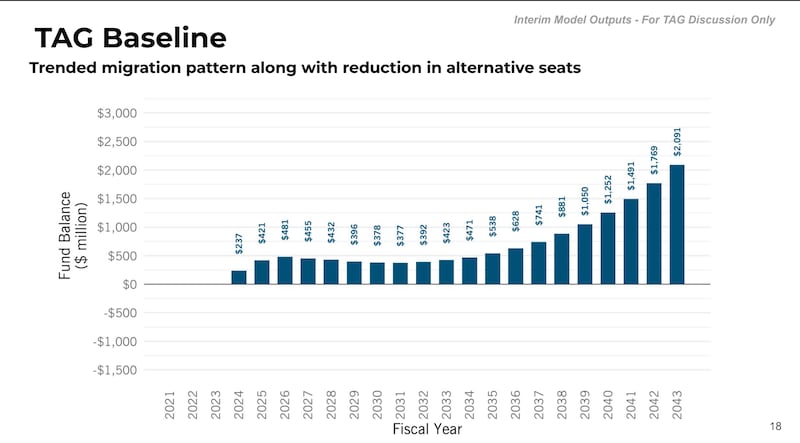
That modeling is based on these assumptions: The program will require about 8,265 seats at its universal capacity, instead of a previously anticipated 11,200; that the number of alternative seats will decrease to 1,500 from about 2,500 (for example, state-funded preschool seats); and that 60% of families will opt for 10-hour days while 40% opt for six-hour days.
It also assumes that costs for each seat and fixed costs will increase each year, and that the program’s revenue will on average grow by about 8% a year. (It should be noted that the funding stream of the program means its revenue growth likely will not be linear.)
Previous modeling from the county, based on higher demand assumptions, indicated that even with the planned 0.8% tax increase, the Preschool for All fund would be in the red in the mid-2030s and be showing signs of recovery by fiscal year 2039.
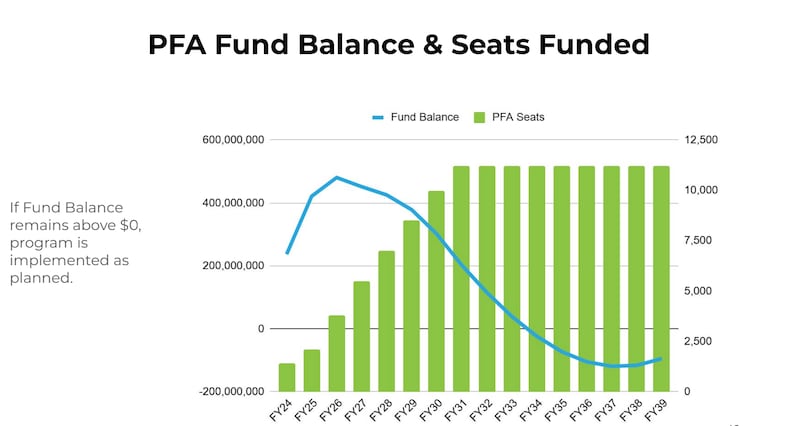
Mike Wilkerson, director of economic research for ECOnorthwest, told TAG members he recommended switching to the baseline the firm has forecasted.
“We had the previous county baseline that exists, but we’re suggesting we move to a new baseline,” he said. “What that baseline is showing is effectively a slight drawdown in fund balance from the peak of 2026 down to 2032 and then effectively near exponential growth after that up to a fund balance of $2 billion.”
Using this baseline, TAG members also received the first glimpse into how some of their proposed economic scenarios would play out. Most notably, forecasting projects that without a 0.8% increase, the new baseline scenario would still keep the program’s fund balance above zero in every year—and it would sit at $511 million by 2043.
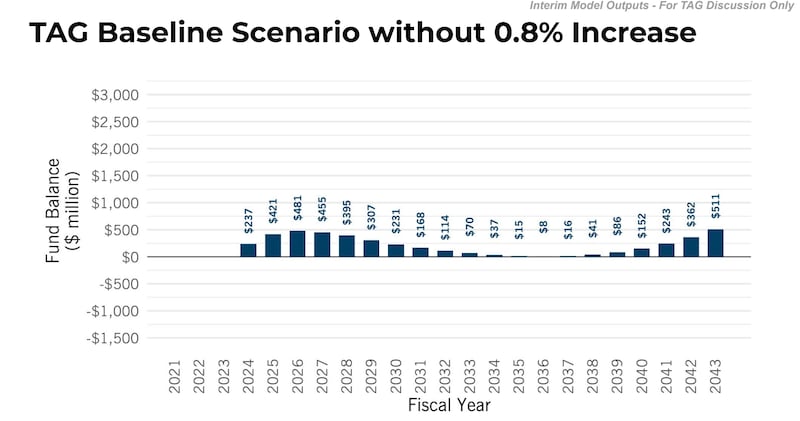
That’s a strikingly different projection from the one county officials have previously presented, indicating that the fund balance would permanently decline without the scheduled increase.
Other preliminary modeling shows that turning all seats into 10-hour seats or forecasting a lower revenue growth rate are factors that would affect the fund balance. TAG members largely agreed that the baseline ECOnorthwest presented was a good start, though the firm could still modify it in the coming months.
TAG members also encouraged ECOnorthwest to do some modeling work on using a property tax to fund Preschool for All, which would be a more stable source of revenue than income tax alone. Some members wanted that option off the table entirely, citing political inviability, while others thought it would be a worthy option to present to county commissioners, who ultimately have the final say in any revenue changes.
“This group is supposed to be independent in providing whatever feedback they want to,” county economist Jeff Renfro told TAG members Dec. 10. “But also note at a recent briefing, property taxes for PFA came up and the board reacted extremely negatively.”