Skip to main content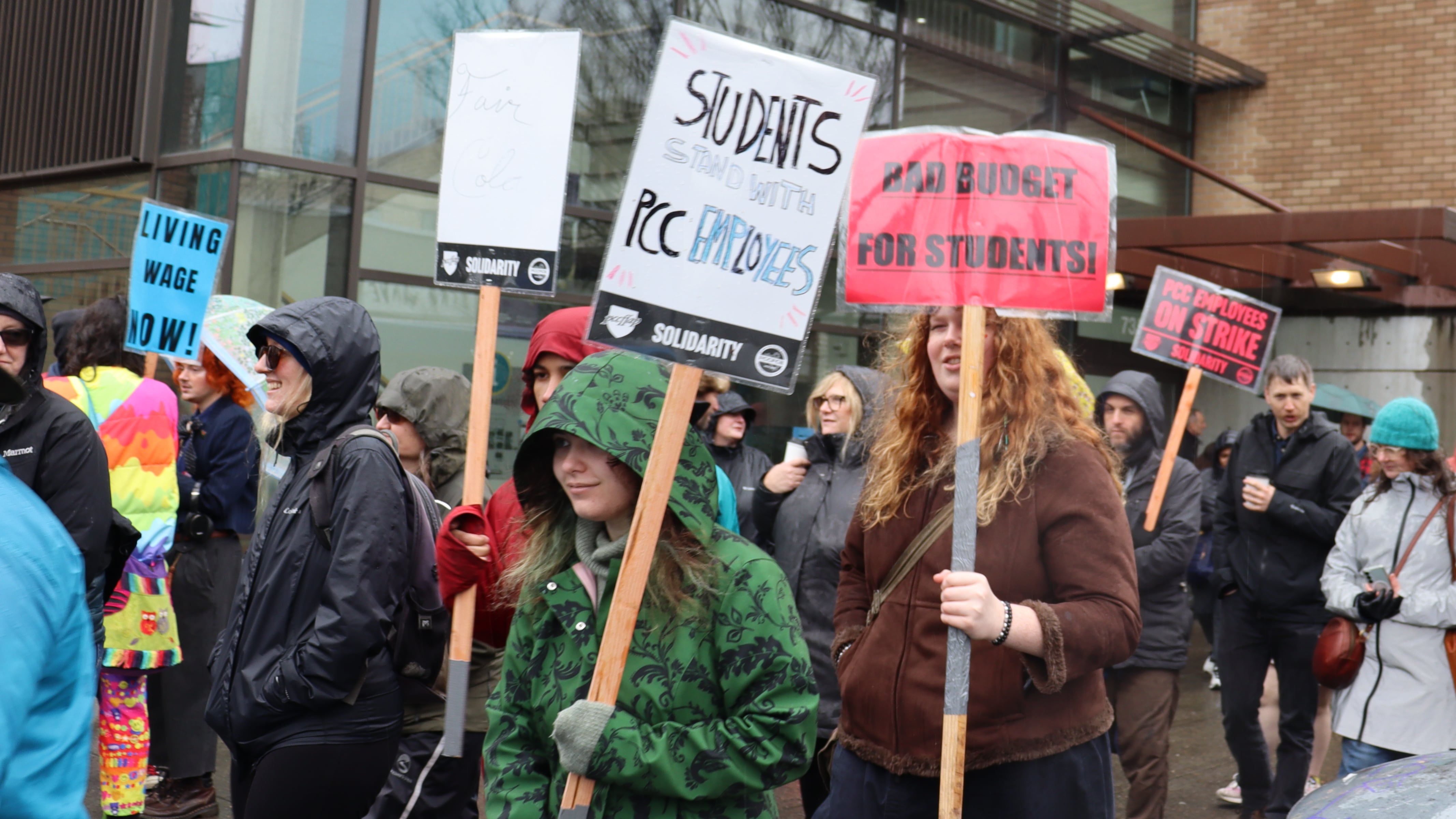
Two of Portland Community College’s largest unions went on strike on March 11, marking the first community college strikes in Oregon’s history.
Even though both unions have contracts that run from 2023–27, the strikes come after unions and the college couldn’t come to agreements in midterm reopener conversations around salary and benefits. The college’s Federation of Faculty and Academic Professionals, and Federation of Classified Employees, have both held out on the picket line largely over cost of living adjustments. Combined, the unions have about 2,300 members.
After long negotiations on Sunday and Monday, it appears the unions are in different places, even as both continue to hold the picket line. (Both had previously rejected PCC’s proposal of a no cost of living adjustment in the third year of their contracts, and a 4% adjustment in the fourth year.)
PCCFFAP executive vice president Michelle DuBarry says the faculty union has made little progress at the negotiations table, most recently floating a 2.75% cost of living adjustment both years, on the condition that the college open up negotiations around other topics not covered by a classic reopener. Those include topics including finding a solution to opening more classes for students (some classes currently rack up waitlists), and taking a more in-depth look at the planned closure of PCC’s music and sonic arts program.
Meanwhile, Justin Eslinger, contract action team chair with PCCFCE, says his union might be close to a deal. “Management started treating both unions very differently” on Monday, he said.
PCCFCE proposed no cost of living adjustment in the third year, and a 5% adjustment in the second year, alongside a $2,750 lump sum payment per person after ratification, among other benefits. Eslinger told WW Tuesday evening that management notified PCCFCE on Tuesday that it would respond to the latest offer Wednesday morning.
Eslinger said he was at best, “cautiously optimistic” that this could be the beginning of the end for the PCCFCE strike.
“We’re under a huge amount of pressure from our members to keep bargaining,” DuBarry says. “We want our wages to keep up with the cost of living, and anything less than that is just going to be really hard for our members to accept.”
Meanwhile, one PCC board member has taken his concerns public. Kien Truong wrote on social media on Monday that he thought the college was not considering its current context as it looks to dramatically increase its reserves. He added that the college was in a better financial position than many of its counterparts, noting rising enrollment and that the legislature had not cut from the higher education budget in the short session. (Truong previously had sent two letters to fellow board members and PCC president Dr. Adrien Bennings, one on Feb. 27 and another on March 11, outlining similar concerns.)
“In my view, the financial crisis framing does not match PCC’s reality, and we owe our community an honest conversation grounded in actual numbers,” Truong wrote on social media.
In a statement, PCC spokeswoman Khylie Gardner told WW the college needs to make responsible decisions to protect its current and future operations, noting that last year, PCC spent $26 million more than its revenues. Gardner added enrollment gains post-college have been modest.
The college’s latest offers, posted to its bargaining website, offer both unions no cost of living increase in the third year, and a 4.25% increase to FFAP and 4.5% increase to FCE in the fourth year, among other negotiated benefits.
“PCC administration is working to balance fair, dignified compensation for employees with the reality that PCC cannot commit to ongoing costs it cannot sustain,” she wrote. “The College is committed to reaching an agreement that allows students to return to the classroom and continue their learning as soon as possible.”
Negotiations are slated to begin again Wednesday morning.