Skip to main content
On March 10, Portland Public Schools officially kicked off one of the most emotionally fraught conversations a district can have: deciding which schools to close.
By next winter, the school district intends to select up to 10 schools for closure across its elementary, K–8, middle and alternative levels. The district currently has 45 elementary schools, 11 K–8s, 15 middle schools and 3 alternative schools. That means the district could close about 1 in 7 schools serving kindergarten through eighth grade.
If all goes to plan, the district says those closures will take effect at the start of the 2027–28 school year.
PPS is trying to get the school closure process right, with the hope it can become a model for other districts across the country. The alternative—botching school closures—has played out in cities from San Francisco to Chicago. Fallout has fractured neighborhoods, upended school boards, and driven out top school district officials. That dynamic is something district leaders, from Superintendent Dr. Kimberlee Armstrong on down, are keenly aware of.
“I do want to acknowledge that this conversation about right sizing is going to be difficult. We are talking about communities who are completely invested in their schools,” Dr. Jon Franco, the district’s senior chief of operations, said at a March 10 School Board meeting. “We do not take this lightly. We will proceed with the care and with the transparency that our families deserve.”
But as districts nationwide struggle with declining enrollment and budget crises, many are turning to school closures as one way to get more out of their limited resources. Their experiences offer some insight into what Portland families can expect. Here are four questions about the process that WW has tried to answer:
1. Why does Portland Public Schools need to consider school closures?
Like districts nationwide, PPS has struggled with declining enrollment that worsened with the COVID-19 pandemic. The district’s enrollment peaked in the 2018–19 school year, but has declined 12% since then, from 48,708 that year to 42,622 this year. That’s much faster than declining enrollment nationwide, which fell about 2.5% between 2019 and 2023. But it’s on pace with many urban districts seeing steeper enrollment declines. For example, Los Angeles Unified posted a 13% decline in those years, education website The 74 reported.
Enrollment forecasts PPS conducts in conjunction with Portland State University’s Population Research Center don’t offer any good news, either: The latest forecasts based on 2024–25 enrollment data project 37,057 students enrolled in the district by 2034–35, another 13% decline.
The district has been engaged in an enrollment campaign that it hopes will turn the tide—and it’s enrolling more kindergartners this year for the first time since 2012–13. But that glimmer of optimism doesn’t change the fact that the state of Oregon allocates funding to school districts based on how many students enroll in them.
School Board Chair Eddie Wang says school closures are always difficult, but he feels the public recognizes these are hard times.
“We literally have 6,000 students less than we did in 2018,” Wang says. “That’s three high schools’ worth. That’s, like, 30 elementary schools’ worth.”
PPS’s school staffing formula also relies heavily on enrollment and student need. In turn, schools with higher enrollment numbers tend to be able to offer more programming.
And those enrollment numbers range vastly. The district’s largest elementary school, Ainsworth, enrolls 560 students, while Rosa Parks Elementary enrolls 160. Laurelhurst K–8 (610 students) has nearly three times as many pupils as Skyline K-8 (207). And Jackson Middle School reported 689 students this academic year, while George Middle School enrolls 358.
“PPS has a duty to provide both the physical and programmatic infrastructure to support a rigorous, well-rounded curriculum with opportunities like the performing arts,” board member Virginia La Forte says. “To make any of this possible, we need more students learning together in the buildings we operate. As we navigate a very difficult budget, we have to be intentional and efficient by maximizing every dollar for every student.”
2. What criteria might the district consider when deciding which schools to close?
The district is in the early stages of gathering feedback from the Portland School Board, whose input will inform how the district broaches its strategy for school closures.
There are endless factors to weigh when considering which schools to place on the chopping block, from transportation to student outcomes. The stakes are high: National research has found that school closures can result in negative academic outcomes for the kids they affect. Here are some of the big considerations:
Deferred maintenance, and the condition of buildings across PPS’s aging portfolio, could play a role. “If there are buildings that we should just not be investing any more money in, then that would be to me a good building to consider letting go of,” School Board member Christy Splitt said at a meeting March 12.
School enrollment is a factor as well. PPS will not only have to consider the schools with low enrollment right now, but also how merging school buildings might affect enrollment later on. Board member Stephanie Engelsman has used Bridger Creative Science School as an example of unintended consequences. The two schools that merged into Bridger in 2022–23 then had a combined enrollment of 752, but the merged elementary school now stands at 446.
The district, board members agreed, must engage families who don’t always show up in force to meetings, and try to level the playing field for historically ignored groups. “This is a process that the entire PPS family should bear the brunt of and be part of and be engaged in,” said Michelle DePass, the board’s vice chair.
PPS might also consider what a school’s neighborhood will look like in coming years. If a neighborhood sees more affordable family housing built there in the next decade, that neighborhood is more likely to attract families with kids than a neighborhood where the population is aging and homeowners live in empty nests.
“There are lots of questions I know you all see all across Portland,” Armstrong told reporters March 10. “We have new housing going up, multifamily housing units. Where are those being constructed, and will that impact enrollment?”
3. Which schools are up for consideration?
School Board members widely agree that the district should consolidate schools in one fell swoop, instead of quadrant by quadrant. The early consensus is that PPS should consider every school—from underenrolled ones to popular magnets—in the process.
Wang, the board chair, says past district decisions to exclude overenrolled, popular schools from consolidation equations effectively left PPS reshuffling a bunch of “already dangerously underenrolled schools.”
“The basis of having everything on the table is already the start of equity in the process,” Wang says. “And the fact that we’re not just going to be centering our focus on just the lowest-enrolled schools, which often happens toward lower socioeconomic status schools.”
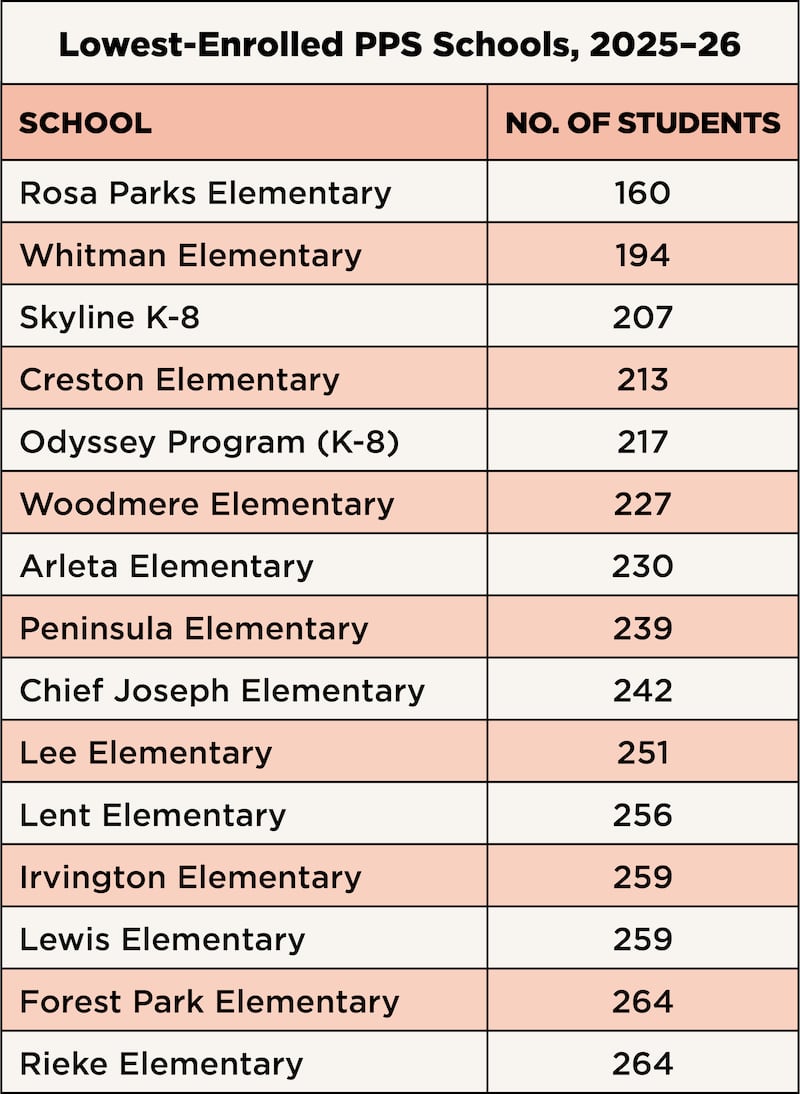
Many of PPS’s 15 lowest-enrolled schools are on the outskirts of Portland, and about half have Title I status. WW has compiled a list of them, the majority of which are elementary schools (see table below).
The district has engaged a consulting firm to help guide its decisions, as reported by The Oregonian. The firm, Racially Just Schools Evaluation Group, specializes in helping school leaders make tough decisions about school closures. “You’re asked to make decisions that are financially responsible, politically defensible, and morally sound. All at once,” its website reads. “Most districts don’t fail because they lack values. They struggle because they lack a clear, defensible decision pathway.”
Portland has another complicating factor that a city like Chicago doesn’t: earthquakes.
As PPS has pursued seismic retrofits with money from the 2025 school bond, it used enrollment projections for the next three years and prioritized schools with enrollment thresholds over 300 students for seismic improvements. Top officials at PPS told board members that doesn’t mean schools that failed to make the list will close, but it remains a concern for many school advocates. What’s more, PPS officials have assured the School Board that schools they selected for retrofits this round would avert closure—meaning up to nine schools of the 74 candidates are presumably safe.
Franco tells WW the district has “procured a pool of design and engineering contractors for seismic work that are flexible.” Those contractors can be reassigned to different schools as closure and seismic prioritization conversations develop, he says.
Whether the district should maintain its K–8s will also be a hot topic for discussion. At least a couple of board members have raised an interest in breaking up the remaining K–8s into elementary and middle schools. A long-standing debate has asked whether students who attend K–8s get less resources than their counterparts who opt for elementary and middle schools, given how resources might be distributed.
4. How much money could school closures save PPS? And if not money, what are the benefits?
The data on how much money school closures can save a district is mixed. For many experts, it boils down to how many staff might be let go in the process of closing schools. Dr. Marguerite Roza with the Edunomics Lab at Georgetown University told reporters last February that the bulk of money saved comes from reducing personnel costs, which make up the bulk of district budgets.
PPS, for its part, is not banking on saving much money from closing schools. Superintendent Dr. Kimberlee Armstrong told reporters March 10 that the district doesn’t anticipate saving millions with these tough conversations. (The district faces a $50 million budget deficit in the coming school year that it anticipates will grow.)
Roza says savings can happen gradually. “You don’t lay off people all at once, but what you might do is close a school and then take the principal from that closed school and use them to fill the spot of a principal at another school that was leaving anyway,” she says. “What you’ve done is saved yourself from spending more on hiring that new principal. That’s how those savings work.”
But there are soft perks to closing schools too. Experts tell WW the consequences of having an endless stream of buildings means school districts end up having to spread their resources more thinly across them all. With fewer buildings, there’s more opportunity to concentrate resources for students.
Closing schools presents “the opportunity to optimize school communities and make sure our schools are well resourced,” Armstrong said, “and that we’re able to provide things for all of our schools in a way that responds to the needs of the students.”