Skip to main content
Time is money, the saying goes. But at Portland Public Schools, the inverse is true: Money is time.
Specifically, time in the classroom. When the district needed to save $22.5 million, it reached an agreement with the Portland Association of Teachers for four furlough days. The result? A short school year for the district’s 42,000 students gets shorter by three instructional days.
The furlough days are just the latest blow to many PPS families, who must each year navigate a complex calendar where only 18 of the 37 school weeks are full ones—meaning kids are in school, uninterrupted, for five straight days. (This varies between grade levels, but is true for most K–8 students). Parents have come up with various names to describe the parts of the year when students are out almost as often as they are in, like “No School November.”
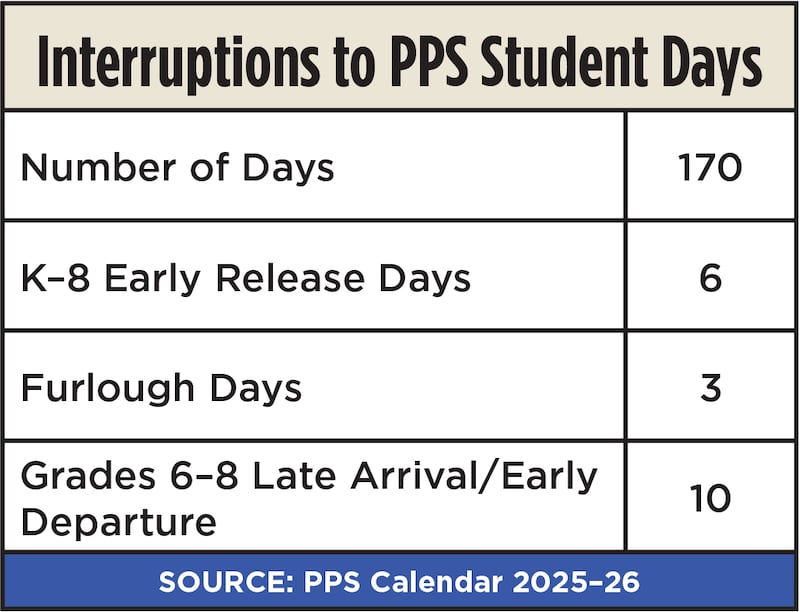
The extra furlough days mean PPS will let out on June 5, instead of on June 9 as originally planned. Students will also miss out on May 1, previously a regular instructional day. The upshot is that the school year shrinks from 170 days to 167.
The furlough days help PPS patch a $22.5 million budget hole it discovered midyear. To bridge that gap, PPS identified about $10.5 million in savings by placing controls on discretionary spending, its chief financial officer said. The rest of the money it saved by furloughing employees, including teachers. Each furlough day will save PPS about $3 million.
PPS Superintendent Dr. Kimberlee Armstrong told the School Board on March 31 that furlough days—and cutting instructional time for students—is “the worst-case scenario and thing that districts look to do last.” There’s a bigger story in that statement worth addressing.
On average, Oregon’s students have the nation’s third-shortest school year, says Sarah Pope, executive director of Stand for Children Oregon. (The education advocacy organization has been engaged in a study with ECOnorthwest around short school years, chronic absenteeism, and student performance.) That’s before any additional furlough-related reductions. Pope says PPS has a relatively high number of days compared with the Oregon average of 165, but furloughs will inch it toward that average. The average school year nationwide is about 180 days, according to an analysis by the Pew Research Center in 2023.
“If a child starts kindergarten in Oregon and then finishes in 12th grade, they’re on average already going to be a year behind the rest of the country just in terms of time in school,” Pope says.
Other observers lodge concerns that the number of interruptions to PPS’s 170 school days—in the form of early release days (when students take close to half the day off) and four-day weeks with a day reserved for professional development—further harm the learning experience.
The furlough agreement seems to take into account the need to recover as much instructional time as possible. Two previous early release days, April 22 and May 13, were converted into full instructional days under the agreement.
Candice Grose, chief of communications for PPS, says the instructional calendar is aligned to the district’s agreement with PAT.
“Days that include early release, late start, or professional development are intentionally built into the calendar to support teacher planning, collaboration, and training—time that directly strengthens classroom instruction and student oucomes,” Grose says.
Pope says there might be a link between interrupted school weeks and chronic absenteeism, something Stand is curious to explore. Anecdotally, she says she’s heard from many parents and educators that the inconsistency is “very, very challenging” for attendance.
But the thought of adding more days to patch Oregon’s long-standing short school years is often unappealing to districts facing budget cuts.
Grose says each day of school represents about 0.5% of a licensed educator’s salary. “There is a direct relationship between school days and funding,” she says.
Pope says it’s worth exploring how different districts have been able to use state funds to bankroll school years of varying lengths. And she says the state must share the blame for short school years. Oregon, she says, should be holding school districts to higher standards around instructional time. (The state requires a minimum of 900 instructional hours a year for grades K–8, 990 for grades 9–11, and 966 for grade 12.)
“The state doesn’t have a really strong and high requirement around time spent in school, and it’s also very flexible,” Pope says. “It’s just that our requirement is so low and there doesn’t seem to be any repercussions for dropping below it.”