Skip to main content
Portland Public Schools Superintendent Dr. Kimberlee Armstrong startled parents and teachers Wednesday by disclosing that the district intends to close between 10 and 20 schools. That number was much higher than estimates in spring, when PPS anticipated shuttering between five and 10 buildings.
It’s the latest alarming news from a school district that is gradually revealing its school closure plan. The ultimate goal of what’s sure to be a contentious process is that the schools that remain have strong resources.
The district’s rationale: Currently, its portfolio of 45 elementary schools, 15 middle schools and 11 K-8 schools spreads available resources thin. Condensing them could allow for more opportunities at each school.
Two charts that officials will present to the Portland School Board on Tuesday show just how big of a lift that will be. The two charts offer one explanation of why Armstrong increased the closure estimate this week.
The district is trying to ensure schools are well resourced by the standards set in the state’s Quality Education Model. The QEM crafts prototypes of elementary and middle schools that allow students access to core enrichment services like librarians, art teachers, and counselors. It sets thresholds for those resources at 360 students per elementary school, and 500 students per middle school.
The charts show how many elementary and middle schools would be above their respective thresholds in the 2031–32 school year depending on how many schools PPS chooses to close.
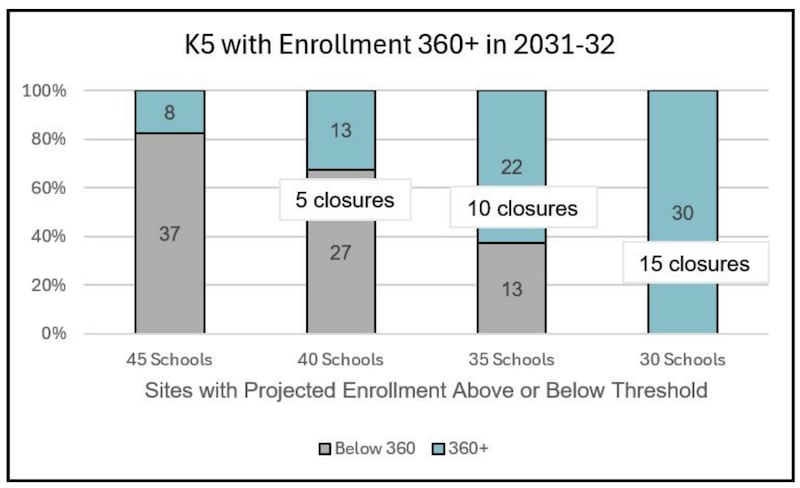
At the elementary level, the PPS model shows that 15 closures—or a third of elementary schools—would ensure that the remaining 30 would enroll 360 or more students each. Fewer closures would result in different breakdowns of schools at threshold. For example, if the district opted to close five elementary schools, 13 of the 40 remaining schools be above 360 students and 27 would not.
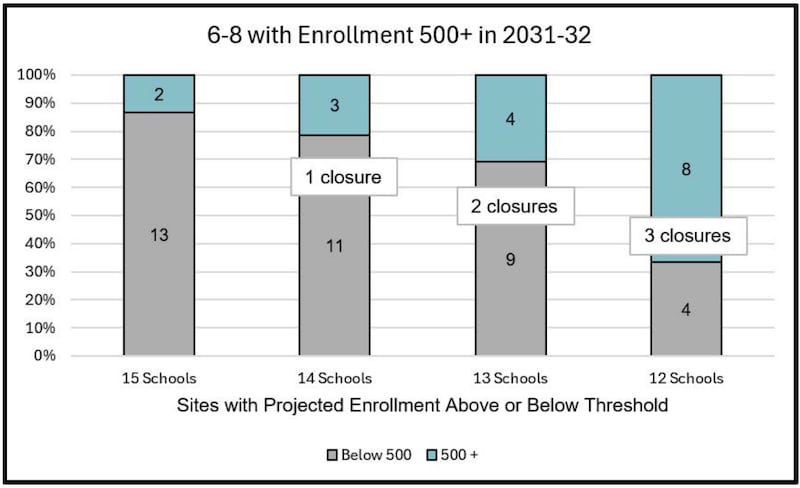
At the middle school level, the district’s early analysis does not present a scenario in which all middle schools would be above 500. But it does show that with three closures, eight of the 12 remaining middle schools would enroll more than 500 students and four would fall under the threshold.
For context, just 27% of elementary schools in 2025–26 were above 360 students, and 40% of middle schools were above 500 students, according to a separate district presentation in August.
Those numbers are expected to get worse as PPS enrollment continues to erode. In August, officials said that if the status quo remained by the 2031–32 school year, just 18% of elementary schools would serve more than 360 students. Middle schools would see the most dramatic drop-off. Just 13% of them, or two schools, would hit the 500-student threshold by that academic year. That’s in part because PPS is seeing the enrollment loss it experienced during the pandemic, largely in younger grades, extend through its system.
The district will ask the School Board on Tuesday for input on how many changes it needs to stabilize the system.
In a slide showing what would happen if the district chose not to act now, district officials wrote that in five years: “The vast majority of schools across the system serving elementary and middle school age students will be susceptible to enrollment fluctuations resulting in varied student experiences with staff and resources spread thin.”