Skip to main content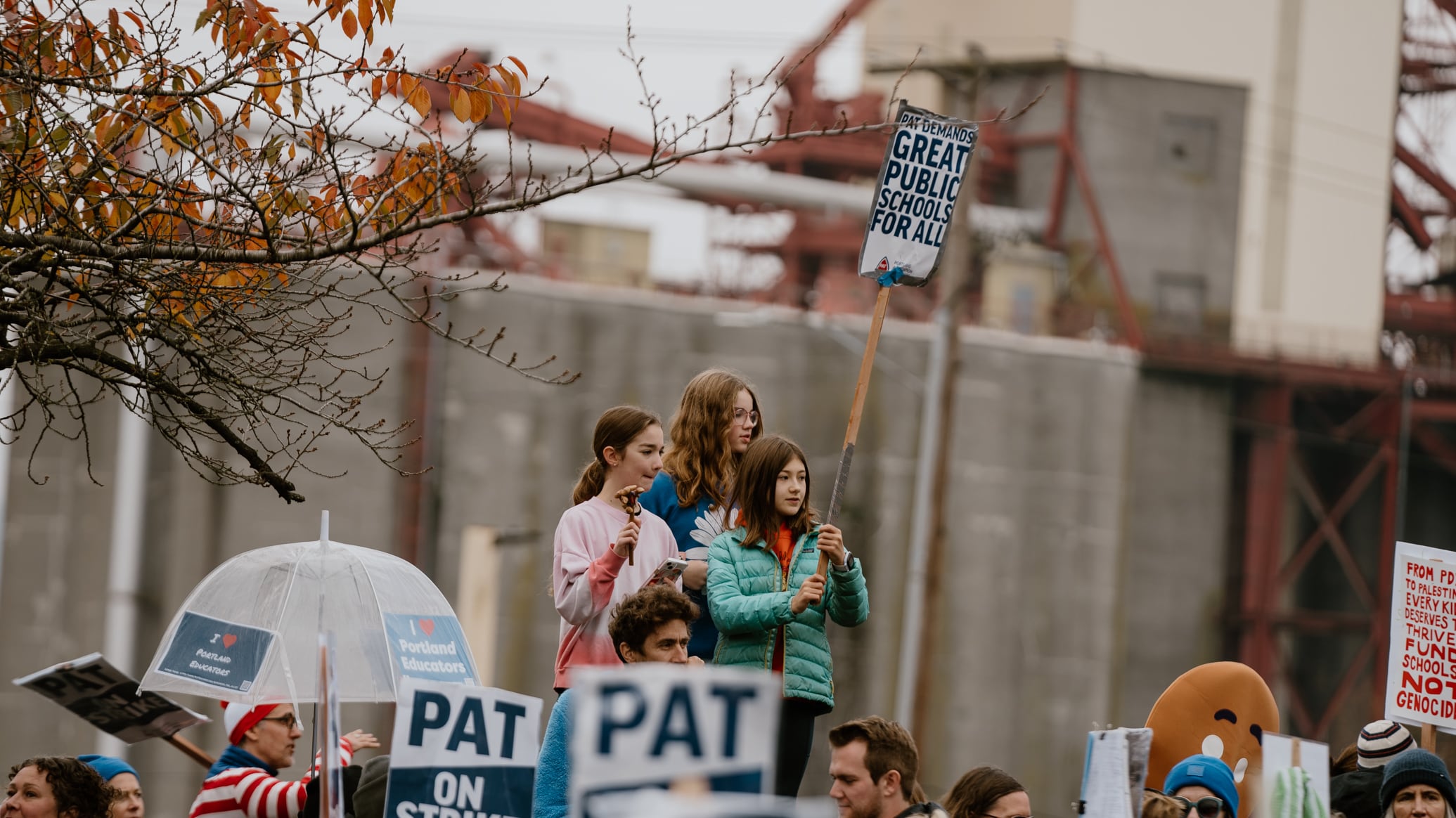
Most of the seats in the Grant High School auditorium were empty when the Portland School Board met Sept. 1. But the first two rows of seats were blue.
That color glowed from the union T-shirts worn by members of the Portland Association of Teachers, solemn as they looked up at the seven-member board. Several clutched signs reading “Protect our students, protect our public schools.” And one thing was abundantly clear: PAT’s leadership was furious.
In the immediate, their anger was directed at a contract extension for Portland Public Schools Superintendent Dr. Kimberlee Armstrong, whose updated compensation package includes a pay increase largely in the form of a retention bonus that kicks in if Armstrong completes four years with the district.
But as PAT president Alisha Chavez took to the stage to protest the superintendent’s contract, she also took a portion of her remarks to slam something else: school closures.
“Educators are being told every day: Take furloughs, volunteer your time constantly, accept layoffs, take more students, take bigger classes, do more with less,” Chavez said in the opening lines of her public comments. “And now we’re supposed to accept that closing schools is somehow part of the solution.”
On Aug. 26, the first day of school, Armstrong took school communities and educators by surprise as she revealed the district would look to close 10 to 20 of its elementary, K-8 and middle schools, double the five to 10 she’d estimated in spring. Models the district has released in the week since show numbers in that range are necessary for the remaining schools to meet thresholds for robust programming.
In its messaging around school closures, one of the most contentious processes a district can face, the PPS administration likes to talk about such programming. Spreading limited resources among fewer schools means more courses, counseling and extracurriculars at each building.
That message may soothe some parents, although others will never get past the pain of losing a neighborhood school. It is not so comforting to the teachers union, which sees another reality: In “rightsizing” the district to match declining enrollment, PPS is poised to cut a whole lot of jobs.
The bulk of the district’s budget pays for personnel, including thousands of workers in unions that represent bus drivers, paraeducators, and teachers. The district has largely retained its educators even as enrollment has fallen and is projected to continue falling for the foreseeable future. For the 2017–18 school year, PPS reported to the Oregon Department of Education that it employed 2,731 teachers for 47,908 enrolled students. In the 2024–25 academic year, it employed 2,701 educators—30 fewer—for 42,785 students.
In other words, as enrollment declined by more than 10%, the number of teachers declined by just over 1%.
With the district facing a $65.2 million budget “reset” in the coming year—a process that PPS hopes sets a new ongoing baseline—closing schools offers a chance to change that ratio. And PAT has grown increasingly vocal about its fear district leaders will use the consolidation process as a way to streamline layoffs—leaving more work for those left behind.
“You cannot close schools without increasing the pressure on the schools that remain,” union president Chavez told the School Board on Sept. 1. “The educators who remain that weren’t laid off in the process are expected to somehow make it work.”
A teacher rebellion would add a fraught dynamic to the already difficult task of school closures. At a time when PPS is in financial peril, Chavez told the School Board it was up to everyone to make shared sacrifices. With contract negotiations slated to begin in January, Chavez told board members PAT wouldn’t forget their willingness to close neighborhood schools while greenlighting Armstrong’s contract.
“Don’t tell us that the districts can’t afford meaningful investments in educators while approving significant increases at the top,” she said. “We will remember the choices you make when we sit across the bargaining table from you all, because educators deserve to know: Will the same standard apply to us?”
If school closures are to be paired with teacher layoffs, the district isn’t saying so.
District spokeswoman Valerie Feder says PPS does not anticipate school closures will realize “significant net savings in the short term.” She did not offer specifics as to where PPS expects to save money by closing schools or how much.
“There will be some savings in operating costs when we close a site,” Feder says. “A portion of the savings will be reinvested to support the implementation of the transition of students to the new building. These plans will be developed as we work through the process and with input from students, families and educators.”
Indeed, research indicates school closures don’t save much money in the short term, says Carrie Hahnel, a partner at Bellwether, an education consulting firm. In her position, Hahnel has closely examined public school districts struggling with declining enrollment, including those that have turned to closures.
Hahnel says where school closures begin to save is in the long term. Research shows consolidations do save money, largely because districts end up spending less money on personnel. For example: If a school closes, the principal’s job is often in jeopardy.
Personnel consolidations put unions in a bind, Hahnel says. That’s because the process pits two of the union’s key goals directly against each other: retaining members and ensuring good working conditions for them. “Publicly, the only position that they can truly take is anti-closure,” she says of unions. “They want to protect their staff and they want to prevent layoffs.”
Simultaneously, if a district achieves its goals around closures, Hahnel says the results can be better for the employees who remain.
“A district that is financially stable is in the best interest of the union. It creates less uncertainty for teachers in their jobs. It makes it possible to enter into contract negotiations and be able to secure increases to have health care funded,” Hahnel says. “Those two things are at odds when you’re going through a closure process.”
Chavez tells WW she worries about the effects that displacement of school administrators will have for PAT’s members. State law allows administrators who worked at PPS as educators to retain their status and seniority as contract teachers, which Chavez worries will displace newer teachers.
And she says she’s hearing lots of concern among union members that a contentious school closure process with poor follow-through could accelerate the exodus of students from PPS.
“If we close 20 schools, how many more students are we going to lose?” she says. “I don’t know if it’s going to backfire, and then we’re going to be even more unenrolled than what was predicted.”
Lisa Relou was part of the administrative cabinet at Jefferson County Public Schools in the suburbs of Denver, which recently closed more than 20 schools over two academic years as it stared down many of the same pressures as PPS, including rapidly declining enrollment. Relou, who now works as a consultant advising districts on closures, says consolidations have saved the Colorado district about $20 million a year and allowed students more opportunnities.
Relou says in order to retain families and have productive relationships with unions, districts must bring people along for conversations about school closure as they go and clearly spell out goals. Districts can build trust with educators if they communicate implementation plans—including which personnel might be affected when schools close—even ahead of public recommendations. And she’s seen others make short-term commitments to keep staff and initiate attrition processes to motivate early retirements, sparing newer teachers.
That’s a delicate balancing act for districts that shouldn’t “take away from obviously what they’re trying to achieve, which is more fiscal responsibility with and matching their costs with the revenue that they have,” she says.
But aside from an advisory board that PPS has convened, Chavez says, the district has so far not engaged educators much in the closure process. (District officials have publicly stated they intend to in fall.) And Chavez says PAT will put pressure on the Portland School Board—the bulk of whose campaigns the union endorsed and bankrolled—to seek savings everywhere else before turning to closures.
“I hope that the School Board is coming to us to hear our perspective on how school closures and consolidations are going to directly affect our units and our students and our families,” Chavez says. “I hope that they’re not just listening to district admin…and that they’re not just rubber stamping something as big as this.”
The union said this spring that it planned to recruit new candidates for the Portland School Board. It’s likely that most—if not all—of the four School Board members up for reelection in spring 2027 will choose not to run again.
And while the majority of the School Board on Sept. 1 directed Armstrong to push forward with the school closure process, it was clear that pushback from parents and teachers had already dampened the enthusiasm of a handful of members. One such member, Christy Splitt, said she was more skeptical than she had been at the beginning of the process.
“I really want to make sure we’re hearing from our teacher voices, and I’m getting the sense that we’ll probably hear that teacher voices and family voices are concerned about the magnitude of change,” Splitt said. “I think we probably do need to close some schools, but [to close] one quarter of the schools just really shook me and really changed my perspective.”