Skip to main content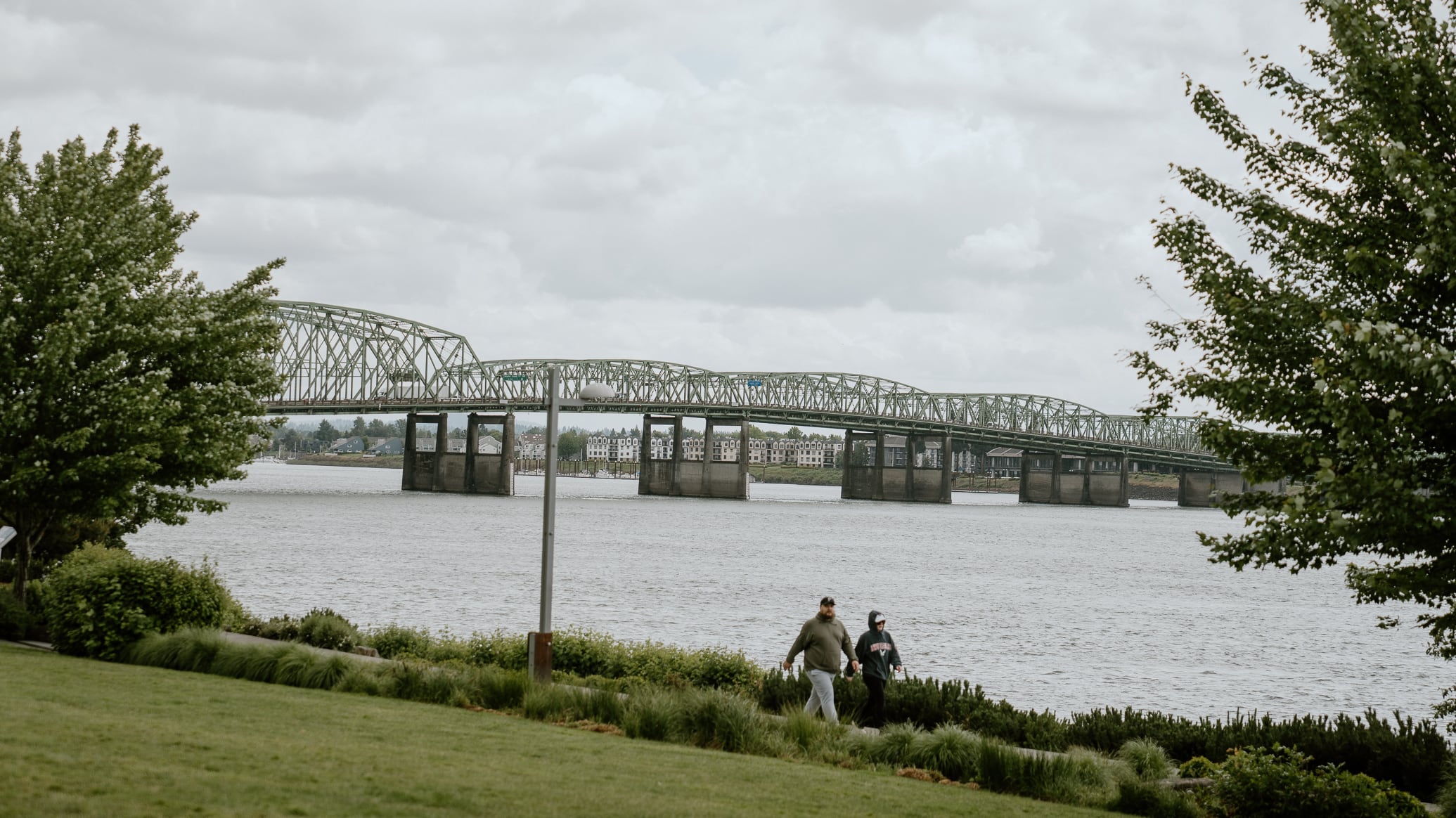
This story was produced by the Oregon Journalism Project, a nonprofit newsroom covering the state.
The Interstate Bridge Replacement Program released an official estimate Tuesday of the updated cost of replacing the span between Oregon and Washington, stretching light rail to Vancouver, and reworking 5 miles of freeway ramps on either side of the bridge: $14.4 billion.
That cost is so high that the governors of both states have abandoned their goal of redoing the entire 5-mile stretch of Interstate 5 from North Portland to Vancouver.
In remarks released with the new cost estimate, Gov. Tina Kotek and Washington Gov. Bob Ferguson proposed to do the work piecemeal, focusing only on a new bridge (with light rail) and leaving the highway fixes for later.
“We need a new bridge and it’s time to start building it,” Kotek said. “By focusing our available funding on a core set of projects, we can deliver what Oregonians have been waiting on for decades: a modern, earthquake-ready bridge, with no bridge lifts, less traffic congestion, extended light rail, and better options for people walking and biking. At my direction, the Oregon Department of Transportation will focus on protecting Oregon taxpayers by making sure this critical project is delivered as efficiently as possible.”
The new price tag of $14.4 billion for the whole project is a massive increase from the last official estimate of $6 billion released in 2022, and it’s even a jump from a draft estimate OJP published in January of $13.6 billion.
At that time, lawmakers from both Oregon and Washington expressed anger that project staff had withheld information from the public and a bistate legislative oversight committee about potentially far higher costs. It now appears those concerns were well placed.
“I was truly shocked by the updated price tag this past January that leadership had hidden from the public,” said state Sen. Khanh Pham (D-Portland), co-chair of the Joint Committee on Transportation. “I hope today’s decision marks a turning point in the IBR project in which the agencies acknowledge the financial realities of our state budgets and the imperative to curb excessive megaproject spending to preserve funding for core functions of our transportation system.”
In a March 17 news release, project staff attributed the new, higher costs to several factors: a more complete, detailed design, which considers more than 400 risk factors; a longer timeline, which extends the project completion date from 2034 to 2045; and an escalation of construction costs of 58%.
“The estimated cost to build the five-mile corridor is $13.5 billion to $15.2 billion with a likely cost of $14.4 billion,” project staff wrote in the cost estimate. “The updated cost estimate reflects national trends of significant cost increases driven by inflation and market conditions leading to higher construction bids.”
That’s a big problem for Oregon and Washington, which both face budget challenges. Beyond the looming reductions in federal funding that both states anticipate, Oregon is also grappling with a slow-rolling funding crisis at the Oregon Department of Transportation.
Meanwhile, the IBR project currently counts just $5.5 billion in committed state and federal funding, leaving a yawning gap between what the states have and the cost of what they want to build.
Instead of focusing on that funding gap, project staff and state leaders would like to redirect the public’s focus to a portion of the job—simply building a new bridge that includes light rail.
That cost: an estimated $7.5 billion.
Pham, who has consistently raised questions about the project, is cautiously optimistic that leaders realize they can afford only part of the proposed work.
“Oregon is already struggling to invest in the most basic maintenance and preservation of our statewide coastal bridges, mountain passes and local streets,” she said. “It’s imperative that policymakers in both states continue to push back against an oversized, bloated project and demand that ODOT propose and deliver a right-sized bridge with a right-sized budget that doesn’t bankrupt our state.”
But Portland economist Joe Cortright, whose public records requests have consistently offered insight into the troubled project, said the new strategy is an act of bait and switch.
“The high-level bridge requires elevated freeways on both the Oregon and Washington sides of the river, with new interchanges elevated high into the air to reach the new roadway,” Cortright wrote in commentary on the website City Observatory. “ODOT & WSDOT have intentionally designed this so once you start, you must build everything. The reality is they’ll never stop with Phase I; start construction and you’re signing up for $15 billion and 20 years of construction hell.”