Skip to main content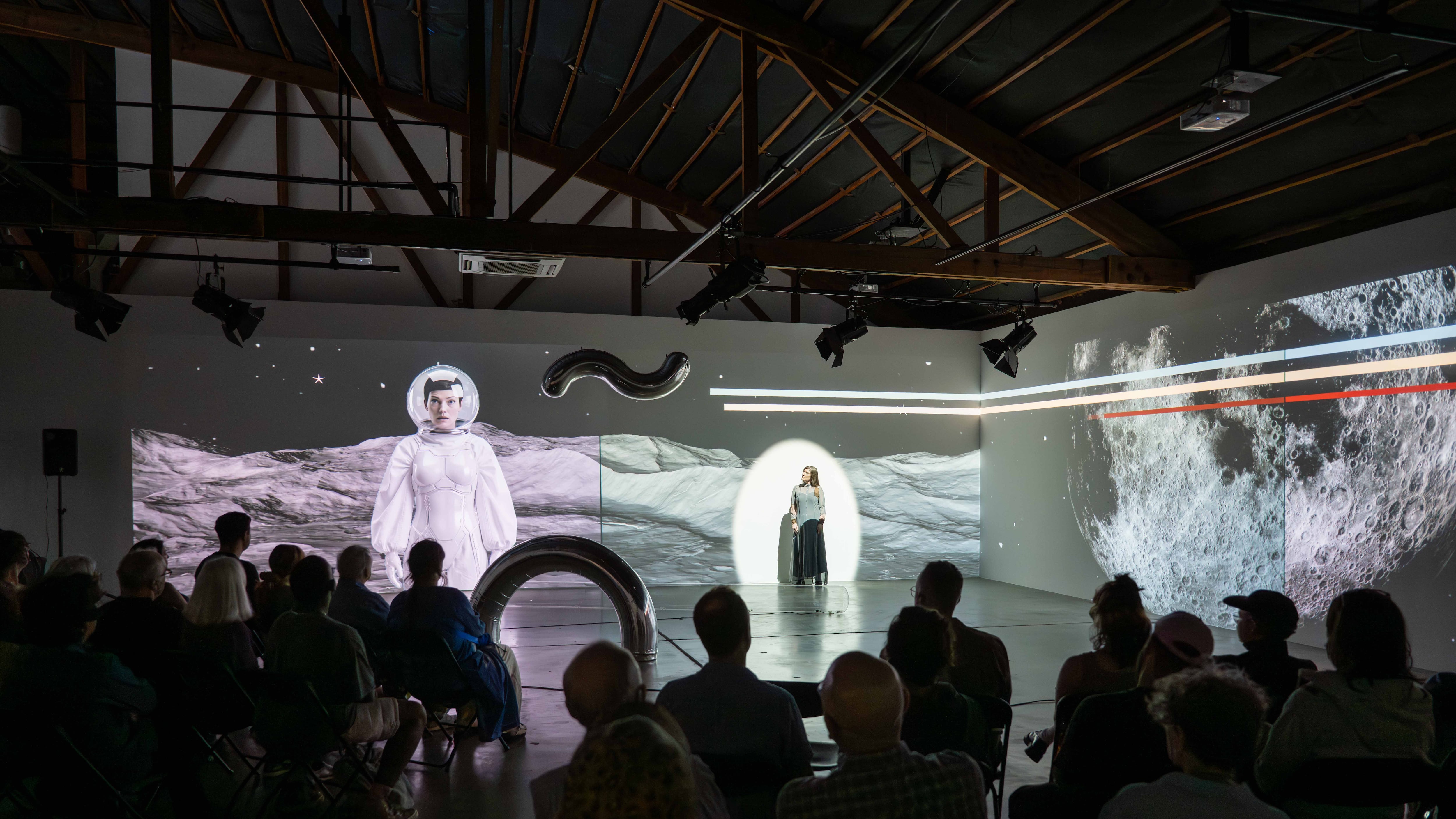
Reading groups are en vogue. Kaia Gerber, Dua Lipa and RuPaul host public book clubs. Silent book clubs—that’s where you read together in public—have sprung up worldwide. Designers like Miu Miu and Chanel are hosting literary salons. And, of course, there’s BookTok.
It’s not so much that books have caught the zeitgeist—rather, gathering around books is the trend.
New York artist Amy Ruhl’s contribution to this year’s Converge 45 triennial, Other Spaces, which debuted Aug. 30 at Oregon Contemporary, grew out of one such reading group.
Other Spaces is both an installation and performance inspired by Ruhl’s own sci-fi reading group, which recently read Ursula K. Le Guin’s 1974 novel The Dispossessed and Trouble on Triton, the novel Samuel Delaney published as a kind of critique to Le Guin’s two years later.
The installation, which is on view through Oct. 4, doubled as the set for the performance. At the debut, a panoramic video projection filled several walls of the large gallery, broadcasting four different wall-sized images simultaneously: aura color clouds, natural landscapes and a handful of characters played by Ruhl herself. A few large inflated plastic sculptures—balloonlike doodles, squiggles and orbs—sat on the floor or hung from the rafters.
Both novels are set in supposed utopias, and both upset the common understanding of a utopia as a kind of paradise. The word literally translates from the original Greek to “no place,” or a place that can never be reached. Once our desires are fulfilled, that is, new ones will always emerge in their place.
Conceptually, Other Spaces grapples with similar questions. However, while it borrows from their settings and themes, Ruhl’s piece isn’t about either book. It too is about gathering around books.
Ruhl is an artist and filmmaker known for her close reading of feminist and speculative fiction and fantasy texts, which she transposes into video art, plays and multimedia installations that have been exhibited extensively across the United States and U.K.
Though a working knowledge of The Dispossessed and/or Triton would help a viewer pick out direct references, Ruhl’s props and videos also lean heavily on signs anyone living in 2026 can recognize: what you might call woo-woo therapeutic aesthetics, which of course come with their own utopian undertones. It’s in this way that Other Worlds truly takes off from the two books, placing them visually in conversation with the present.
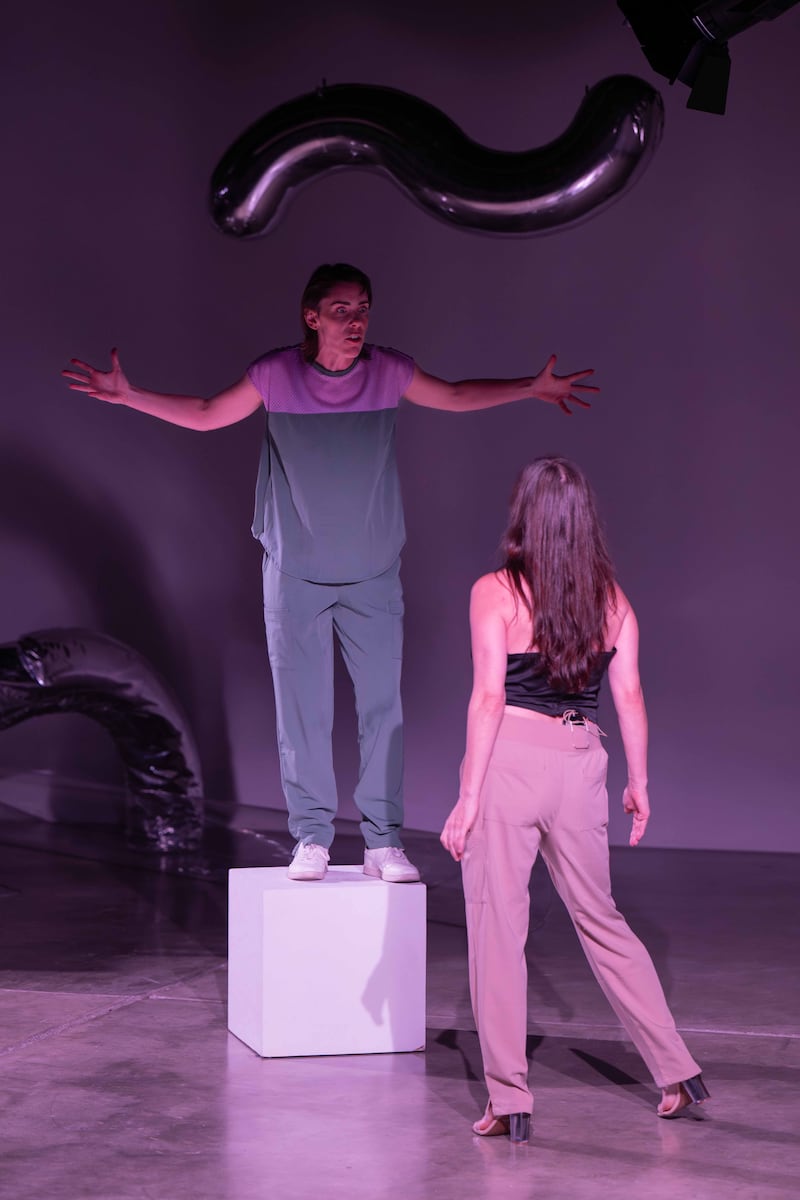
The performance, which combined dance sequences, monologues and scene acting, was crafted from the ephemera of Ruhl’s reading group—snippets of sentences, half-baked ideas, passages of intrigue.
“I mined the transcripts of our conversations for words or phrases that glimmered on the page—phrases that I could abstract, combine, and expand upon,” Ruhl wrote in an email to WW. “The process is very collage-based.”
By giving a lasting shape to what is usually fleeting, the performance begins to suggest, if not an answer to why reading groups have become so popular in recent years, at least an example of what gathering around a specific text might “do.”
Utopian prospects are certainly still relevant today, still worth reading and talking about. There was no Goop in the ’70s. “Wellness” had yet to become a very expensive obsession. Yet Le Guin’s and Delaney’s stories have plenty of perspective to offer contemporary utopian ideals.
This method of connecting across timelines also speaks closely to the Converge 45 triennial’s title and theme, “Here, To you, Now,” which the triennial’s curator, Lumi Tan, borrowed from another Le Guin novel, Always Coming Home.
“The written word is there, for anyone, at any time,” Le Guin wrote in 1985. “It is general and potentially eternal. The spoken word is here, to you, now. It is ephemeral and irreproducible.”
It’s hard to imagine a better venue for transforming the former (a book, a “text” frozen in time, loaded with potential) into the latter (an engaged discussion, an active vehicle for change and perhaps growth) than a book club.
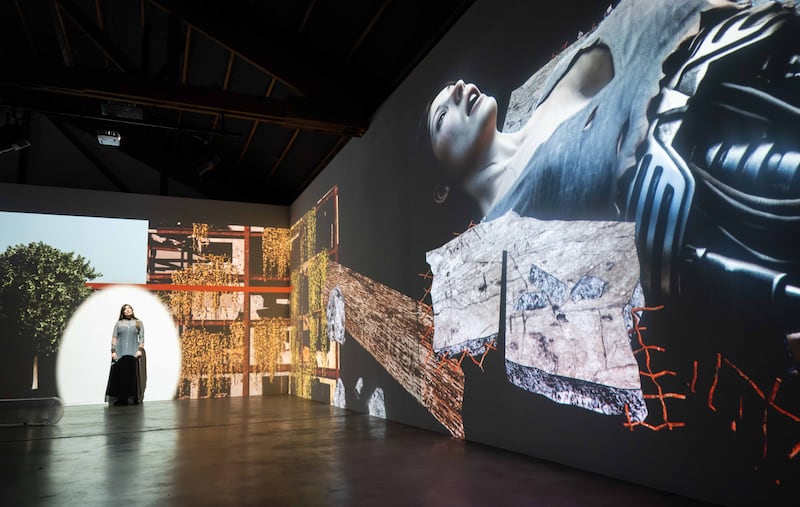
Other Spaces is set in a futuristic society that has been reconstructed around a fictional politics called the “Wellsprunt Movement.” Self-optimization, wellness and community living are its pillars. We learn about the norms and history of this society through an opening monologue delivered by a bardlike character, played by Ruhl, whose vocal tone and lilt mimic a virtual assistant like Siri.
Standing in front of a panorama of glitchy images of misty, mountainous landscapes and spiritual gurus (all avatars of Ruhl herself), Ruhl’s character introduces the movement’s slogans: “Teach your aura about ownership, and collect”; “There’s no goal other than your own construction.”
The society seems to fancy itself a utopia; its inhabitants’ needs are always met. But the cracks are everywhere. It plays like the satirical lovechild of biohacking, self-optimizing people like Bryan Johnson and New Age wellness figureheads like Gwyneth Paltrow.
Much of the performance is set in a corporatized rehabilitative institution, where defectors are sent to “get well” again. Choreographer Lu Yim plays one such defector. Alone in some sort of rehabilitative playroom, Yim’s character repeatedly asks for “directives” to prompt their movement. “Distort the architecture of your discomfort,” a disembodied voice instructs. “Keep the hurt moving until you can’t find it.” Yim dances as if molting an old skin, itchy and puppeteered.
The primary scene imagines the unwritten story of a minor character from The Dispossessed, Tirin, played by Sophia Cleary. Le Guin’s character is institutionalized after writing a taboo play. Ruhl expands the character into Tirin the rehabilitatee, who is instructed to therapeutically act out the play by a nurse attendee—a botlike woman played by Ruhl. Ruhl and Cleary skillfully manage this scene within a scene, moving between Tirin’s play and a meta discourse about the norms and rules of the Wellsprunt culture that Tirin rejects. And all of the sudden the show becomes a reading group.
SEE IT: Other Spaces by Amy Ruhl at Oregon Contemporary, 8371 N Interstate Ave., oregoncontemporary.org/converge-45-here-to-you-now. Noon–5 pm Wednesday–Saturday, through Oct. 4. Free.