Skip to main content
On paper, Portland seems a pretty logical choice to host the Women’s World Cup when it returns to the U.S. in 2031.
“Soccer City, USA” has a reputation as an epicenter of women’s sports. Its history spans the University of Portland teams of the 1990s and 2000s, with greats like Megan Rapinoe and Christine Sinclair, to the hometown Thorns, who boast three NWSL championships and league-leading attendance.
So it was with sorrow and not a little annoyance last month that Portland’s footy faithful learned the city and its 100-year-old soccer-specific stadium, now called Providence Park, hadn’t made the short list of possible venues for a tournament organizers say will be the largest and most profitable women’s sporting event in history.
The snub stung more because Providence Park successfully hosted Women’s World Cup matches in 1999 and 2003.
“I’m really bummed,” says Gabby Rosas, a die-hard fan of the U.S. Women’s National Team and a leader with the official Thorns supporter group, the Rose City Riveters. “I would love to be able to show off our community and what we’ve been building here in Portland.”
At the supporters’ clubhouse Axe & Rose earlier this month, fans were salty. Portland passed over for Arrowhead Stadium in Kansas City? It was a joke. But who to blame? Portland Timbers owner Merritt Paulson was a popular scapegoat, and others wondered about the dedication level of RAJ Sports, which bought the Thorns from him. President Donald Trump loathes Portland and boasts of his FIFA connections. Or have conditions on the streets of Portland made it that tough a sell?
Grassroots enthusiasm is surely not the issue. Instead, sports officials who spoke to WW say Portland has entrenched problems that will almost certainly prevent it from hosting—among them, a lack of actual grass.
For its charm and history, Providence Park is deficient to host modern international soccer in several key ways. For one, it’s small. At around 25,000 seats, it was the smallest stadium in the 1999 and 2003 cups, and the women’s game has grown considerably since then. Today, FIFA mandates a minimum capacity of 40,000 to host group-stage games in a Women’s World Cup.
Of course, in the business of international sports, stadiums can be upgraded and exceptions can be made. Snapdragon Stadium in San Diego is also on the small side (capacity: 32,000), but it made the 2031 short list with a plan to expand by 15,000 seats and a partnership with a nearby NFL stadium. Aside from Snapdragon, the seven other short-list U.S. venues are NFL stadiums at least twice as large as Providence Park.
Facilitywise, FIFA has requirements aside from capacity. City-owned Providence Park is 100 years old and was built in a natural amphitheater 30 feet below grade and above an active stream, Tanner Creek. The park lacked the internal infrastructure, amenities and digital connectivity required in 1999, and it certainly does in 2031. But perhaps the biggest problem with the park is the playing surface.
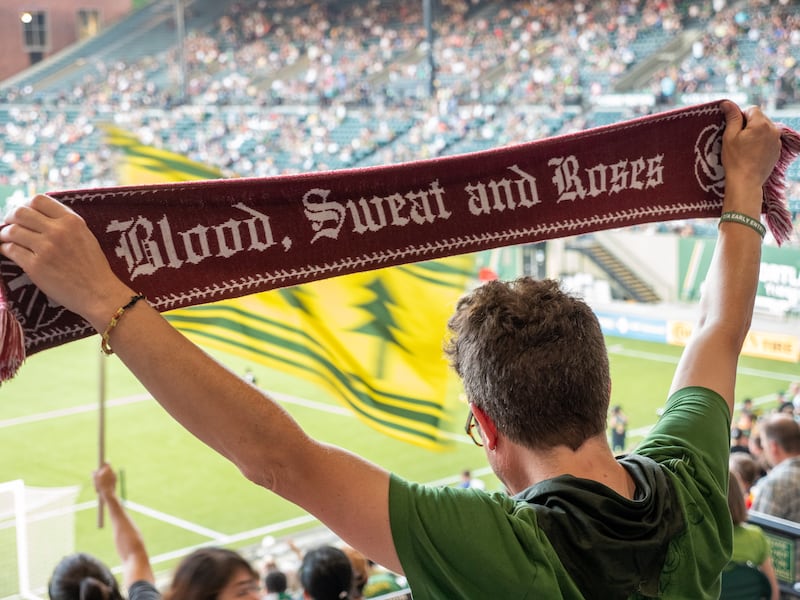
Providence Park, like most major outdoor stadiums in the cool, wet Pacific Northwest—among them Autzen, Reser and even the region’s other two MLS stadiums—have artificial turf.
Cheaper, more durable and easier to maintain than the genuine article, fake grass has also been associated with injuries, overheating and, regarding the women’s game, inequality. A decade ago, when Canada hosted the Women’s World Cup, artificial grass was used in all the venues, which led to questions about parity with men’s soccer, where grass pitches have long been the norm. In response, FIFA required real grass or grass hybrids in France in 2019 and again in 2023 in Australia-New Zealand.
Officials have talked for years about switching to natural grass at Providence Park. In 2018, Paulson reached out to former Mayor Ted Wheeler about a cost-sharing plan with an eye to one day attracting top-tier international play to Portland. That plan failed to gain momentum but switching to grass is far from impossible, especially on a temporary basis. That’s what Seattle plans to do in 2026 and 2031. It’s what Portland did back in 1999 and 2003.
On Thorns and USWNT message boards, the turf issue is well trodden, with die-hards known to go deep on the performance of various grass species. But to Jim Etzel, head of Sport Oregon, grass is the least of his concerns.
“If Portland was a host city, we would figure out a solution, but it’s going to add to the cost,” Etzel says. “Every challenge is solvable. Most of the time it’s solvable with one thing: money.”
Since 2011, the Timbers have spent more than $130 million upgrading Providence Park, according to a team spokesman. But improving the park to meet FIFA’s minimum standard to host group-stage games in the women’s tournament would cost at least another $100 million, according to Etzel.
And costs don’t stop at the park. If Portland were to address all the deficiencies with Providence Park, it would next need to cut a sizable check to FIFA, which requires a financial contribution to participate. For 2031, it could be somewhere north of $40 million.
“There’s not $30 million of corporate dollars I can go find in this marketplace,” Etzel says.
Though U.S. Soccer predicts $4 billion in revenue in 2031, being left out might not be the worst thing for Portland or Providence Park. Nearly all the American cities named in the U.S.’s joint bid have so far declined to sign long-term agreements with FIFA as they seek more favorable terms. According to Sports Business Journal, the hesitation is related to the experience of 11 U.S. cities named to host the Men’s World Cup in 2026, which are on the hook to provide between $100 million and $200 million in improvements based on agreements signed with FIFA in 2017. FIFA has already backed down on one demand for 2026 considered especially onerous—that cities provide free public transportation to matches.
FIFA and U.S. Soccer did not respond to requests for comment. Travel Portland directed questions to Sport Oregon, the state commission that represents Portland in bids to host major sporting events.
Destination sports events, with participants traveling throughout the region or country to participate, bring millions to Portland. Next summer, the city will host the USA Fencing Nationals. They will last 10 days and occupy every square inch of the Oregon Convention Center, with an expected 15,000 visitors driving 10,000 contracted room nights in the city. It’s the largest fencing event in the world, though fencing’s not really a spectator event, outside of friends, family and aficionados, Etzel says. Most Portlanders probably won’t even realize the event’s in town. So-called participatory sports often drive more revenue to Portland than the spectator variety.
Jenny Nguyen, proprietor of the buzzy bar The Sports Bra, called the World Cup snub a “huge miss.” But she thinks Portland’s burgeoning reputation as a center for women’s sports is now strong enough to withstand it.
“Where Portland was once a beacon of women’s sports in a sea of quiet, there are definitely more beacons out there, shining brightly and helping drive momentum, growth, development, revenue, representation, and investment,” she wrote in an email. “Do I think Portland is falling behind? Absolutely not.”
In a way, advancements in the women’s game have led to unintended consequences for Portland. The growth of the women’s game has led to a need for more larger venues than Providence Park. Insisting on parity with the men’s game has hastened an end to artificial turf in international competition.
Fans like K. Staller still see potential for something like what happened with Columbus, Ohio, the spiritual home of the U.S. Men’s National Team, with a one-of-a-kind home-field atmosphere that brought the Men’s World Cup to a modest market.
“It’s not completely unreasonable,” Staller says, “that it could happen to us.”