Skip to main content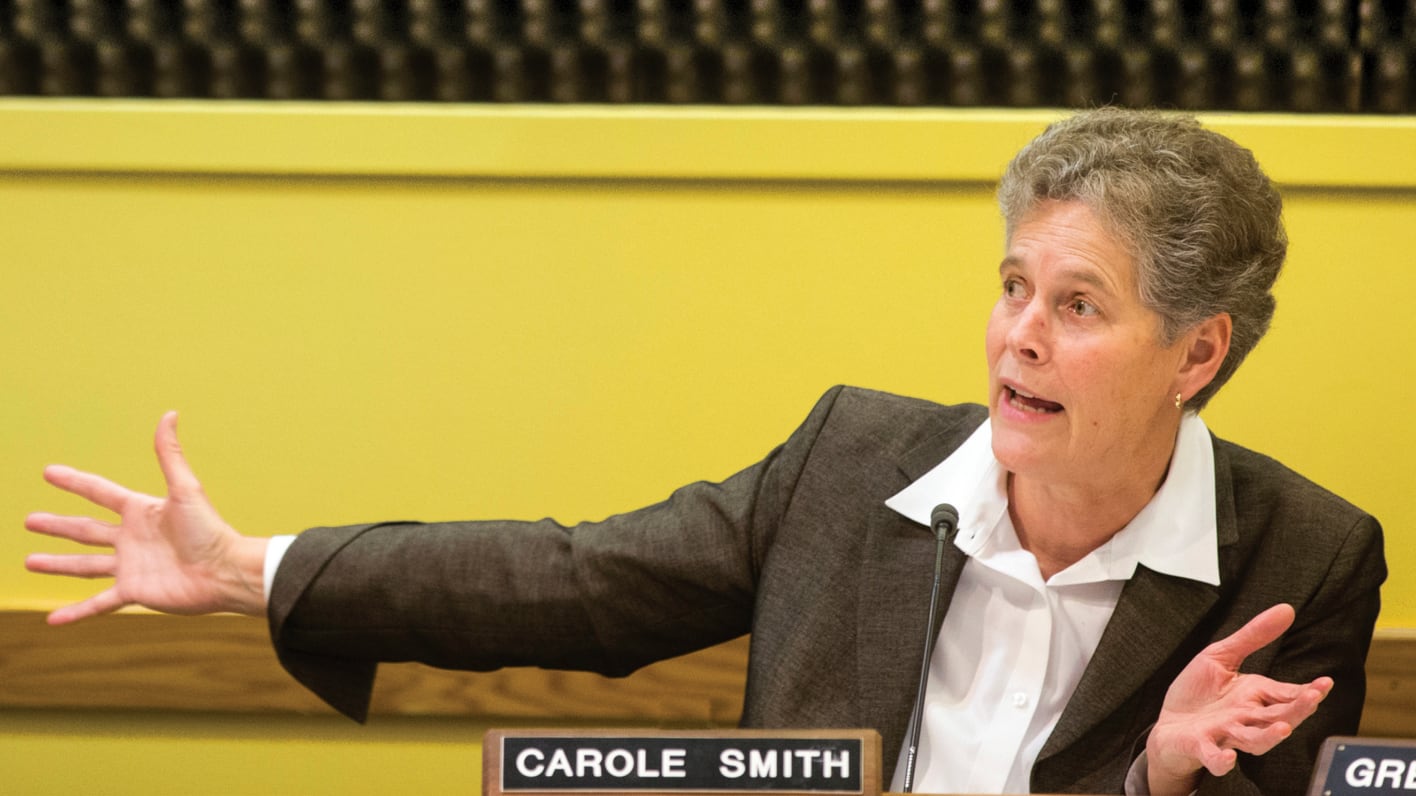
This story first appeared in the Jan. 14, 2015, edition of WW.
Carole Smith is the most powerful woman in Oregon education.
As superintendent of Portland Public Schools, she makes tough decisions every day regarding the district’s $535 million annual budget, 80-plus schools and 3,200 teachers—all in the service of 48,000 kids.
She’s also a hugger.
Smith, 60, likes to throw her arms around staff and parents. Employees who have just given a PowerPoint presentation get an embrace. She even tries to hug the president of the district’s teachers union despite strained contract talks that nearly triggered a strike last year.
Her approach has made Smith beloved in some quarters, but her style exudes a desire to be liked. Critics say she too often steers away from anything controversial.
But not now.
In March, Smith will launch the district on what could be the most divisive chapter of her seven-year tenure as superintendent: She wants to change where thousands of children attend school.
Here’s why. For decades, students in Portland Public Schools have inhabited a two-tiered system divided by black and white, and by rich and poor.
Today, economically disadvantaged students are still far less likely than their middle-class peers to hit third-grade reading targets and graduate high school on time. And students from poor families too often end up in small schools that lack the money to provide a robust education. A new analysis by WW shows that middle schools with high rates of poverty offer far fewer electives than those whose students come from wealthier families.
Smith is challenging the status quo to fulfill a commitment she made to offer poor and minority children the same education PPS offers white, privileged children.
The superintendent proposes to achieve that goal by redrawing school boundaries and shifting enrollment patterns.
Public schools largely get their funding based on how many students they have. Smith’s plan would shift millions of dollars a year from bigger, more well-off schools as it sends more kids to smaller, often less successful schools.
It will be a move unlike anything in the district’s recent history.
“How we approach the boundary changes will shape the future of our city,” Smith says.
In that sense, she isn’t just the most powerful woman in Oregon education. She’s also one of the city’s most influential leaders whose decisions go far beyond the schools to weave a new social fabric in Portland’s neighborhoods and communities.
Many Portland parents, teachers and community members are applauding PPS’s Robin Hood act. “It’s not fair that the kids at my school aren’t getting the same education as kids at another public school,” says Lauren Andronici, whose children attend Vernon K-8 School near the Alberta Arts District.
But parents who might otherwise embrace the notion of equity often change their minds when it’s their kids who stand to lose out. “One reason,” board member Matt Morton says, “is the level of resistance to change that you see from those who have benefited from a system that has in many ways protected them.”
It’s impossible to know at this point which schools’ boundaries will be redrawn or which students will be affected.
Families who chose to live in a particular neighborhood so their kids could go to a highly sought-after school—Grant High, for example—may soon learn PPS is shuffling their kids elsewhere.
Given the controversy, the superintendent may have a bigger worry. Smith’s track record of improving equity in the district has been uneven at best. If her history on equity is any judge, the results will fall far short of her ambitions.
Smith has heart. But she will need far more than hugs to get things right.
Here are six big questions city leaders, parents, educators and students need to ask as Smith begins to shake up Portland.
1. When will Smith and Portland Public Schools explain the reasons—and the consequences—of what’s about to happen?
School district officials started letting parents know in 2013 that PPS was considering realigning attendance boundaries. Smith says redrawing the boundaries will help the district account for growth. Ten years ago, enrollment was shrinking, but now it’s on the rise, and the district needs to adjust now that some schools have too many kids and some have too few.
PPS, she says, lacks a clear, understandable system for making enrollment among schools more even.
“We’re now facing growth challenges,” Smith told WW in an interview. “Having to adjust boundaries to have healthy-size [enrollments] that fit the buildings and can sustain programs is going to be part of what we have to do as just a matter of being able to serve our kids.”
School officials also want to redraw boundaries to erase old lines that have historically divided the district by race and economics. And as students shift from one school to another, money shifts as well.
That might help poorer schools gain ground, but it could also weaken schools that have become models for success.
Take Beverly Cleary School in Northeast Portland’s Grant Park neighborhood.
Named for the celebrated children’s author, the K-8 school has earned the Oregon Department of Education’s highest rating three years in a row based on test scores. Parents give generously to the school’s foundation—$200,000 last year, making it one of the richest in the district. Middle-school students there can take drawing, cartooning, futsal, personal finance and screenwriting. No other K-8 in Portland offers such a generous menu of choices.
“We built it together,” says James Robertson, a Beverly Cleary parent. “No one wants to lose it.”
The school is bursting at the seams—its enrollment has grown 50 percent in five years, while the district’s has grown only 4 percent. PPS officials assume some parents cheat—temporarily renting an apartment near the school or lying about their address—to get their kids in.
The growth in Beverly Cleary’s numbers has helped fuel the school’s programs.
PPS officials say they’ll use boundary changes to move kids out.
Robertson and his wife, Irina, chose to live in the nearby Rose City Park neighborhood because it feeds into Beverly Cleary and they had heard great things about the school. But they also were thinking ahead and wanted their daughter, Nataliya, now a first-grader, to eventually go to Grant, one of the district’s most coveted high schools.
The Robertsons now realize their home on Northeast 52nd Avenue sits at the edge of Beverly Cleary’s boundaries. Their daughter could be shifted elsewhere if the lines change. They worry that could mean she’ll be destined for Madison High rather than Grant.
Now, Robertson says he watches PPS machinations more than most parents and believes many will soon wake up to the uncertainty his family faces.
“A lot of people are going to want to know as soon as possible how they’re going to come out of this OK,” he says. “That’s what I want.”
2. When it comes to shifting students between schools, do Smith and PPS know what they’re doing?
Controversy over redrawing school boundaries has blown up on Portland Public Schools in the past. This time out, school officials sought help. In November 2013, the district hired the Hatfield School of Government’s Center for Public Service at Portland State University to suggest ways to carry out boundary changes.
The resulting report published last May found that PPS “lacks internal clarity” about the reasons the district wants to redraw school boundaries.
The report also found that PPS’s equity agenda—not just uneven enrollments between schools—was really driving the district’s plans. PSU’s experts recommended that the district come clean with the community.
If not, they warned, the district “risks undermining PPS’s credibility with the community and potentially fails to make the changes that will positively impact both enrollment and equity.”
The district in March will send out surveys to test the public’s attitude toward its plans.
“PPS doesn’t have a vision,” says Rita Moore, a schools activist who has worked on equity issues. “So it’s crowdsourcing a vision.”
The district has asked 23 employees and citizen volunteers to come up with a way to redraw school boundaries that is, as PPS puts it, “equitable, inclusive [and] transparent.”
When the group met Jan. 8, district officials employed an approach to decision making that crossed the Occupy movement with The Office. They offered statements like “schools should reflect the broader diversity of the district.” Members held up green cards if they agreed, red if not, or yellow if they didn’t know.
But committee members had questions: What exactly was the committee supposed to accomplish—actually redraw boundaries or simply propose yet another process for PPS to follow next?
District officials had no answers.
Pam Knowles is a member of the Portland School Board as well as a member of the committee. At the end of the meeting, Knowles said the group needed clarity.
“There seemed to be a lot of confusion in the room,” Knowles says.
WW asked Smith about the committee’s lack of focus. Smith sent a written answer, in which she said it takes time for a new group to find its way. “I have confidence the committee will come together and complete this important work,” she said in the statement.
One big risk of district officials improvising their way through such an important change is the danger of unintended consequences.
Prudence Carter, professor of education at Stanford University and co-editor of the book Closing the Opportunity Gap, says Portland deserves credit for trying.
Any school district that’s working toward equity, she says, “is bound to be more forward-thinking and have better results.”
But Carter says simply changing boundaries isn’t enough. “You cannot assume you have the political will among your more-affluent families to go to school with their less-affluent brethren,” Carter says. “You just can’t assume that.”
Parents here are already expressing alarm at that prospect.
“They don’t actually know what upper- and middle-income parents are going to do,” says Christina Davidson, who lives in Northeast Portland’s Sabin neighborhood but sends her children to the Japanese program at Southeast’s Richmond Elementary.
“They feel that people will automatically enroll in their neighborhood schools, but people who have other options—people who are by definition privileged—will tend to look at other possibilities.”
3. Does Smith’s spotty track record on equity portend failure here?
No one doubts the superintendent’s commitment to equity. Early in her career, she worked in Boston to help desegregate that city’s schools. In Portland, she spent 23 years overseeing a small alternative school, Open Meadow. She served as chief of staff to then-Superintendent Vicki Phillips and moved to the top job when Phillips resigned in 2007.
Smith has made raising the number of kids meeting third-grade reading targets, reducing racial disparities in discipline, and increasing Portland’s abysmal graduation rate her top goals.
Last year, PPS’s overall graduation rate stood at 67 percent, up from 59 percent three years earlier. White and middle-class students saw gains. But the district saw racial and economic gaps widen. Graduation rates for both black and poor students barely budged, hovering between 58 percent and 53 percent.
PPS officials can’t say how boundary changes will translate into meeting any of these goals, either in the short run or over time.
“This by itself does not achieve equity,” Smith told WW. “It’s one of multiple levers needed.”
Parents have reason to worry, though. The district’s efforts to achieve equity have sometimes produced results opposite of what officials intended.
Disparities in the way Portland schools discipline black and white students still grew, for example, even after Smith spent $2.5 million on racial sensitivity training for employees.
Another example of an equity effort backfiring: PPS’s transfer system—also known as “school choice.”
For years, the district has allowed parents to apply to transfer their kids to schools outside their neighborhoods. The idea was simple: A family’s ZIP code shouldn’t consign a child to an inferior education.
The school-choice movement took off in the 1990s. In 2002, district officials introduced a lottery after noticing that the system favored more-affluent white parents seeking to send their kids to more popular schools.
But PPS now says the lottery has perpetuated inequity. White, upper-income families use the lottery disproportionately, leaving behind schools that are smaller, poorer and weaker as a result.
In some gentrifying areas, schools are more segregated than the neighborhoods that surround them.
About 28 percent of children in the neighborhood around Northeast Portland’s Woodlawn K-8 are white, but they make up only 15 percent of the school’s population. By comparison, 37 percent of neighborhood kids are black, but they represent 51 percent of the school.
“If you keep doing the same thing, the unintended consequences are no longer unintended,” Moore says.
To address this, the district wants to abolish the lottery for transfers between neighborhood schools. (The School Board was set to vote on the plan Jan. 13.)
Ron Herndon, former leader of the Black United Front, helped PPS shape the policies that led to school choice. He says the district is going about it all wrong. It’s not where kids attend school, he says, but about preparing teachers in those schools to do a better job of teaching the kids they have now.
“Now you’re saying, ‘Woopsie, we made a little mistake, we have to make sure that the white parents stay in neighborhoods where they have poor-performing schools,’” Herndon says. “The problem is not the economic status of the community. It’s having people in those classrooms and people who are leading those schools who have had success in educating those populations.”
4. Will Smith have the courage it takes to follow through on her plan?
In 2009, PPS launched a shakeup of high-school attendance boundaries to increase equity in enrollment. Smith and the School Board promised bold changes. They didn’t deliver.
At the time, high-school enrollment was lopsided, leaving poor and minority students shut out of the larger schools offering better programs. In Northeast Portland, for example, Jefferson had 435 students. Four miles away, Grant had 1,610.
The city’s whitest, wealthiest and biggest schools—Cleveland, Grant, Franklin, Lincoln and Wilson—all offered at least three foreign languages. The other four high schools—Roosevelt, Madison, Marshall and Jefferson—offered just one.
Smith and the School Board paid an outside consultant $75,000 to reimagine new high-school boundaries for the district. Rumors circulated that the plan called for closing a central school such as Grant or Cleveland that served middle- and upper-middle-class students. Lawn signs soon sprouted up in front of $600,000 bungalows in Northeast Portland’s Grant Park neighborhood.
“Close the gap,” the signs read, alluding to achievement results, “not the schools.”
PPS left the richer schools alone and turned instead on the one with the city’s least-affluent, least-powerful parent constituency, Marshall High, in Southeast Portland’s working-class neighborhood of Lents. Then-School Board member David Wynde (now director of the district’s budget office) called the decision to close Marshall “wrong, wrong, wrong.”
Jefferson—which served far fewer students than Marshall—became a “focus” school that neighborhood students no longer had to attend, and PPS put an 850-student cap on enrollment at career-oriented Benson Polytechnic, even though it was one of the district’s success stories.
Smith says the plan, which went into effect in 2011, was a success based on 2014 measures. “Three years of growth in enrollment, growth in student achievement and growth in graduation rate,” she says.
By its own measure, though, PPS has failed to meet one crucial objective. By 2014, district officials pledged, the enrollment gap between high schools would be no more than 300 students. But Roosevelt still has 640 fewer students than Lincoln.
Other gaps remain. Roosevelt now teaches two foreign languages—Spanish and Japanese—but the disparity persists. Lincoln now offers French, Spanish, German, Mandarin Chinese and Arabic.
Gaps also persist in the number of advanced placement classes offered. Lincoln and Cleveland, at the top end, offer 91 and 61 semesters of International Baccalaureate classes, respectively. Wilson, Madison, Roosevelt and Franklin have no IB classes and offer only 25 to 38 semesters of AP classes each.
Franklin mom Lisa Zuniga threw herself wholeheartedly into the work of helping PPS pull off the high-school redesign. Disillusioned, she later joined other parents in filing a complaint against the district in 2013 for failing to provide the minimum number of high-school instructional hours. The Oregon Department of Education found the district out of compliance and ordered reforms.
“I was a big fan of high-school redesign,” she says. “I went to almost every meeting, and I said, ‘Let’s do this thing!’”
But she adds: “The rich curriculum we were promised is not a reality.”
5. Why doesn’t the school district’s math add up?
If PPS wants to do something about equity, middle schools are a great place to start.
Ten years ago, the district decided to move away from stand-alone middle schools and create more K-8s. Then-Superintendent Phillips sold the shift as a way to address declining enrollment and stubbornly low academic achievement at some middle schools.
But something else happened. Most middle schools flourished, while most K-8s didn’t.
The changes hit poor and minority students harder. WW’s analysis of PPS records shows that the wealthier you are, the more likely your kid is to attend a middle school. In other words, the district has pushed K-8s where poverty rates are relatively higher.
Why does this matter? Because PPS’s middle schools tend to offer students richer, more diverse electives than K-8 schools with higher rates of poverty. WW’s analysis of district programs shows middle schools offer an average of 13 electives—68 percent more than K-8s (see sidebar).
Smith’s boundary change plan is one response to this inequitable trend.
In 2009, PPS set a target of enrolling 160 students in the sixth through eighth grades at each K-8 school. Today, the district has fallen short of this goal in 18 of 25 schools—some to a shocking degree.
Boundary changes are supposed to fix the problem.
That’s where the district’s bad math comes in. PPS can send more students to these K-8s. But several of the schools can’t handle the number of kids they have now.
Take Scott K-8 School in Northeast Portland’s Roseway neighborhood. It has 120 students in grades 6 through 8. But the school is already overcrowded and running out of classrooms. So are Lee K-8 in the Madison South neighborhood and Woodlawn K-8 in Northeast Portland.
In response to WW’s questions, Smith said in a written statement that PPS may have to unwind its policies on K-8s by reverting them to elementary schools.
“This is a problem that we are aware of and we expect to address directly with district-wide boundary review,” she said in her statement.
6. Even if she has the nerve to pull off her plan, will Smith have the clout?
Smith took the top job at PPS pledging to stay at least 10 years. She still has more than two years left—her current contract expires in 2017.
But as with any superintendent, Smith serves at the pleasure of the seven-member School Board.
Until now, the board has been a fairly soft touch when it comes to Smith. She gets strong marks in her job evaluations, which put a lot of weight on closing racial gaps that Smith has not erased. (The evaluation criteria for Smith include the word “equity” 15 times. The word “achievement” appears three times.)
In August, the board voted to give Smith an unprecedented 28 percent pay raise, bumping her annual salary to $247,000, plus benefits.
Co-chairwoman Knowles says Smith deserves the big bump, noting she helped the district pass a $482 million bond issue for construction and delivered a new contract for teachers that won significant improvements.
Six of seven board members agreed to talk with WW about the changes. The majority of the board agrees with Smith’s approach and applauds her steps. Ruth Adkins, who’s up for reelection in May, declined to be interviewed, saying she wasn’t ready to talk about the plan.
Tom Koehler, one of the board’s newest members, expressed skepticism that Smith’s boundary-change strategy will get better equity results for students.
“I don’t know where she’s headed,” Koehler says.
In May, four of the seven seats on the Portland School Board are up for election—and all the incumbents are Smith believers.
Paul Anthony and Mike Rosen, two of the challengers stepping forward to run for School Board, have both raised serious questions about Smith’s leadership and board members they say have rubber-stamped her policies.
“Everyone seems very happy saying nice things, passing nice policies,” says Anthony, CFO of a Beaverton financial services company who has children in North and Northeast Portland schools. “Very few people seem to want to follow through.”
WW asked Smith how she would respond to a shifting majority on the board. She offered a written statement that said in part: “I have seen a near complete turnover of the School Board since I became superintendent and have enjoyed working with new members as they have joined the board.”
Such tact is in character for Smith. But her track record—and what many see as the School Board’s compliance with her decisions—will frame the May board elections.
“Parents are done with aspirations,” Rosen says. “I want to know what you’re going to accomplish, how you’re going to accomplish it, and how long it’s going to take until we can provide the right resources for students, teachers and even central administration to make that happen.”
WW news intern Gabriella Dunn contributed to this story.