 Skip to main content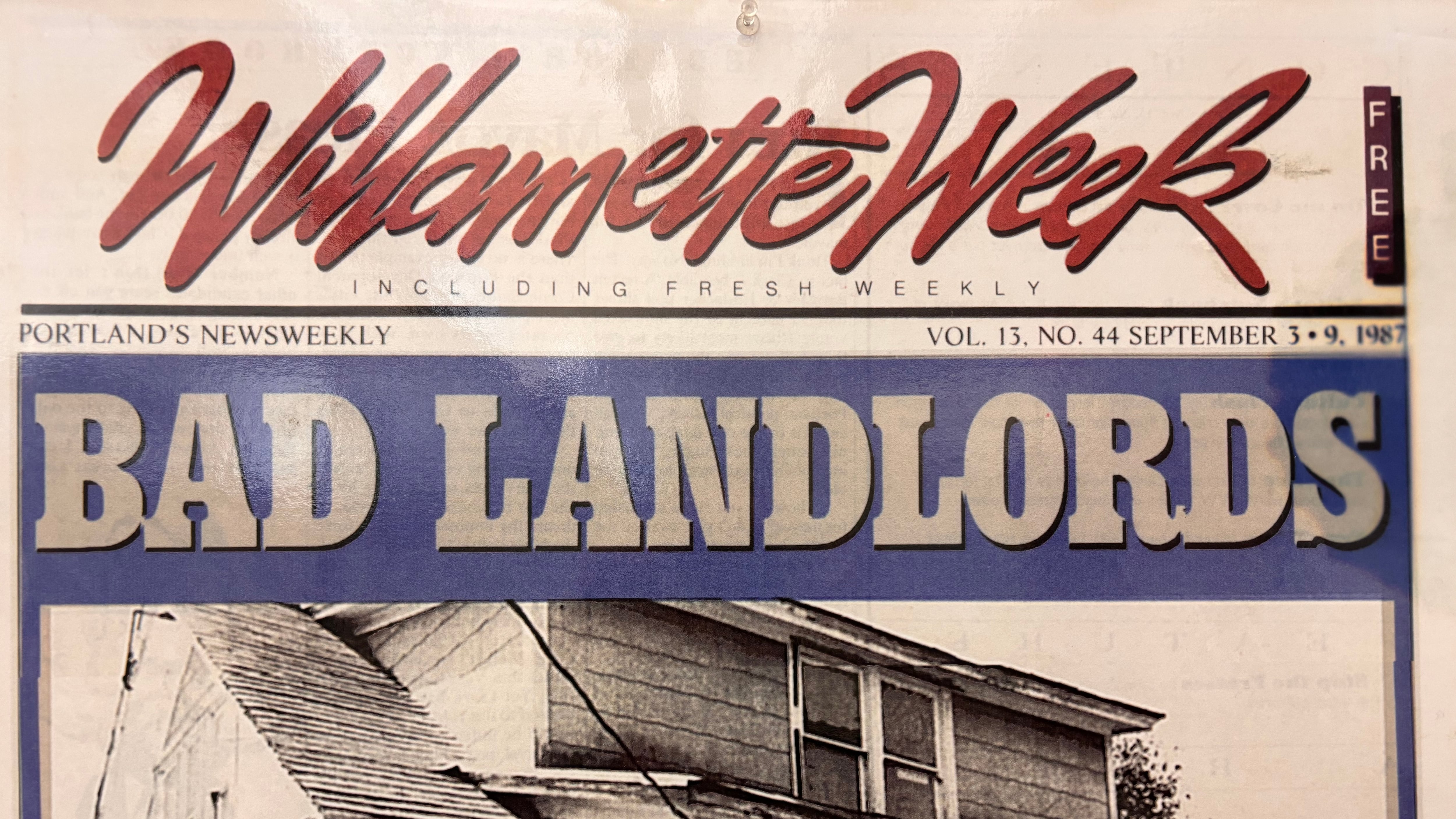
Staff writer Brent Walth combed through county property records and city building inspection reports to expose the worst of the worst residential landlords in Portland. One was Terry W. Emmert, president of Emmert International, a wide-ranging enterprise based in Clackamas that specialized in moving buildings, including dilapidated homes his company would buy up and move from one lot to another for resale or rent. “Bad Landlords” was an early example of Walth’s investigative journalism in a career that would span 30 years as a reporter and editor at Willamette Week, the Eugene Register-Guard and The Oregonian. In 2001, he shared a Pulitzer Prize for Public Service at The Oregonian for the daily’s investigation of abuses by the U.S. Immigration and Naturalization Service. In 2015, he became an associate professor at the University of Oregon School of Journalism and Communication. Walth is also author of Fire at Eden’s Gate, a superb 1994 biography of Oregon Gov. Tom McCall.
This story first appeared in the Sept. 3, 1987, edition of WW.
Everyone needs a place to live. While many of us think we could not do without a variety of amenities — a fireplace, a view, a reserved parking space — all that others ask for is safe and clean housing.
For some, that may seem too much to ask. Their ceilings fall in, pipes leak, electrical wiring fails, rodents scurry around. You wouldn’t want to live like this, but thousands in Portland do, and many have no choice. Perhaps more disturbing is the way some landlords make a lot of money because of it.
Portland clearly does not have the slums other cities have — witnessed by the Los Angeles “ratlord” recently sentenced to spend 30 days in one of his own tenements. And bad landlords are a distinct minority in Portland. In fact, city housing inspectors, who routinely tour the worst housing Portland landlords have to offer, say that the vast majority of code problems they find are minor and that owners are more than happy to make repairs.
WW would like to introduce some of the exceptions.
In October 1980, WW published a list of bad landlords in Portland. Now we’ve retraced our steps. We talked with city officials, housing specialists and attorneys who deal with tenant cases. Using property-tax records, we studied more than 50 large and small landlords, crosschecking individual names with city business licenses and state corporation filings. Next, individual properties were checked in city inspection records for violations, and, in turn, about 100 properties in all sections of Portland were visited.
We also talked with the tenants, the people who live in the worn and often unsafe houses and apartments. In most cases, the tenants are low-income and have enough trouble making rent payments, let alone financing moves to a better place. WW found many tenants willing to put up with unsuitable conditions simply because their landlords allow them to miss a rent check now and then. Many tenants asked that their names not be used, fearing reprisals.
What follows is far from a complete list of problem landlords in the Portland area, but it’s evidence enough that despite stepped-up enforcement by the city, bad landlords are alive and well.
Jon L. Heil
In WW’s search for problem landlords, no name came up more often than that of Jon Heil. According to tax records, Heil owns five properties in Multnomah County, but city housing inspectors identify as many as 10 properties Heil has managed or owned in the past two years. Heil declined to talk to WW about his properties.
Heil, 39, owns an eight-unit apartment court at 5310 N Mississippi Ave. in the Humboldt neighborhood, only a few blocks from Interstate 5. From the outside, the apartment court is the picture of neglect. Heil’s tenants — most of them low-income and relying on some sort of government aid — tell of a landlord who all but ignores them and the problems with his building.
On the day we visited this apartment court, a new stove was delivered to Apartment No. 6. The previous stove, according to the tenant, had quit working altogether three months earlier. The tenant says it took that long for Heil to respond to the problem. As a result, she had no way to cook meals for herself or her infant. Says the tenant, “Heil is just very, very slow.”
When Laura Green moved into No 5, she found a kitchen vent and a wall charred with soot. Her kitchen also has an uncovered electrical outlet, and the unit’s fuse box, placed right next to the sink, also has no cover. When her refrigerator failed, Green says, Heil brought her a replacement he claimed to have found in a warehouse. “The refrigerator was full of roaches,” Green says, pointing to the base of the appliance. “This place didn’t have bugs. But when he brought this thing in here, roaches just started pouring out.”
In Apartment No. 1, tenant Sandra Sloan cannot control her temper when talking about Heil. She relies on Housing Authority of Portland to pay her rent. As a result, she says, Heil responds only to HAP, not to her, when something goes wrong.
Sloan said when she went to unplug a dryer in the bathroom one day, the entire outlet came out of the wall. She said Heil came to fix the problem only after HAP inspectors complained. Heil used a long screw to anchor the outlet back in place — leaving the bare screw poking into the next room, where Sloan’s young son sleeps. She says Heil wanted to ignore the hazard he created. When she complained again, Heil solved that problem by sawing off the screw.
The problem all the tenants in this apartment complex share is the lack of heat in the winter. Tenants say Heil includes the heat in their rent but he buys only so much heating oil every month. When that runs out, the apartments turn cold, often for a week at a time. Sloan says the lack of heat last year drove some tenants out. Unable to afford a move, she is forced to move her family to a friend’s house when the apartment becomes too cold.
In 1983, Heil borrowed $25,000 from Walter and Betty Warnke, a Portland couple who had met Heil through an investment agent. Betty Warnke, who now lives in Vernonia, says when Heil stopped making payments on the loan, she and her husband went after two homes Heil had used as collateral.
The Warnkes soon discovered one of the houses, located at 4026 N Michigan Ave., had a history of health and safety problems. According to city records, inspectors in August 1984 found 16 code violations in the house, including serious plumbing and electrical wiring problems. The next month, inspectors “red tagged” the house, posting it as unsafe to occupy. Within days inspectors found Heil had violated the ban on occupancy and rented the house anyway. When ordered by the city to make repairs, Heil all but told inspectors to get lost. Hearings Officer William Shatter fined Heil $2,500, which Heil never paid. When the Warnkes took possession of the house, the array of code violations and a $2,500 lien came with it.
In March 1985 Heil began buying the Finer Court Apartments, a 16-unit building at 3804 N Haight Ave., from Hung P. and Yun F. Wang of Portland. According to the Wangs, Heil stopped making payments on the building in late 1986, and they sued him in Multnomah County Circuit Court to repossess the property.
In court records, Heil claimed he and his company, the now-defunct North Bank Investment, had spent more than $13,000 to remodel the complex. But when court-appointed receiver Jeanne Golden examined the place, she found rodent- and roach-invaded apartments marred by neglect and inhabited by tenants with hundreds of Hell’s unfulfilled promises.
Apartments were found with broken appliances and without heat or smoke detectors. In one unit, the kitchen sink was propped by a board. In another, the ceiling had collapsed from leaking pipes in the upstairs unit. Northwest Natural Gas workmen found gas lines had been bypassed and hooked to water heaters for the complex. The subsequent $613 gas bill went not to Heil but to the tenant of one of the apartments. In all, Golden noted 279 necessary repairs left behind by Heil. Cost: $21,000.
Heil has left unpaid debts elsewhere. In 1985, Heil went to Multnomah County District Court to evict a tenant he claimed had stopped paying rent. The tenant claimed Heil had refused to fix problems in the apartment. The tenant prevailed when Heil failed to show up for the hearing. When the county tried to cash Heil’s $36 check for court fees, the check bounced.
Harry V. Benson, Lincoln Loan Co.
Lincoln Loan Co. is a dinosaur of the landlord business — a dinosaur that, however slightly, is still breathing. In fact, Lincoln Loan and its surviving founder, Harry Benson, may be the last of the big-time bad landlords. Beginning in 1944, brothers Harry and Fred Benson amassed an empire of some of the city’s crummiest homes.
Today, Lincoln Loan is not what it used to be. Fred died a couple of years ago, and Harry, 65, is said to be ailing and does not fight the city as he used to. Lincoln Loan, however, still owns more than 200 properties in Multnomah County, and many of these are single-family homes that are dilapidated but still occupied by Benson’s tenants.
For his part, Harry Benson seems to feel picked on by inspectors, and he’s skeptical about “confidential” complaints from tenants or neighbors. “They don’t tell us who’s making the complaint,” Benson says, adding, “What I want to know is, do they single out a company like Lincoln Loan and just drive out to our houses?”
Whatever prompts city inspectors to look at Benson’s houses, they find a lot. According to city records, 33 Lincoln Loan-owned houses have come to the attention of housing inspectors for one reason or another in the last five years. Building inspector Stan Scotton says 20 Lincoln Loan homes have been rated by inspectors as “dangerous” buildings in the past year.
For years, Lincoln Loan and the Bensons worked as a clearinghouse for these old homes, offering to sell the properties to low-income customers who lacked the good credit references to get conventional bank loans. For the tenants, the deals were often hard to pass up: low down payments, low monthly payments and a promise the houses could be theirs.
Meanwhile, the Bensons continued to hold title to the house, making them the legal owners and allowing them to evict the “buyer” if a payment was missed. When that happened, which was often, the Bensons could reclaim their property and benefit, at no cost to them, from the improvements made by the tenant-buyer.
According to housing inspectors, the Bensons often used these contract-sale deals to avoid making repairs themselves. Says one inspector: “We’ve seen too many of these so-called ‘deals’ fall through. We go after the titleholder because he’s still the legal owner.” As a result, the city targeted the Bensons, not their customers, when things went wrong.
Harry Benson acknowledges his long track record with city inspectors — “We’re known up there. There’s no question about that” — but he takes issue with the idea that Lincoln Loan, while remaining the legal owner, is responsible for the upkeep of its homes. “I don’t care what [a contract buyer] does when they’re buying [a house],” Benson says. “I don’t have the right to tell them to put a new roof on it.”
The Lincoln Loan-owned home at 5906 SE 42nd Ave. was within weeks of being torn down by the city when Benson sold it to Ron Carmichael lor $20,000. Carmichael says he found a series of serious problems, including missing walls and floors that sank an entire foot. “In some ways I wish I’d never bought it,” he says.
At another Lincoln Loan-owned house at 3036 SE 39th Ave., a few blocks south of Southeast Clinton Street, Wayne Hadley hopes to make a go of it. He’s paying Harry Benson on the contract plan for this one-level home that neighbors say has been nothing but a blight. The roof appears worn beyond repair, and the interior needs a thorough refurbishing. Hadley says the house was “trashed” when he first moved in. “It had been vacant for a few months,” he says. “There was food and garbage all over the place. When I first came in here I had to chase a pregnant rat out of the kitchen closet.”
At 8570 N Charleston Ave. is another one of Benson’s contract sales. The tenants were not home when we visited. But neighbors say the house has been occupied for several years and is nothing short of a health and safety hazard. The back yard is a tangle of overgrown weeds and trash. The next door neighbor, Sarah Dressel, worries that the yard is a hazard for her young daughter. “My landlady can’t afford a fence, and neither can I,” she says. “I hate to think what would happen if my daughter got caught in all that stuff.”
Dressel says it’s a struggle to keep mice and rats that roam from the house out of her own home. But most troublesome, she says, is the problem with the house’s sewer system. “When they flush their toilet, it comes right up in the back yard,” she says. “You can hear it, you can see it, and you can smell it.”
Benson says he rarely inspects the houses he sells and almost never shows them personally. But he says he makes sure a buyer knows the problems with a house, especially if it has a record with the city. “Look,” Benson says, “I’m not selling anything. I’m not out there as a salesman selling something people shouldn’t have. These buyers are coming to me.”
While preferring to sell his houses on contract, Benson is also a traditional landlord. Jim Wagner says five years ago he rented from Harry Benson the one-story house at 2104 SE Ankeny St., just between the Buckman and Kerns neighborhoods. At the time, he says, Benson promised he wouldn’t raise the rent as long as Wagner didn’t ask him to fix anything. Wagner kept his end of the deal. Comments Wagner, who says he’s spent $500 of his own money fixing up the house, “When I moved in here it was in pretty bad shape.”
It still is. The dining room floor shakes when you walk across it. If you look down, you see light from the dirt-floor basement shining up through the floorboards. The ceiling in almost every room shows signs of a leaky roof. Above the kitchen the leaks became so bad a 4-by-4-foot chunk of plaster fell to the floor. Wagner says he doesn’t have money to fix the hole and has covered it with a blanket. A similar hole runs down the kitchen wall, exposing the wooden slats in the walls.
Wagner’s housemate, Cynthia Stokes, says the porch steps were so rickety the postman refused to deliver mail to the door until the steps were fixed. In the winter, she says, the house will not stay warm, causing monthly heating bills of $100. She says the bathroom plumbing needed extensive repairs. “I don’t know what was wrong exactly,” she says, “but when you turned the water on, it shot out of the pipes in all directions.” Wagner paid for that repair himself as well. On top of all this, Stokes says the house’s foundation is all but given way. “When we turn the washing machine on,” she says, “the entire house shakes.”
Benson says he is not aware of problems at Wagner’s house and that he did not make an agreement with Wagner never to raise rents in exchange for not making repairs. Says Benson, “That’s illegal.”
Terry W. Emmert
Terry Emmert is a very successful businessman. He is president of Emmert International, the Clackamas company that specializes in moving things — buildings, oil modules, ships and so on. He also moves houses that are in the way of planned freeways and shopping centers. Often he buys these homes for pennies on the dollar, moves them to new lots and then tries to sell them. The houses he doesn’t sell he rents.
Many of Emmert’s projects have been impressive. A new housing subdivision on Southeast Michael Drive in Milwaukie, for example, was built almost entirely from houses he’s moved. According to tax records, Emmert owns about 71 properties in Multnomah County, and many of these are single-family homes he moved onto new lots in east Portland.
Not all of these properties are as nice as those in Milwaukie, however. As a landlord, some of his tenants say, Emmert is unresponsive when things go wrong with his houses, and many of his former and current tenants say their patience with him has long run out.
Take 10506 SE Rex St., just north of Lincoln Memorial Cemetery on Mount Scott. Ann Maynard lives there. The house was moved in the late 1970s to make way for Clackamas Town Center. The living-room floor slopes in what seems to be two different directions. And the house, Maynard says, is poorly insulated. When the front door is closed, light shines through around the edges.
“In the winter,” she says, standing by the door, ”you stand here and the draft just comes — whoosh.” Adds Maynard, who says she pays monthly rent of $550, “They don’t want to hear from you, and they don’t take pride in anything at all.”
Next door, at 10512 SE Rex St., another Emmert house, Randy and Robyn Lais point to a large patch in their living-room ceiling. Says Robyn, looking at what amounts to an uneven repair job, “We had mud running down the stairs when we came home from dinner. There was a hole in the roof with light shining right in.” Robyn says workers first tried only to patch the hole. When she protested, Emmert was forced to replace the entire roof. Just the same, it took Emmert three months to do it. Today, there is a noticeable 1-by-2-foot patch in the ceiling.
Aletha and Richard Van Dyke say they’d like to talk to Emmert but have had no luck. The Van Dykes are a low-income couple who have trouble making rent payments (something Emmert points out). They have lived in the Enmert-owned house at 10621 SE Schiller St. for more than three years and — as a wad of work orders Emmert showed to WW indicates — have had many problems with the dwelling.
But despite the work Emmert says he’s done there, the house still has serious problems. In the winter, leaky gutters (“They’re like an automatic sprinkler when it rains,” says Aletha) flood the small yard. The toilet is cracked (“They said they won’t fix it until it leaks,” she says). The fireplace hearth is crumbling, and part of the living-room floor feels as if it might give way. Aletha also adds the house does not stay warm in the winter, causing heating bills she says exceeded $100 a month last year.
Perhaps most serious is an aging fuse box hidden behind a flap of paneling in the living room. Richard says the house’s electrical system can’t support more than a few necessary appliances. Says Richard, “You can scream and holler all day, and it won’t do any good.” All this, and the rent was raised last month from $360 to $395.
The Van Dykes say things could be worse: They could live in the building behind their house, as three other Emmert tenants do. A hole in the outside wall of that dwelling reveals no insulation. Says Richard about the house, “It’s just a shell.”
When first asked about these and other complaints, Emmert called the claims “garbage” and said he had not heard of them, noting, “I never talk to my tenants.” Emmert says he leaves the problems to his property manager. Adds Emmert, “Would you call up the president of Nordstrom’s and ask him about a defective pair of shoes one of his stores sold in 1985 and what he knows about the person who bought them?”
Later, count by count, Emmert and his property manager, Marleah Llewellyn, say categorically they have done everything they have been asked for the Van Dykes. Emmert adds that problems like leaky gutters may well be the tenants’ fault for not cleaning them as they should. Emmert also says upkeep and maintenance of the house is the tenants’ own responsibility and is stipulated in rent agreements.
Agreements showed to WW by tenants, however, refer generally to keeping the house clean and specifically to yard work only.
Like many landlords WW spoke with, Emmert talks at length about problems with tenants. For example, he blames Oregon’s economy for what he calls “an influx of problem tenants” who do not care for their dwellings as they should. How about existing problems, such as the drafty doors in Maynard’s and the Van Dykes’ house? “Why don’t they weatherstrip the doors themselves?” he asks, adding, “In my home, if I look at the right angle I can see light through the door, too.”
To emphasize his point about problem tenants, Emmert tells a story of how he says tenants used complaints to avoid paying rents. The tenants, he says, all lived in homes along the same street, flooded their basements — and, in turn, claimed their belongings had been water-damaged and halted their rent payments.
The tenants Emmert refers to agree their basements flooded — not as he describes it, they say, but from foundations — built to hoist the houses Emmert moved — that cracked and leaked during a rainstorm. Says Sherri Hofbauer, a tenant of one of the houses, “We woke up one morning with three inches of water in our bedroom.”
When Hofbauer (who then lived in the house now occupied by Ann Maynard) and the tenants of the other houses asked for reimbursement for their water-damaged belongings, an Emmert company official called the flooding “an act of God.” Hofbauer says when she stopped paying rent in protest, Emmert tried to evict her. Hofbauer fought back. Hofbauer’s attorney, Frank Wall, says Emmert’s lawyer offered to settle after touring the damaged homes. The result: Hofbauer was required to move but without paying her back rent — an in-kind payment, she says, for the damage the flooding caused.
Lee A. Ellmaker
Lee Ellmaker’s story is a long and complex one. He made WW’s list of bad landlords in 1980 when he owned the Bridgeport, the Biltmore and the Arlington hotels, each of which provided low-income housing in the Burnside area. Ellmaker’s hotels were, to a building, scenes of blight and crime. Today, the Bridgeport is gone and the Biltmore run by Central City Concern. What still exist are Ellmaker’s reputation as a Burnside slumlord and, along with it, the Arlington — a building that, as one inspector told WW, “is still a pit.”
Ellmaker, 75, declined to talk to WW about the Arlingtron’s problems or even about the renovation now going on in the hotel, saying he was still unhappy about WW’s treatment of him in 1980. “You guys slandered and vilified me 10 years ago,” Ellmaker told WW. “I still have great hatred for your newspaper.”
Ellmaker owns other rental property, including apartments at 1701-1719 NW Glisan St., which have run afoul of inspectors. But the low-income hotel business has been Ellmaker’s mainstay.
Now, after years of battling city inspectors, Ellmaker may finally bring the 73-year-old Arlington, at 333 NW 6th Ave., up to code. Ellmaker claims to have spent $40,000 on the building and intends to spend $150,000 more. Housing Services Supervisor Douglas Miller says if Ellmaker follows through with his plans to fix up the hotel, the Arlington may pass inspection.
If so, that would run counter to the hotel’s, and Ellmaker’s, history. Under the control of Ellmaker, a lawyer, the Arlington has had code problems, dating back to 1974. In 1980, WW reporters found a fire escape being used as a bedroom for one of the hotel’s managers, blocking the route for emergency escapes.
Its latest round of problems, according to city records, began in February 1984, when Ellmaker was failing to provide heat to his tenants. In 1985, Ellmaker signed a sales contract for the hotel to Robert Gross, a Portland physician. Gross operated the Arlington until August 1986, when he turned it back over to Ellmaker.
Ellmaker, according to city officials, now blames Gross for the conditions of the hotel, while Gross says the hotel was legally Ellmaker’s the entire time. Gross is correct, as far as the city is concerned, that Ellmaker as legal owner is ultimately responsible.
No one ever said running a hotel such as the Arlington is easy. Ellmaker, who reportedly suffered a heart attack in 1984, may not be up to the task. (His son, Michael Ellmaker, has taken over some of his father’s business.) Ellmaker does find himself in something of a dilemma. Leaving the hotel open puts its residents in danger. Yet closing the hotel — something Ellmaker has wanted to do in the past year — puts him at risk of lawsuits that may he filed against him by different agencies that do not want to lose the low-income housing in Old Town.
Nevertheless, Ellmaker habitually finds blame with other people for his hotel’s problems. In assorted letters to city officials, for example, Ellmaker blames Miller and other city inspectors for his heart attacks. In other letters he blames his tenants — specifically, “black” people who vandalize his hotel. Spreading this blame doesn’t always wash, however. Says one social service official who is more than familiar with the Arlington and Ellmaker, “Many of the problem people can be kept out with the right manager. He just doesn’t seem to care about the hotel or who manages it.”
Despite the Arlington’s chronic problems, Ellmaker succeeded in holding city inspectors at bay from October 1986 to April 1987 simply by complaining to city officials that he was being harassed by the inspectors.
In October 1986, when city inspectors launched another crackdown on the Arlington, Ellmaker protested loudly. Bureau of Buildings Director Margaret Mahoney, in response to Ellmaker’s complaints, says she asked the inspectors to postpone work on the Arlington. As one inspector put it in a memo. “[W]e were called off…”
“Mr. Ellmaker said our inspectors were causing him to have heart attacks and aggravating his heart condition,” says Mahoney. “He was very emotional in his description of his problems. He also said he didn’t want any of our housing inspectors back in his buildings.” Mahoney said she decided to let tempers cool, and, in return, she obtained a promise from Ellmaker to allow her to inspect the building herself — a promise, she says, Ellmaker did not keep. Adds Mahoney, “We’re now proceeding with enforcement on the building.”
While housing inspectors were put on hold, the fire marshal’s office was still at work. In October 1986, fire inspector David Coffey found the Arlington’s rear emergency exit nailed shut. Ellmaker claimed he had the nails removed, but when Coffey reinspected a few months later, he found the door either nailed or locked. Hearings Officer William Shalzer fined Ellmaker $3,000 and then suspended $2,500 of the line. Ellmaker eventually paid the remaining $500.
Despite Ellmaker’s claims that he spent $40,000 fixing up the hotel between September 1986 and February 1987, a city inspector on April 17 of this year found 217 violations, including illegal use of extension cords, broken smoke detectors and boarded-up break glass for a fire-escape door. In all, hazardous conditions were found in 10 occupied rooms. Ellmaker later called the violations “a lot of small things” and called the inspection “malicious harassment.”
Ellmaker, according to city records, claims he will be spending as much as $190,000 on the hotel. Even if that’s true, it’s uncertain how long the hotel will stay up to code under Ellmaker’s ownership. One possible fate for the Arlington is purchase by Central City Concern. The Portland Development Commission is now working with both Central City and Ellmaker in an effort put the hotel in the social-service agency’s hands.