 Skip to main content
This story first appeared in the July 26, 1983, edition of WW.
I am a standing Sentinel,
Ready, always ready,
But it’s ten years since the war has ended,
Ready, always ready.
These are peaceful times,
But there is no peace in me,
Certainly in understanding my past,
There’s a chance I’ll someday be free.
— David William Cripps, Journal notes
Willie Cripps took just about everything that came his way at high speed, including the corners. For a man who had learned long ago to sniff out the unseen danger around the bend, who was always ready for any ambush of fate, that section of Highway 35 out of Hood River should have held no surprises.
At about 10:35 pm on April 24, where the pavement veered toward Parkdale, Willie cut his own path. His Datsun hit the guardrail, then spun as it flipped, end-over-end, down the embankment. Thrown through the windshield, Willie died instantly, six weeks short of his 37th birthday.
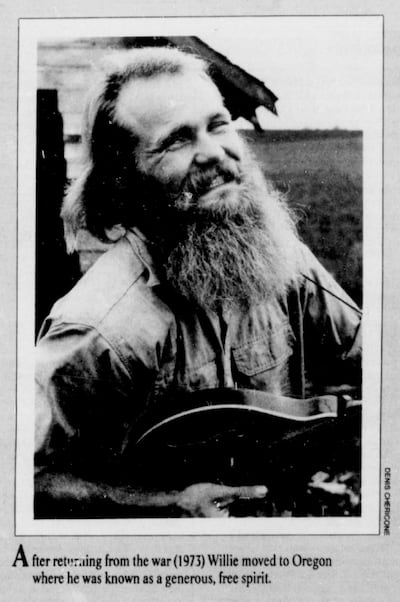
Three months later, those who knew him are still stunned: Willie died without leaving so much as a skid mark. He had been more than just a survivor he had lived so close to the edge for so long, most of them had begun to think him invincible. A genial half-Scot, half-Croatian giant, sporting a long beard, generous to a fault, inspired by Eastern mysticism and the growing cycles of the orchards around Hood River, he was a former Silver Star Green Beret who had renounced the war in Vietnam and dedicated himself to creativity and vitality, playing music that brought traditional American folk tunes dancing to life. Somehow the good karma he cultivated couldn’t have let him down like this.
On April 24 he had spent the day at the Pear Blossom festival in Hood River, the kind of folk gathering he relished, playing the five-string viola he had carved himself. Between tunes he tossed the change appreciative passersby left in his instrument case into the crowd of kids wrestling in the grass behind him. He was well known among the children of Hood River, where he’d lived for 13 years.
Willie played with some of the best traditional musicians in these parts — the Holy Modal Rounders, Jeffery Fredericks — and had put together some well-respected bands himself over the years. “Anarchic bluegrass” is how one Portland music critic fondly described his music. But the gigs he considered important were those with the smallest audiences, on the street — at Saturday Market, when he’d play the viola, his beard tied out of the way; or marching down the Mall, decked in his kilt, playing the bagpipes.
What struck people as much as his versatility as a musician was his physical strength. He was a big, broad-chested man, 6-foot-2, 210 pounds, and seemed even bigger. He was strong enough to lift a small car, agile enough to do cartwheels, fearless enough to cross bridges on the guardrails, walking on his hands.
“No question, Willie was the strongest man I ever knew,” says Denis Chericone, a Portland pianist who knew him less as a musician than as a soldier with whom he had shared more than time in the trenches at Khe Sanh.
Few of his acquaintances knew much about Willie’s life in Vietnam, but on that day in April he was at the end of a long bender of flashbacks and memories of the war. Vietnam was more than a piece of history to him; it was alive in his blood. Sgt. David William Cripps was as close to a hero as this country got in Vietnam, a fighter who established his reputation at the siege of Khe Sanh and was elevated to almost mythic proportions by the Viet Cong for his cunning and ferocity in the Mekong Delta. He became as attuned to the vibrations of survival and slaughter in Vietnam as he was to the subtleties of his instruments in Hood River. Except for the last months before he died, he never talked about it much, but his closest friends could sense when, walking through the forest in the Columbia Gorge, he suddenly metamorphosed into a vicious, wary guerrilla hunter. Then he seemed capable of anything. It was behavior that surfaced in moments of stress, that brought about the deep depressions he usually hid from his friends.
Willie wasn’t one of those Vietnam Vet psycho-killers populating the TV cop shows. He was a complex man, embroiled in a struggle with himself, with his history, with his guilt. But Chericone and his other buddies who kept in touch after ’Nam figured he was a lot closer to going out in a “high-energy blaze” than most people realized.
“You want to know about Post Traumatic Stress?” asked Chericone last winter, three months before the accident. “You go to talk to Willie Cripps.”
No one mentioned it at the funeral — not aloud, anyway. The public explanation — that Willie had been drinking a lot, was tired, and had fallen asleep at the wheel — was painful and troubling enough. But others besides Chericone were mumbling that maybe Willie had decided he’d “seen enough,” that maybe something “finally caught up with him” on that section of Highway 35, and maybe he was yet another casualty of this war that keeps on killing.
Post Traumatic Stress. The Veterans Administration keeps some incomplete statistics on the number of veterans who have committed suicide since the war. The figure is very low. Among Vietnam veterans’ groups like the Vietnam Veterans Outreach Program in Portland, whose members meet and counsel men like Willie, though, the numbers of suicides and suspicious single-car accidents that are bandied about reach 80,000. During the war itself, 57,704 Americans died as a result of hostile action.
Whether depression or a particularly horrifying flashback sent Willie over the embankment will never be known for sure. We can only recount the record of his service in Vietnam, the horrors he encountered, his disillusionment, his return to the States, and his subsequent interior battles. He was well-loved, after all, a man who left people wondering at his energy and vitality. What happened to Willie Cripps is an American Tragedy that everyone who knew him is trying to understand.
Future Green Beret
Rosemary and David Cripps were watching the news on an evening in March in 1966 when their son Willie, then 19, came bounding up the stairs to tell them he had just enlisted.
In some parts of the United States that spring, protests and anti-war agitation had begun over the rapidly escalating war in Vietnam. But in Whittier, California, the “ask-not-what-your-country-can-do-for-you” fervor of the Kennedy era was still very much alive. “We were upset,” recalls Rosemary Cripps. mournfully. “But he did what he thought was right.”
It was also a way to “get off on his own,” remembers his younger brother Matthew, who was then 12. In any case, he says, the draft was in effect, and when Willie didn’t see a way around something, he went right through it. That’s why he didn’t simply enlist, he joined the U.S. Army Special Forces, the Green Berets, “the first in Vietnam,” as their unofficial motto proclaimed. Matthew says Willie “didn’t know what he was getting into.” But to others, Willie’s decision seems less a poorly considered choice than the inevitable next step in his life. “I don’t care what anyone says,” says Chericone. “In his heart Willie was a warrior. And in Vietnam, his life fulfilled itself.”
The oldest of the five Cripps children, Willie was born in Montana, where his father had a small farm. The family moved to Connecticut not long after Willie was born, and a few years later to Whittier.
In grade school Willie was a big kid for his class, but not as big or as tough as the boy several grades ahead of him who beat him up after school. Willie came home day after day in tears, but his father didn’t console him — he trained him. Within a few months, the boxing lessons had their desired effect. Matthew recalls it clearly, though he was only about 6 at the time. “Willie beat the guy, but good.” Throughout the beatings, Willie’s father remained on good terms with the father of the boy who bullied Willie. On the evening after Willie dispatched his rival, the bully’s father insisted that Cripps call off Willie, make sure that his son was left alone. According to family history, an enraged Cripps slammed the man through a plaster wall.
David Cripps, the fiery, hard-drinking son of Scottish and Irish parents, was “one tough cookie,” recalls Matthew, smiling slightly at this understatement. A jack of all trades, he had done almost everything — worked in paper mills, tried his hand at farming, been a carpenter and an antiques restorer. The mortar shrapnel left in his lung by World War II brought him a small disability pension.
Soon after the war he met Rosemary; a few weeks later they were married. This mingling of Scot and Croatian blood made for an intensely bonded — if volatile — bunch of offspring. To those who knew them, the Crippses seemed less a family, in the usual American sense, than a clan. The brothers showed their affection as well as their animosity — emotions they couldn’t always distinguish — by wrestling and beating each other up. Even years later, after they all had grown up, they carried on the practice. But they were close. In his first letter home from ’Nam, Willie had written in Vietnamese, “I love my family.”
It was a fiercely competitive family. David Cripps had been drilling the children in calisthenics since they were young, preparing them for one of the big events of the year, the annual Highland Games in Santa Monica.
Crowds of 20.000 filled the grandstands for this annual homage to Scottish athletic traditions. Willie and Matthew, clad in their kilts, would usually win in their age group in the caber toss, a show of brute strength in which a piece of wood like a telephone pole, weighing up to 120 pounds and measuring 15 feet or more, is hurled for a distance. Willie, a bagpiper since he was small, almost always took a first in the jig, and a second or third in the march.
Willie’s father was a patriotic man, and his child-rearing techniques had a definite military aspect to them. But the official rationalizations and explanations of the U.S. involvement in the civil war in Indochina failed to persuade him. Nonetheless, when it became clear that his oldest son would himself be involved in that war, he began to prepare him in earnest for it.
He taught Willie, for example, to approach doorways quietly, cautiously, always alert to the possibility of danger on the other side. Willie learned how to walk into a room and, his eyes still focused forward, to scope out instantly every shadow, every corner of the periphery, ready to jump on anything that moved. If he ever forgot, and walked into the family kitchen too quickly, or into the darkened living room too carelessly, his waiting father pounced, ready to knock the wind out of him with a fist to the gut, or to bruise his ribs with a wooden bat.
Willie learned fast, and it was a lesson he never forgot: those you might most want to trust could be waiting there for you in the shadows.
“My husband was very strict — with Bill I used to think too strict,” remembers Rosemary Cripps. “But Bill used to say if it wasn’t for his father, he never would have made it through the war.”
Encircled at Khe Sanh
By mid-February 1968, the U.S. military base at Khe Sanh had been under siege for three weeks, and Willie was three months into his tour of duty in Vietnam. The battle for this mountain-ringed plateau in the northern part of South Vietnam was rapidly emerging as the most controversial of the war.
The North Vietnamese Army artillery, dug deeply into the Laotian mountain range a dozen miles to the west, had the small base mapped, and the airstrip began to explode even before the C-130 carrying Willie and the other reinforcements had touched down. The plane landed and was still moving as Willie and the others jumped out with their gear, dashing for the trenches as the aircraft sped up and soared off, incoming NVA shells exploding behind them.
Willie had been flown up from Danang, where he had been working as a medic in the Special Forces hospital, tending the South Vietnamese and Montagnard soldiers wounded in the Central Highlands. Khe Sanh was the first combat he had seen, and though it wouldn’t be the last, it would change the way he thought of the war.
For several years. Khe Sanh — a remote, relatively obscure outpost near the Demilitarized Zone — had been used by the Special Forces as a base from which to harass the NVA troops coming down the Ho Chi Minh Trail into South Vietnam. But when three NVA divisions, armed for the first time with Russian tanks and heavy artillery, surrounded it in early 1968, Khe Sanh became a national fixation. (Then-President Johnson became so obsessed that Khe Sanh would turn into another Dien Bien Phu [the site of the humiliation of the French a decade earlier] that, according to Michael Maclear in The Ten Thousand Day War, he had a scale model of the outpost built in the White House basement. There he followed the resupply efforts, the probing of the camp’s perimeter by the North Vietnamese, and the bombing of the airstrip.)
For the 5,600 U.S. Marines and 80 Green Berets dug into the charred strip of mud and sandbags, half a mile long and a quarter mile wide, there was no way out and rarely a way in. Willie spent his first 48 hours there building the deepest, largest bunker on the base, complete with a secret escape tunnel, in case the thousands of NVA soldiers in the jungle overran the outnumbered Khe Sanh garrison, as they had the heavily fortified Special Forces camp eight miles away at Langvei a week earlier.
Willie spent much of his five weeks at Khe Sanh underground. When he surfaced, he walked softly, with an car tuned to the distant hills, where a muffled “whomp-whomp-whomp” meant he bad four seconds to dive under cover before the big, 152mm shells from the NVA guns started tearing in. On the bad days. Khe Sanh would be ripped by as many as a thousand of the shells. And that didn’t include the machine-gun fire, mortar rounds and light artillery that rained down in sporadic sheets from the mountains nearby.
During one particularly rough barrage at Khe Sanh, Sgt. Bobby Lee Shippen, a fellow Green Beret who is now a counselor for Vietnam Vets in Santa Cruz, was huddled in a trench. Above the blast of explosions, he heard nearby a deep, familiar Scottish brogue, singing, “Who’ll Rock the Cradle When I’m Gone?” Shippen peeked out of the trench long enough to glimpse his buddy Willie, out there in the open, sudsing himself in an outdoor shower, undeterred by the incoming fire.
“F— it,” Willie said later, in his big, unhurried voice, “I was hot.”
The explanation was good enough for Shippen. By that time, Willie’s sudden furies and death-defying recklessness no longer took him completely by surprise. At Special Forces training school at Fort Bragg, Shippen had nicknamed his friend “Electro-Static-Man” because it seemed to him that Willie picked up electro-magnetic impulses from the atmosphere that sparked him into wild, uncontrollable frenzies — risking a court martial to take a motorcycle ride through the halls of the medical training center; suddenly pummeling one of his friends and then explaining apologetically, “I don’t remember a thing.”
At Khe Sanh. Electro-Static-Man seemed drawn to danger by the sheer voltage of it. He would volunteer regularly for the night patrols and ambushes, which were already considered among the most hair-raising in the war. To keep the enemy off balance, the Green Berets were mounting nocturnal raids away from the base. Out on ambush, Willie got consistently “high scores,” and, according to his friends, as often as he could swing it, went on the intelligence-gathering patrols into the Montagnard villages in the jungle. Pretty soon, notes Chericone, “Willie had free reign up there.”
Willie found the air strikes called in against the NVA-filled jungle more annoying, and at times more lethal, than the enemy whom the bombs were intended to pulverize. The B-52s and Cobras would make up to 300 strikes a day, often dropping their loads within a mile of the Khe Sanh’s barbed-wire perimeter, shaking sandbags loose and knocking the soldiers from their bunks. In all, more than five Hiroshima bombs’ worth of explosives were dropped on the surrounding mountains, making the area the most densely bombed in the history of warfare. Willie saw more than a few U.S. Marines sheared by shrapnel from bombs dropped too close.
For the television-viewing public in this country, Khe Sanh became one of the few spots on the map of Vietnam they recognized and remembered. Although it eventually held (one day after the Tet offensive the North Vietnamese simply disappeared back into the jungle), the absurdities and horrors that unfolded there during the 77-day siege probably did as much as anything to undermine public support for the war. As Maclear puts it, “holding it, relieving it, and evacuating it were all heralded as victories by the U.S. high command.” Back home, Khe Sanh proved the psychological turning point in the war.
Meanwhile, in the trenches, Willie, Shippen and Chericone were having their doubts as well. All three had trained together intensively as medics, which meant that after they learned the 150 methods devised by the Green Berets to kill people, they spent a full year learning the thousands of things one must know in order to save them. Every day that passed at Khe Sanh, the three men saw more of their buddies they couldn’t help, their remains stuffed into body bags stacked along the airstrip, where they were left for days on end because the shelling was too thick to fly them out.
Chericone would find an isolated section of trench every day, to cry for a while. Shippen experienced his first mind-body separation — “shell shock,” he calls it. “Even Willie,” says Chericone, “was starting to flip out.”
Together, they began to wonder about the enemy, absorbing everything the B-52s could throw and still coming; they tried to sift through the smoke and debris to rediscover the purpose for which they had been dropped there.
“We knew something was crazy,” says Shippen, “but by then we were crazy. The only choice anyone had was to stay alive, to get back home in one piece. Our purpose there was simple: survival.”
For some in that strange war, the odds of survival seemed to increase if they went head-on into the heaviest, most dangerous situations. In his five weeks at Khe Sanh, Willie elevated this survival strategy to an art form. In doing so he discovered his cynical, dangerous side — the guerrilla warrior tuned to a lethal pitch.
Hearts and minds
Khe Sanh was still under siege when Willie was sent down to one of the Special Forces’ A-camps in the Mekong Delta. Years later, those who knew him would see that there were two, often contradictory, sides to Willie Cripps — “a heavy Gemini, very heavy,” as one put it. But few knew the extent to which the war in the Mekong had been the wedge that split those sides for good.
The A-camps, in remote areas of South Vietnam usually controlled by the Vietcong, were manned by teams of 12 Green Berets and served as the base for the infamous “rural pacification” program. The idea was for the Special Forces to train an anti-Vietcong militia. Working directly with the peasants by day and fighting the guerrillas on their own terms at night, the Green Berets hoped to win “the hearts and minds” of the people.
Willie’s tools of persuasion were antibiotics, quinine and sanitized bandages. He’d go to the villages, treat the peasants’ infections, pull their abscessed teeth, amputate their shrapnel-torn limbs, and deliver their babies. He learned to cook their food and speak their language, and quickly grew to love them for their gentleness and simplicity. When Willie’s Green Beret detachment arrived in a village, the children would flock to hear him play his harmonica, and Willie became devoted to them.
But the darker side of “pacification” was counterinsurgency, and Willie played this role just as intensely. His face blackened with grease paint, he’d stalk Vietcong agents or sympathizers among the villagers and kill them. The Vietcong in the area considered him a big problem, but their attempts to eliminate him failed so many times that they finally gave up. Word went out among the Special Forces troops: if you want to stay healthy, go with Cripps.
From the citation that accompanied his Silver Star, it is obvious why Willie became notorious to the Vietcong in the Mekong. He had been out on a routine search-and-clear operation in the Delta when his platoon was hit by heavy machine-gun and mortar fire. He ran into the fire to evacuate the wounded and gather dropped ammunition, then circled back. Charging toward the Vietcong machine-gun position, he emptied a rifle grenade launcher, and then tossed an armful of hand grenades. His single-handed counterattack wiped out the ambush, “personally inflicting heavy casualties on the enemy,” according to the citation. He came out of it without a scratch.
Life on the land
They dribbled back one by one from Vietnam, after their tours of duty in America’s longest and darkest war. Like most of them, Willie came home alone, airlifted out of the jungles and dropped, less than 48 hours later, in suburban California.
No parades welcomed him. But neither did he receive the greeting that introduced Shippen to this country when he landed. Shippen was spat on and reviled by a group of demonstrating women.
Willie did his best to put the war behind him, and on the surface he seemed to succeed in his attempts. But he felt haunted, and this haunting kept him on the move and on the periphery of life — a singular character, but one who exiled himself to the edge of life in Oregon, the migrant camps and the tavern bandstands.
He arrived home, unpacked his gear, and quietly stuffed his uniforms in with the morning’s garbage. Although his two younger brothers prodded him incessantly for details, all Willie had to say was, “I did a lot of things over there I wish I hadn’t had to do.” If his brothers were drafted, he told them, he would take them to Canada rather than let them get sucked into the nightmare he had just left.
Willie ignored the letter that soon arrived from the U.S. Department of the Army, inviting him to a presidential ceremony in Washington, D.C., at which he was to be awarded the Silver Star. The medal arrived in the mail a few weeks later.
Even to his first wife, Susan, he never talked of the war, though she sensed from the outset that whatever he had seen or done over there was following never more than a few steps behind him. He had warned her never to touch him near the head if she had to waken him, but always to gently touch his ankles. He was afraid that his reflexes were still too keen, that, startled from sleep, he might have strangled her before he was awake enough to realize she was not a Vietcong soldier.
Susan met Willie at a party in Virginia soon after he returned from Vietnam. He was sitting on a sofa, playing some Irish jigs on a mandolin. “He had these sad, sad eyes.” she recalls. “I just wanted to make him smile.” By the end of the evening, Willie had cheered up. During the 11 years they spent together, Susan would play the same role again and again, pulling Willie back from his fits of despair.
They soon moved to Oregon, where they began working in the orchards, working the harvests in the fall, pruning in the winter, cruising for a few months, moving to Portland for a while, where Willie could play his peculiar brand of gypsified bluegrass. They scraped by, sometimes with the help of free cabins supplied by the orchard owners. They splurged their entire earnings from one harvest on an Irish wolfhound, and lived one spring in a tent by the Hood River.
Even in the orchards, Willie would find ways to live dangerously. He’d scare his buddy Chericone, who was then in Portland. “He’d climb anything,” Chericone recalls. “He’d climb the steel cables on tankers, moored in Portland Harbor; he found the tallest tree in Laurelhurst Park and scaled that.” Once, after taking some hallucinogenic drugs, Willie shimmied up the cross braces on the water tower overlooking Terwilliger Boulevard to spray-paint a message for the passing motorists, “Nixon Loves You.” It seemed to capture his cynicism, his disgust, his pessimism about the country he had come home to.
Susan understood why Willie felt so strongly about things, why at times he would become so enraged by a system he said rewarded the most unconscionable and preyed upon the most helpless. It seemed that his ability to perceive the shades of gray, the nuances of color in the world, was gone. Susan wasn’t the only one to notice it. “With Bill,” says his mother, “it was always black and white. He was convinced that 98 per cent of the world was on the take. It made things real tough on him.”
Willie’s moods mirrored his world view. He’d read voraciously from the Eastern mystics, Buddhists and Sufi, “always searching for some magic formula for peace in those pages,” says Susan. But the only thing that really got him out of his funks was movement. His strategy for survival in war became his strategy for survival in peace: he became a moving target.
For 11 years, he and Susan moved again and again — at least every six months. “It was never because it felt right to move,” Susan said. “It was because we had to get out from those dark places. Willie would have hung such a cloud over himself that he couldn’t function. During his most depressed times, he’d say, ‘Let’s give everything away and go away.’ We’d go, and things would be all right for a while.”
Once they packed everything and left for Europe for a major, transcontinental bicycle trip. But a couple of months later, Willie’s knees gave way before they reached their final destination — Vietnam.
“We really wanted to bicycle all the way,” recalls Susan. “He really loved those people, he really wanted to go back there.”
High-tech hippie
Willie began building the truck house in the fall of 1978. It was his concession to Susan’s desire for stability, his gesture toward settling down. It wasn’t enough for Susan, though, who left him the following year. But it was about as close a thing to a home Willie would have after the war.
It was built on the back of a ’57 Chevy truck, like a gypsy caboose that followed wherever the search led him. Willie believed in being prepared; everything he thought he’d need, and just about everything that mattered to him, was in the truck house. It had a bed, a small woodstove for heat, candle-powered lamps, a propane range. The interior was finely appointed with brass and tight-fitting cabinetry. “High-tech hippie.” is how some described it. One wall was taken up by the wood shop — a workbench, a compact array of dozens of tools needed to shape and carve his instruments, and a small, pedal-powered lathe on which to turn tuning pegs.
Willie’s instruments were fashioned much as his life was — they broke most of the rules. “They were his own thing,” recalls Paul Schuback, the Portland luthier with whom Willie apprenticed for six months in 1971. “It was like someone molding clay.”
Willie made mandolins, violins — “If it had strings on it. he’s probably made one,” says his brother Matthew — but his favorite was his own hybrid viola, which had an extra string, a low K added below the other four. He made it entirely by hand, carving the tortoiseshell for the chin rest, filing the brass for the tailpiece. The scar below Willie’s left bicep indicated the vein from which he had drained the blood he mixed with the varnish for the finish of the instrument.
Willie and his instrument were blood brothers, and the bond was evident when he played. “Willie,” says Matthew’s former wife, writer Robin Rosemond, “just played his heart out.”
“He was a natural, a total musician,” recalls Richard Tyler, a pianist who often played with Willie over the years, in bands including the Clamtones and the Rounders and also in a duo. “Music was his life, it was what kept him sane. And he could play anything. You couldn’t throw a tune at him he didn’t know — he was a walking encyclopedia of American folk music.”
Willie was playing at Hood River when he met Deborah Duke, the woman who became his second wife and by whom he had a son, Omar, a rambunctious 12-pounder. Deborah fell for his wild exuberance, his warmth and his humor, and “those Santa Claus eyes.” That is how she likes to remember Willie — up there with his fiddle, immersed in his music. For that, she says, “is the closest Willie ever came to peace in this life.”
Chericone and Shippen, who periodically visited Willie in Hood River, knew that it wasn’t only the lure of the outdoors that had drawn Willie to the orchards. He could sweat out some of the ghosts there, before they could get too much of a grip on him; his life there could be flexible enough to bend with his furies. Sometimes he’d take long hikes in the woods, walking silently, listening, on a hair trigger, just as he had in the Mekong. “Willie,” says Shippen, “was out on patrol.”
Willie would tell Chericone about how he’d sometimes climb onto a roof top with a hunting rifle, scoping police cars as they drove by; about the time in a supermarket he had been following a policeman and thought, “If that guy makes the wrong move, he’s a dead man.”
Others had seen that darkness come over Willie. There was the time Willie and Matthew had been crossing a street one night in Southeast Portland, when the driver of a delivery truck decided to play “chicken” with Willie. He bore down until the last moment, when he realized Willie wasn’t going to jump out of the way. The truck screeched to a halt, bumping Willie hard enough to knock him to the ground. Willie leapt up and went for the driver’s throat; his face had turned purple by the time Matthew could pull Willie off. On another occasion, Willie was crossing Front Street from Waterfront Park, when a motorist stopped at the crosswalk and made a few remarks about Willie’s beard. Willie calmly shifted his viola and violin to his far shoulder and, with his free fist, shattered the car’s windshield.
There were other stories. The time Willie faced down a bar full of “red-neck loggers” in Government Camp. The time a fellow orchard worker came at him with a knife. When Matthew recalls those moments, his otherwise undaunted admiration for his older brother is tinged with something he hasn’t quite yet figured out about Willie. “When he gets to it,” he says, lapsing into the present tense, “Willie can be very heavy.”
Deborah Duke glimpsed that violence in Willie only once, and that was enough. She will never forget it.
It was after a day of arguments — about Willie’s increasing alcohol consumption, about who would take their child, Omar, for the afternoon. Willie suddenly grabbed Deborah and threw her across the room. She wasn’t hurt, and it was the only time Willie ever came close to harming her physically. It was his eyes that frightened her. Their warmth had gone — “They were black, they were empty,” she says. They convinced her she had to leave him.
Having it bad
“For some guys, it’s souped-up cars. For Willie,” says Deborah, “It was his beard.”
By the spring of 1982, Willie’s beard had been more than a decade in the making, and nearly reached his crotch. It was his badge of honor, his salute of outrage to the cultural mainstream he by then so loathed.
He shaved it that spring, and shaved his head as well. The message was obvious even to those setting eyes on him for the first time: he looked just like a bad-ass Marine. In many respects, he was still down in the bunker at Khe Sanh. Willie was a man under siege.
“His eyes were on fire,” says Chericone. “He’d spontaneously start crying. His fuse was gone.”
Deborah had left him, taking Omar. And Willie’s father’s death five years earlier was beginning to affect him in profound ways.
Then there was El Salvador. The rural pacification programs, the domino theories, and the Green Beret advisers from Fort Bragg were getting an encore on the 6 o’clock news. It was the same old war happening all over again, Willie told his mother, the rich slaughtering the peasants. “If U.S. troops are sent in to fight,” he told Chericone, who shuddered to think what he meant, “I’m going to get really angry.”
Seeing the evening news was like the pilot for the series flickering in his head. He told Chericone about the Vietcong agent he had shoved out of a helicopter at 1,500 feet to inspire four other prisoners to speak up; the interrogation by the stream when he drowned his captive; the hut he sprayed with machine-gun fire after a Vietcong sapper ran into it — the enemy soldier got away, but a young Vietnamese girl who was playing there did not.
There were other stories. Willie was so full of them now that they would start screaming to him in the night, jerking him from his sleep. In the orchards, his heart would start pounding so hard that he’d stick his head in a bucket of cold water to try to cool the demons down.
When he had shared these confessions with Deborah, he’d break down, sobbing, as all these memories tethered down for so long started blowing loose. It wasn’t just that he had killed, or that he had killed for a corrupt cause, or that he had fought without an ideology. It was that he had thrilled in it, relished it, sensing that something in his destiny was being played out in the jungles in the Delta, something that felt so right, even though it was wrong.
At Deborah’s behest, Willie sought counseling at the local Veterans’ center. Chericone accompanied him, and remembered the counselor who told them, “I can only give you 10 minutes right now.” When Willie started talking, the counselor started writing, and didn’t stop for three hours.
By then there was an official label for his condition — Post Traumatic Stress Disorder. It was not a disease, but an “involuntary re-experiencing of a catastrophic event.” It was common to those who had survived such disasters as earthquakes and the Hiroshima atomic-weapons blast, and might be affecting as many as a quarter of the 2.9 million Americans who served in Vietnam. Those who saw heavy combat there were considered particularly at risk.
The list of Post Traumatic Stress Disorder symptoms would sound familiar to anyone who knew Willie: withdrawal from the external world, hyper-alertness, startled reactions, sudden rages, abhorrence for authority figures, recurrent nightmares, flashbacks, chronic depression. The afflicted tend to become drifters, permanently alienated from the labor force, prone to alcohol and drug abuse, and suffering higher than normal divorce and incarceration rates. Mike Maxwell of the Vietnam Veterans Outreach Program estimates that in the Portland area alone as many as 10,000 Vietnam Vets may be in need of treatment.
Willie tried getting help for a few months. He stopped drinking. Then he cut out on his own. “Willie saw Vietnam as a karmic event he was involved in and played out,” said one musician friend. “But ultimately, he saw it as one that was his own making, and something he had to work through on his own terms.”
“Willie had it, he had it bad,” says Shippen, who founded a Vietnam Veterans’ support group in Santa Cruz two years ago and has been working with PTSD ever since. “One of the ironies of it is that you have to be relatively together to get help for it.”
When Matthew opened Willie’s truck house the morning after the accident, he found a book of verse by the Sufi philosopher Inayat Khan on the bed, next to Willie’s mandolin. The partially carved back of the instrument Willie had dreamed of building, a 17-string hybrid of a viola and a sitar, was clamped to the workbench.
Matthew also found some papers — an application for service-related disability compensation from the U.S. Veterans Administration. Willie had signed his name; the rest of the form was blank.
How Willie’s last few months appeared to others depends on the vantage of the person describing them. They were hard times, to be sure — his divorce from Deborah and his separation from his son troubled him deeply. He was drinking again. In a Hood River tavern a few nights before his death, he had pulled a knife on some bikers who were hassling him. For the first time since he came home from Vietnam, he had begun to talk to his brother, his mother, and many of his friends about what he had tried to forget there.
But some say they had never seen his lighter side burn more brightly than it did in those last few weeks. He was playing a lot of music, and in many ways he seemed to be getting his life together. In the snapshots taken in March of Willie and his son beneath an oak tree, he looks not like a man haunted by his own terror, or one who has recently lost some of the things dearest to him, but like one who has finally found what he is looking for. He is radiant.
To some of his friends in those last few weeks Willie seemed to be wrapping things up. He visited most of the people he was close to, many of whom he hadn’t seen in months. He made major revisions in his will.
Matthew is not one of those who believes his brother’s death was anything other than a tragic accident. “Willie would never have killed himself,” he says. “He just cared too much.” Though he concedes that Willie was deeply troubled toward the end, he believes his unhappiness had less to do with Vietnam than with his problems with his wife and son. Talking to us at his mother’s house in Glendale. Ore., Matthew can’t believe that Willie would ever have fallen asleep at the wheel. “Why he let himself get that careless,” he says, “we can only speculate.”
He puts on a tape he found in the truck house, which his brother had recorded not more than a couple of weeks before he died. Willie had set an old Irish poem, “After Blenheim,” to music. The poem is a dialogue between an old man and his grandson, about a great battle that had raged generations earlier above the soil where now there is a garden. In his deep voice, Willie sings about the thousands of fallen soldiers rotting in the sun, about the women and children slaughtered by the victors. By the last verse, his words are choking; his voice is breaking:
Great praise they gave the duke who this great fight did win.
“But what good came of it last?” cried little Peterkin.
“Why, that I cannot tell,” said he, “but it was a famous victory.”