Skip to main content
This story first appeared in the Feb. 27, 2013, edition of WW.
On Feb. 11, Gov. John Kitzhaber strode into a legislative hearing and made his strongest pitch yet for the massive highway project called the Columbia River Crossing.
Hearing Room F in the State Capitol was jammed, and the meeting before 16 House and Senate members was thoroughly choreographed. After all, Kitzhaber is gambling his reputation on the biggest public-works project in Oregon history—a $3.4 billion freeway bridge and light-rail line across the Columbia between Portland and Vancouver, something the state’s most powerful businesses and unions have wanted for years.
During his first term as governor, Kitzhaber in 1997 said Oregon could not build wider freeways and spend its way out of the very kind of traffic congestion backers claim the CRC would solve.
But on this day, Kitzhaber leaned into the microphone and repeated the support he’s expressed for the CRC, especially since he ran again for governor in 2010.
“This is a construction-ready project that will increase mobility and decrease congestion,” he said. “We have reached a point of opportunity and of significant urgency.”
Two years ago, Kitzhaber couldn’t even get lawmakers to vote on a symbolic resolution to express support for the CRC. This time, it was a done deal: The committee approved a $450 million measure to make Oregon’s down payment. The House passed the measure 45-11 on Feb. 25, and the bill could go to the Senate this week.
The difference between failure and success was a slight woman dressed in black who watched the governor from the back of the room, leaning forward, her chin resting on her fist.
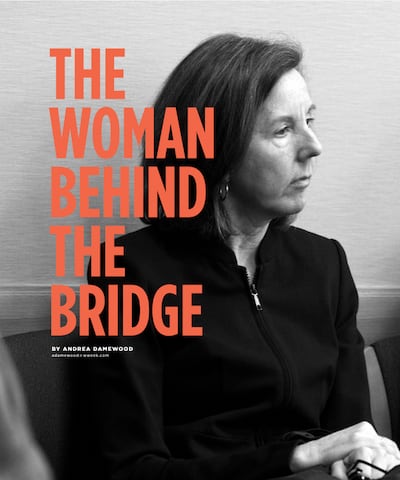
Patricia McCaig has been a political insider for decades, pulling off coups and building a reputation as someone with the strategic smarts to turn around troubled campaigns. She did it in 1990 for Barbara Roberts’ campaign for governor, for Kitzhaber in his 2010 victory, and now for the CRC.
“Five years ago, the idea that Oregon would be the likeliest state to first appropriate its share of the local match was almost laughable,” says Bill Wyatt, director of the heavily pro-CRC Port of Portland. “Patricia’s engagement has been the difference.”
Her flinty and aggressive style makes her an effective advocate and intimidating foe. “Patricia McCaig is not an ingratiating type,” says longtime Oregon pollster Tim Hibbitts, who briefly worked as McCaig’s business partner. “If I were working a major political campaign in Oregon, I would absolutely want Patricia on my campaign. Period.”
Kitzhaber has made McCaig, 58, his top adviser on the CRC, a position in which she has waged a years-long political battle to make sure 2013 is the project’s year.
But she is not a state employee. McCaig’s paycheck is signed by the CRC’s biggest contractor, David Evans and Associates, which profits by the project going forward. To date, McCaig has been paid $417,000.
Government ethics experts from across the country interviewed by WW say Kitzhaber’s use of McCaig appears to be a conflict of interest and demonstrates a lack of transparency.
McCaig’s billings show she has worked more than 800 hours since mid-2011 trying to convince Oregon lawmakers to approve the CRC. But records show she has never registered as a lobbyist with the Oregon Government Ethics Commission, which could be a violation of state ethics laws.
The long journey of the CRC—and McCaig’s role promoting it—is a telling story of the way in which a huge, deeply flawed project can still move forward via power politics and a whole lot of spin.
Kitzhaber declined to be interviewed for this story. He canceled an interview scheduled with WW two weeks ago, citing a conflict in his calendar, and has not rescheduled.
McCaig declined repeated requests to be interviewed for this story.
“My job is strategic communications,” McCaig told WW, “and this isn’t part of those strategic communications to get the bridge built.”
In the years following TriMet’s opening of the MAX light-rail system in 1986, Oregon planners have dreamed about running a train line across the Columbia River. But in 1995, Vancouver voters rejected a plan to extend Portland light rail into their city. For the next few years, officials from the two states discussed how Oregon could convince its northern neighbors to accept a MAX train.
Their answer: Build us a new freeway.
The existing side-by-side Interstate 5 drawbridges and their accompanying poorly spaced interchanges cause daily traffic jams and slow Port of Portland freight traffic.
In 2002, with Kitzhaber backing the idea, Washington and Oregon sketched out a plan for a new bridge with light rail. In March 2004, two familiar faces showed up in the office of then-Gov. Ted Kulongoski.
One was former Oregon Gov. Neil Goldschmidt, who was working for two major contractors, Bechtel Corporation and Parsons Brinckerhoff. His partner was Tom Imeson, a longtime political insider who had been Goldschmidt’s chief of staff in the governor’s office. Imeson led Kulongoski’s transition team, as he has also done twice for Kitzhaber.
Goldschmidt and Imeson urged Kulongoski to put the CRC at the top of his transportation agenda. The state Department of Transportation started planning. Over the next five years, the planned bridge got bigger and wider.
But by 2009, the CRC was in trouble. Local governments agreed to a plan, but bickered over the number of lanes on the bridge. Vancouver’s mayoral race was won by a candidate who opposed tolling—a major part of the finance plan. And criticism over the lack of money for the CRC grew louder and more credible by the day.
Goldschmidt by then had been tarnished by scandal with his admission he had repeatedly raped a teenage girl while Portland mayor. His lobbying partner, Imeson, landed at the Port of Portland.
Sources in the Kulongoski administration say Imeson and Wyatt, the port’s executive director, insisted the CRC get new leadership. The name they put forward was Patricia McCaig. (Imeson confirmed this account. Wyatt, when first asked, said he couldn’t remember what role he played, but later said Kulongoski chose McCaig without his involvement.)
“She has been involved in the public life of Oregon at the highest levels for over 30 years, so she brings quite a Rolodex and set of experiences to a job like this,” Wyatt tells WW. “That’s what she brings, a rare and unique combination of experience and contacts.”
Like Imeson and Wyatt, McCaig is part of a “chief-of-staff club,” having served that role for Gov. Barbara Roberts from 1991 through 1994.
McCaig was working as a secretary in a state agency when Sen. Frank Roberts (D-Portland) hired her in 1979 to help in his legislative office. McCaig was then 26, a University of Washington dropout from Indianapolis, where her father worked as an executive for Shell Oil.
The professorial Roberts soon made McCaig part of his family, including her in weekly Sunday brunches and holiday dinners. “She’s like my adopted daughter,” Roberts told The Oregonian in a 1991 profile of McCaig.
McCaig proved to be a keen political strategist and soon was helping Roberts’ wife, Rep. Barbara Roberts, win election as secretary of state in 1984. Six years later, McCaig staged an upset victory when Barbara Roberts beat Republican Dave Frohnmayer, the establishment’s choice for governor.
How McCaig did it is telling. Roberts trailed Frohnmayer by 15 to 20 points in the polls when McCaig poured all of the campaign’s cash into TV ads. It was August—a time when no one was paying attention to the race; Frohnmayer’s campaign chortled about her terrible misstep.
But McCaig had inside information: She knew The Oregonian was in the field with a poll that would come out right after Labor Day. The Roberts ads—showing a cheery, sunny candidate—aired just as pollsters were asking voters their opinions of the candidates.
McCaig’s strategy worked: The poll showed Roberts trailed by only 7 points, and it damaged perceptions of Frohnmayer’s invincibility. Roberts went on to beat him.
“There were not many people who thought she had a chance to win,” Hibbitts says. “I was one of them. But they put all their money into early television buys, got the momentum and never gave it up.”
McCaig ’s gruff and charge-forward demeanor contrasted with her boss’s friendly, upbeat style. But a growing power imbalance between the two was obvious enough for political insiders to start asking questions. Six months after Roberts took office, an Oregonian headline asked, “Is Patricia McCaig the real governor of Oregon?”
McCaig orchestrated Roberts’ failed efforts to pass a sales tax, including a calamitous 1992 special session in which McCaig misjudged Republican leaders and left her boss embarrassed and appearing weak.
The next year, Kitzhaber—who had served as Senate president—walked into Roberts’ office and announced he would challenge her in the 1994 primary. He turned and walked out, with Roberts chasing him down the hall, pleading with him to stop. He didn’t.
Frank Roberts died of cancer in October 1993, and Barbara Roberts lacked the will to mount a re-election campaign Kitzhaber could very well win.
McCaig and Roberts’ relationship broke apart after that, bitterly. The former governor declines to talk about McCaig. But in her 2011 memoir, Up the Capitol Steps: A Woman’s March to the Governorship, Roberts hints at McCaig’s misunderstanding of who was really governor.
McCaig, Roberts wrote, told the press the 1992 sales-tax fiasco was “the biggest public humiliation of my life.”
“Funny, but I thought the failure and loss were mine,” Roberts wrote. “There seemed in that statement a confusion of roles and perhaps even power.”
McCaig also emerged from those years with a hatred for Kitzhaber. She witnessed what she saw then as Kitzhaber’s callous treatment of Roberts, and told friends and associates of her loathing for him.
The two began their rapprochement in 2000, when Kitzhaber asked McCaig to help defeat several of anti-tax activist Bill Sizemore’s ballot measures. The next year, Kitzhaber appointed her to the state Board of Higher Education.
McCaig had been running communications for David Evans and the CRC for eight months when Kitzhaber needed her to resuscitate his 2010 comeback campaign against Republican Chris Dudley, a former Portland Trail Blazers player who was outraising Kitzhaber by a 2-to-1 margin.
McCaig became Kitzhaber’s campaign director. At that point, Kitzhaber’s campaign had been stumped as to how it should take on Dudley. “The only thing negative we had about him,” says Kitzhaber campaign staffer Kevin Looper, “was his free-throw record.”
McCaig immediately targeted Dudley’s lack of experience and knowledge about how government worked, compared to Kitzhaber’s long record—he’d served 24 years as a state legislator and two previous terms as governor.
She was also the conduit between Kitzhaber and the campaign staff, concentrating information and her influence. “She was the epicenter,” Looper says. “That campaign wouldn’t have been able to tie its shoes without Patricia there to put her finger down on the laces.”
Kitzhaber beat Dudley in one of the closest campaigns for governor in decades, winning by only 22,238 votes out of 1.45 million cast. And those close to Kitzhaber knew he could not have won his historic third term as governor without McCaig.
Elected officials who have spoken to Kitzhaber say that while he publicly endorses the CRC, in private he dislikes it.
But business and the trade unions wanted the CRC, and Kitzhaber embraced it during his 2010 campaign. Not long after he was elected, he appointed McCaig to be “lead adviser” on the CRC.
Critics had been scoring points by arguing the CRC was based on inaccurate, high traffic counts. With $110 million spent at that point on planning, a panel of experts in 2011 found the CRC was pursuing a risky bridge design. Oregon officials couldn’t get legislators to support a symbolic measure on the CRC, and a bipartisan group of 20 legislators had also signed a letter saying cost estimates and tolling projections were iffy at best.
“Before Patricia got involved in the project, the Oregon side was in deep, deep trouble,” Wyatt says. “We had no momentum.”
McCaig organized what amounted to a new political campaign for Kitzhaber that plunged him in as a full partner in the CRC.
In April 2011, he appeared at a kickoff press conference for a new bridge design with Washington Gov. Christine Gregoire—an event far bigger than Kitzhaber held when he launched his 2010 campaign for governor.
Part of the strategy was to portray Kitzhaber and Gregoire as appearing to cut costs by selecting the least-expensive bridge design.
“A lot of the agreements and commitments and arrangements that were put in as part of the package that I inherited when I was elected, I wasn’t a party to,” Kitzhaber told the crowd of politicians, labor and business representatives. “But I want to stand with Gov. Gregoire and lend my support to this project and this decision.”
McCaig came up with a strategic blueprint that looked ahead to the 2013 Legislature. To get there, she and CRC officials began to work on resistant lawmakers.
One of them was Rep. Cliff Bentz (R-Ontario), who in 2009 wrote an op-ed article in The Oregonian with Reps. Jules Bailey (D-Portland) and Brian Clem (D-Salem) questioning the CRC’s proposed cost and lack of open debate.
In 2011, Bentz was named co-chairman of a special oversight committee. He’s now a co-sponsor of the CRC funding bill.
Bentz says he became convinced the CRC was something the state, and particularly the Port of Portland, needed. And he says McCaig was the key source of those answers. “She goes and gets the facts and brings them to you,” Bentz says.
Meanwhile, CRC opponents found they were overwhelmed by McCaig’s volleys. “Patricia is getting people into rooms to lobby legislators,” says Evan Manvel, then a lobbyist for the Coalition for a Livable Future. “Every time we meet with them, we know Patricia’s got 15 lobbyists meeting with them.”
Political consultant Mark Wiener says that’s McCaig doing what she calls “running the traps.”
“She’s checking her bases, making sure all her people are covered,” Wiener says. “She is relentless about that.”
McCaig has taken bad, even damning news and spun it into public-relations gold.
One of the CRC critics’ most persuasive arguments is that the bridge won’t pay for itself: The traffic estimates are way off, and tolls from the CRC won’t carry their share of the costs. As part of McCaig’s strategy, Kitzhaber asked Oregon Treasurer Ted Wheeler to perform an independent review of the financing plans.
In July 2011, Wheeler issued a report that blew a $600 million hole in the CRC’s toll financing plan.
McCaig used the report to pitch legislators a bargain-basement bridge.
“We’ve clearly been directed by the governor, the public and conversations with you to go for a smaller project,” McCaig testified before lawmakers in early 2012. “That’s the reality of these times.”
She called for phasing in the bridge and trimming around the edges. Kitzhaber got credit for the newer, sleeker Columbia River Crossing.
But in reality, the CRC is no less expensive.
The initial phase is now $2.8 billion. But the overall long-term cost of $3.4 billion hasn’t changed. And CRC officials say doing the work later will make it cost more.
McCaig has also shown skill in deflecting the CRC’s accountability with one big misstep: The bridge had been designed too low.
After all the planning (costs have now hit $165 million), the bridge was designed at 95 feet—not high enough for major ship traffic.
When that news broke in March 2012, McCaig and CRC officials blamed the U.S. Coast Guard, which must approve the bridge’s clearance, for not warning them sooner. “It was kind of a surprise to many people, including the governor,” McCaig testified before legislators in September 2012.
Except that it wasn’t. Coast Guard officials say the CRC knew the bridge was being designed without enough clearance. McCaig ’s own invoices show that on Nov. 1, 2011, more than four months before the news broke, she spent 21⁄2 hours advising “CRC leadership on emerging Coast Guard permitting issues.”
CRC planners have since bumped the height to 116 feet—which is still too low for some commercial traffic—and have dared the Coast Guard to reject it.
The CRC’s financing and toll-revenue plans are still shaky, traffic figures are far below projections, and political opposition is growing stronger in Clark County and Washington state by the day.
Despite this, McCaig ’s efforts have led to a bill that nods to many of those concerns. Legislators from both parties say they face growing pressure to vote for the measure, though they decline to talk on the record about it.
But what they describe is similar to the hard sell McCaig recently gave Bob Stacey, the newly elected Metro councilor and CRC foe.
Stacey says McCaig met with him Jan. 22 to convince him to change his mind about the CRC. (Metro has already given its OK to the project.)
“She wanted me to come over and start working and supporting the project as an elected official,” Stacey says. “She said it’s time for me to start helping rather than hindering.”
Stacey says he told her the CRC is wasteful, poorly designed and damaging, and that he would do his best to bring it to a halt.
“She said that was an arrogant conclusion that showed obvious disrespect for people who had worked so hard on the project,” Stacey says.
Nonetheless, Stacey says he knows McCaig has a winning technique. “I wish she were somebody those of us who have concerns about the cost and harm of this project could go to to help us deliver those messages,” Stacey says. “But that’s not the side she’s working on.”