Skip to main content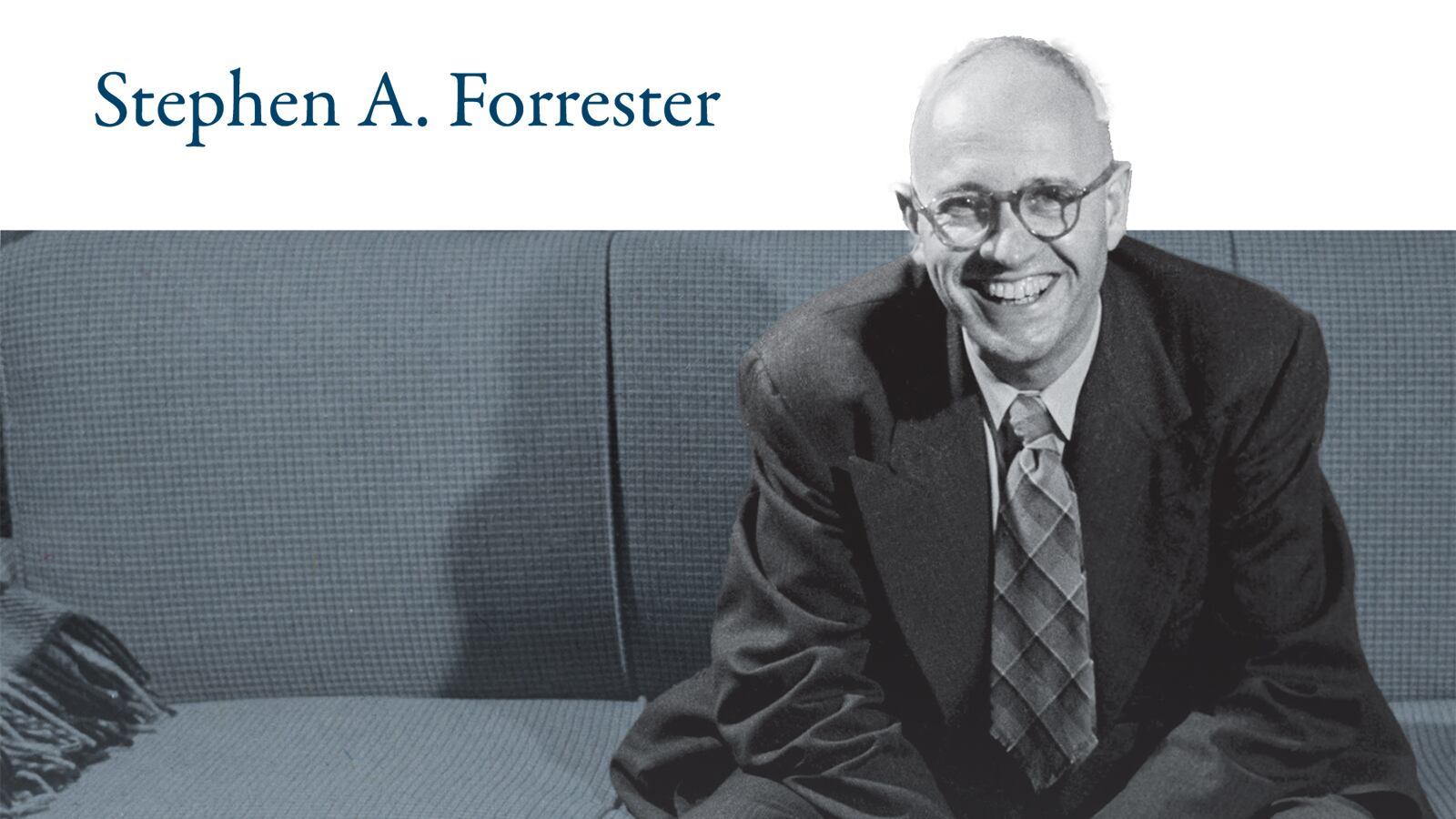
Portlanders who can remember what the city’s younger denizens now call “Old Portland” may recall a brash young Neil Goldschmidt as mayor and a progressive Republican (yes, really) named Tom McCall as Oregon’s colorful governor. Few will remember U.S. Sen. Richard Neuberger, except maybe as the namesake of Portland State University buildings.
Steve Forrester remembers. Before he co-founded Willamette Week in 1974 and became editor and publisher of The Daily Astorian, Forrester was a page in the U.S. Senate in 1963 for Neuberger’s wife, Maurine, who had been elected to succeed her husband after his untimely death at age 47 in 1960. Forrester’s father, Bud, and Dick Neuberger were friends and editors at their respective college newspapers at Oregon State and the University of Oregon in the 1930s, and the Neubergers were regular dinner guests in the 1950s at the Forresters’ Pendleton home.
Forrester’s new biography, Richard Neuberger: Oregon Politics and the Making of a US Senator (OSU Press, 250 pages, $29.95), opens a doorway to another time in Portland and the state. And a pivotal time it was, as Neuberger, the first Democrat from Oregon to be elected to the U.S. Senate in 40 years, paved the way for the modern, unabashedly liberal Democratic Party that would emerge in the ensuing years and predominate the state’s politics today. Forrester will discuss Neuberger and his biography with Judy Margles, director emerita of the Oregon Jewish Museum and Center for Holocaust Education, at the museum on Nov. 16.
As with Neuberger’s single term in the Senate, cut short by stroke, readers will wish Forrester’s biography were twice as long. To say Neuberger—a prolific journalist, author and lawmaker—was ahead of his time is not a cliché, but an understatement. In his brief career in Salem as well as Washington, D.C., Neuberger championed causes, usually environmental, that were almost sure losers in the more conservative Oregon and nation of the time, but that would prove unlikely winners in the years and decades to come.
In the sweeping legislation that spawned President Eisenhower’s interstate highway system, for example, Neuberger managed to sneak in financial incentives for states to limit billboards along highways—a largely symbolic gesture perhaps, but a precursor to first lady Lady Bird Johnson’s Highway Beautification Act a decade later. Meanwhile, Eisenhower had already signed the Klamath Termination Act of 1954 to dissolve Oregon’s Klamath Indian Reservation when Neuberger took office in 1955. Instead of standing by while timber interests bought up land owned by the Klamath Tribes for pennies on the dollar, Neuberger parlayed his chairmanship of the Subcommittee on Indian Affairs to shepherd a bill through Congress for the federal government to acquire the land, leading to the creation of the Winema National Forest in 1961.
A recurring question in Forrester’s biography is whether Neuberger viewed himself more as a writer or a politician. The answer, Forrester concludes, is more nuanced: Neuberger was a conversation starter who shaped public opinion: a vocation he pursued from an early age. While he was still a student at Portland’s Lincoln High School, Dick Neuberger’s byline appeared regularly in The Oregonian, where he started hanging out in the newsroom at age 15. At the University of Oregon, Neuberger rapidly ascended to editor of The Daily Emerald, where he crusaded to end military training on campus and lower the university’s tuition, which, at a whopping $32 a quarter in 1933, was squeezing students in what was then the Great Depression.
Then, that summer, when Neuberger was still only 20, too young to vote or even buy a beer, the young, fiercely proud son of German Jews joined a German-speaking uncle on a backroads tour of Hitler’s Germany. Neuberger exposed the lies behind the Nazis’ propaganda and the already deadly antisemitic violence in “The New Germany,” an eye-opening article published in The Nation a full five years before Kristallnacht and six before Hitler’s invasion of Poland.
Remarkably, Neuberger never graduated from UO; the pull of the freelancer’s pen simply proved too strong. In 1936, he became Northwest correspondent for The New York Times, a position he held until 1954, the year he was elected to the U.S. Senate. No subject was too far afield for his typewriter (in addition to countless newspaper stories, Neuberger wrote more than 700 magazine articles in his lifetime and authored six books); he once even wrote a children’s book about the Royal Canadian Mounted Police.
Before leaving the university for good, however, Neuberger took a crack at UO’s law school, where his mentor was future U.S. Sen. Wayne Morse, then the nation’s youngest law school dean. Neuberger withdrew from the law school in 1935 after becoming embroiled in a note-cribbing scandal in which he was charged with plagiarism (he wasn’t trying to steal anyone’s work; he was simply too busy writing to be bothered with attending classes). The charges were later dropped, and Morse would remain Neuberger’s political counsel, and to some extent fixer, through the mid-’50s.
Morse is best remembered by Oregonians as the stubbornly courageous lawmaker who cast one of two Senate votes against the Gulf of Tonkin Resolution in 1964 that freed President Lyndon Johnson to escalate the U.S. war in Vietnam. In Forrester’s book, however, Morse emerges as something quite different: a vindictive, polarizing figure who feuded bitterly with Neuberger in the latter years the pair served together in the Senate. Forrester probes the root causes of the feud, which remain unclear, but the trigger appears to have been a routine bill to transfer a historic home from the federal government to the city of Roseburg. Neuberger backed the transfer at no cost; Morse wanted the city to pay.
Morse’s inexplicably heated vendetta, Forrester writes, lived on even after Neuberger’s death. Maurine Neuberger—who had formed a groundbreaking partnership with her husband when the couple served together in the Oregon Legislature in the early 1950s, Maurine as a state representative, Dick as a state senator—filed her own candidacy in 1960 to succeed him in the U.S. Senate. In the meantime, however, then-Oregon Gov. Mark Hatfield, a Republican, was tasked with appointing an interim replacement from Neuberger’s party. Instead of giving Maurine Neuberger a leg up by endorsing her, Morse recommended that Hatfield appoint Oregon Congresswoman Edith Green to the seat, figuring the two women would sufficiently weaken one another in the primary that the Republican nominee would defeat the winner in November. “That way,” Forrester quotes Morse telling Hatfield, “we would get rid of both the bitches.”
The centerpiece of Forrester’s book remains his suspenseful account of Richard Neuberger’s narrow election to the Senate. The Neubergers cast their ballots at Ainsworth Elementary in the solidly Republican enclave of Portland Heights where they lived. Schoolchildren booed them that morning, making the Neubergers’ niece break down in tears in front of newspaper photographers. The vote count would stretch for a couple of nail-biting days, with an entire nation watching as control of the Senate hinged on a single race in Oregon.
In the final count, Neuberger won by 2,462 votes out of 569,088 cast, less than one vote per precinct across Oregon. The effects were both immediate and long term. Democrats regained control of the Senate, making way for the ascension of Lyndon Johnson as majority leader and passage of the Civil Rights Act of 1957 (Neuberger voted aye, Morse nay). In 1956, the former Independent Morse was reelected to the Senate as a Democrat by 61,000 votes, and Oregon Democrats swept the rest of the federal offices down the ballot.
The effect of Neuberger’s legacy on state and national politics had a funny side as well, as illustrated by an anecdote Forrester includes near the end of his book. Four months before his surprise nomination for vice president at the Democratic National Convention in 1960, Lyndon Johnson spoke at Neuberger’s memorial service at Temple Beth Israel, paying tribute to the senator who had handed him and his party control of the Senate. During the day, Johnson and other dignitaries made their way to the Neubergers’ home on Southwest Clifton Street.
“As Johnson walked in, he removed his raincoat and handed it brusquely to a young man near the door, then moved on, leaving Governor Hatfield holding the majority leader’s coat.”
SEE IT: Stephen Forrester in conversation with Judy Margles at the Oregon Jewish Museum and Center for Holocaust Education, 724 NW Davis St., 503-226-3600, ojmche.org. 2 pm Sunday, Nov. 16. Free with $5 museum admission.