Skip to main content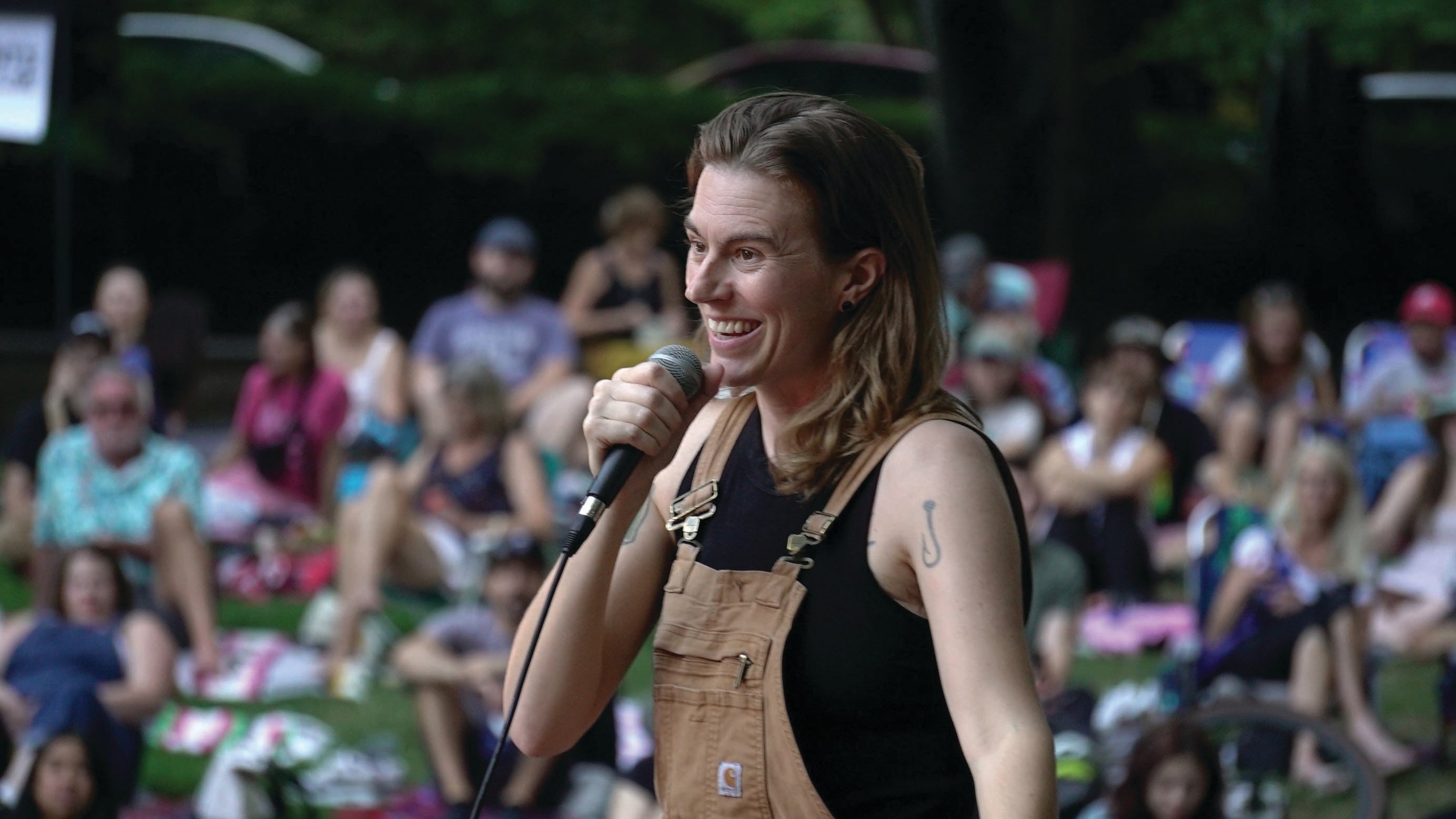
Once comedy shows, live music, improv, and produced theater were the primary jewels in our town’s nightlife crown. But now, live storytelling—evidenced by shows produced not only at clubs, black box theaters, coffee shops, and bars, but also at Powell’s City of Books and the Portland Art Museum’s Center for an Untold Tomorrow at Tomorrow Theater—is one of the most accessible art forms the city has to offer.
And in an era of community reconstruction, perhaps these storytelling events are what the city needs.
“A comedy audience leans back in their seat, but a storytelling audience leans forward,” says Frayn Masters, founder of seminal story event (and now podcast) Backfence Storytelling. “They’re with you. You could have a famous actor and a first-time storyteller on the same stage, and it doesn’t matter. What matters is vulnerability.”
Masters speaks with the authority of an architect: Her Backfence productions have recently partnered with Powell’s Books and occasionally sell out the top floor of one of the city’s most respected storytelling (and story reading) institutions.
“Portland audiences are incredible,” Masters adds. “Engagement is deep. The Moth’s biggest mainstage is here. Storytelling really works as a community-building tool.”
For many, The Moth’s storytelling universe (stage shows, open mics, a podcast, and even anthologies) is their introduction to the form, evidenced by the sold-out crowds the bimonthly events draw, as well as their choice to include Portland as one of the few cities to host their Mainstage extravaganzas. In fact, many of Portland’s favorite tellers got their starts at Moth open mic nights, where the entire audience is encouraged to sign up, and sign-ups are drawn at random, giving 10 speakers five minutes each to tell their tales. The performers are the audience and the audience are the performers; the format blurs the line between stage and seat so effectively as to cancel each other out. Everyone in the room is, for better or worse, in it together.
Indeed, the idea behind most of Portland’s storytelling showcases is that everyone has a story, and unlike comedians or actors, or improv performers, storytellers don’t necessarily need a stage education. With live storytelling, an emotional connection transcends the performer/audience relationship. Stories become currency; they’re recognized as the machine that pushes culture forward; they’re celebrated as a kind of intergenerational record of the time we share on earth.
“With storytelling, the barrier between the performer and audience is thinner,” explains Tod Kelly, a longtime story show producer whose upcoming Church storytelling series was produced in partnership with PAM CUT’s Tomorrow Theater. “You can see someone absolutely crush it, then the next person bomb completely. That vulnerability creates community in a way comedy shows and theater often don’t.”
“It gives people space to feel seen and to participate,” Kelly says. “People tell me all the time that they don’t have a story to tell, and I always say, ‘You have so many stories! You might not have structured them yet, but they’re there.’
“Everyone has at least one story they could tell onstage. Usually, they have dozens.”
Ash Allen, a storyteller, comedian, and host of Shady Pines Radio show Porch Hang, whose presence at both laugh-ins and story slams is fairly concrete, has a similar take on the growing storytelling scene and its effect on Portland’s nightlife.
“In storytelling, people are leaning in with their arms open. It feels like you can’t really fail, because even if your story goes sideways, the audience is holding you the whole time,” Allen says. “They want you to land the plane.”
“With comedy, there’s more of a ‘prove it’ feeling. People cross their arms a little more and wait to be convinced. It’s not antagonistic, but it’s less forgiving.”
While storytelling is by no means new to Portland, the energy around it has been pitching up exponentially since the colliding forces of late-stage capitalism and post-COVID malaise threatened to isolate us indefinitely.
“Honestly, no one really knew what ‘storytelling’ was when we started Backfence in 2008,” Masters explains. “The Moth podcast hadn’t blown up yet. Portland Story Theater and Mortified existed, and Live Wire was also a huge inspiration, but I still had to explain to people what storytelling even meant.”
“People thought it was for kids,” she adds with a laugh.
Tod Kelly, who produces shows for both all-ages and rowdy 21-plus audiences, echoes Masters’ sentiment: “It’s the only art form I know where the same story is never told the same way twice. It exists in the moment.”
“Once it’s gone, it’s gone. That’s the magic of it.”
GO: Church: Wrath at Tomorrow Theater, 3530 SE Division St., 503-221-1156, tomorrowtheater.org. 7:30 pm Thursday, Dec. 11. $20. 21+.
LISTEN: Backfence Unhinged on XRAY.fm. 7:15 am Wednesdays, or anytime on other streaming platforms.
LISTEN: Porch Hang on shadypinesradio.com. 5–6 pm Tuesdays.