Skip to main content
The building isn’t pretty. To most, it’s just a dingy gray box slumped against the back of the Crystal Ballroom. But to architecture writer Brian Libby, it is among Portland’s most towering monuments.
The building at 411 SW 13th Ave. is where Portland inscribed itself into rock-and-roll history. It’s where the Kingsmen recorded “Louie, Louie” on a crappy microphone hung from the ceiling—so lo-fi that the FBI spent two years investigating whether the song’s inscrutable lyrics were dangerous to America.
“There are hundreds of people here right now, in cars and on foot and bicycles and scooters and in these buildings,” Libby said, gesturing outside on a hot evening in August. “Chances are that none of them know about that song being recorded there.”
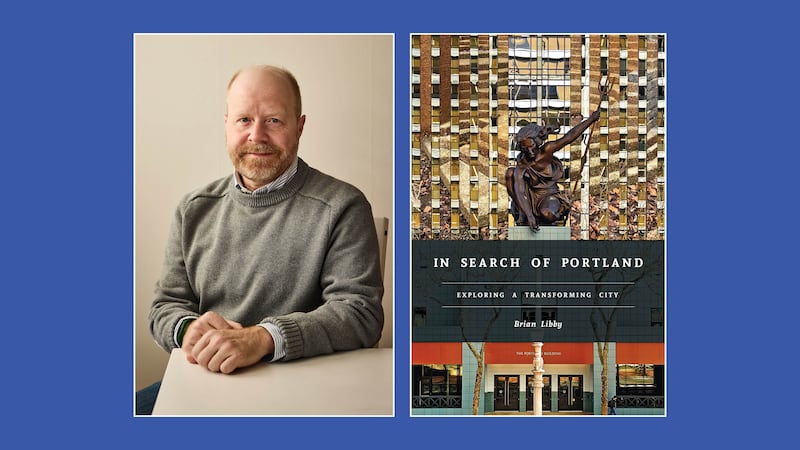
Libby’s new book, In Search of Portland: Exploring a Transforming City (OSU Press, $30, 276 pages), is devoted to uncovering similar histories that hide behind the anonymous faces of countless Portland buildings.
The book is constructed as a series of pleasant little walks across the westside, with Libby, who has spent decades chronicling Portland’s evolving architectural landscape for publications from WW to The New York Times, as a personable guide.
There’s the one about Humphrey Bogart’s favorite table at Jake’s Crawfish, the story of how Gov. Tom McCall helped save Pioneer Courthouse Square, and the former nightclub where a young Sammy Davis Jr. held court. One comes away richer, with a renewed sense of the city as a living thing.
Last month, as his book prepared to publish, I invited Libby out for a walk to see downtown Portland through his eyes—beginning at Libby’s former home in Portland, the Empire Apartments.
The Empire Apartments (1217 SW 11th Ave.)
The low-rent Empire Apartments, across from the now-demolished St. Francis Hotel where Gus Van Sant filmed a scene with William Burroughs in Drugstore Cowboy, were Brian Libby’s first Portland home in 1997. The Empire is also where the idea for Libby’s book began, when he visited his old block 20 years later.
“I had that moment standing outside the Empire Apartments in 2017, and seeing that just about everything had been torn down and replaced,” he said. “People don’t quite realize how much the city is continually changing and rebuilding and remaking itself…. I started to think of a manuscript that I would write as kind of a mental map, or a way of preserving the memory of these places, even if they were to disappear in my lifetime.”
The Hotel Rajneesh (1115 SW 11th Ave.)
At least one building near Libby’s old haunt remains intact: a century-old brick building now home to affordable housing under the name Campbell Court House. But in the 1980s, it was better known as Hotel Rajneesh, owned by Oregon’s most famous cult.
“There was actually basically a terrorist bombing there,” Libby said. “Even though the Rajneeshees were later infamous for carrying out an attempted act of domestic terrorism of their own, they were actually the victims here. Some other fundamentalist who opposed the Rajneeshees planted a bomb [technically, three small bombs].” No one but the bomber was hurt.
Odd Fellows Building (1019 SW 10th Ave.)
This hulking terra cotta and concrete gothic edifice—now home to senior apartments—was arguably where the Oregon ballet was born, Libby tells me as we round the corner.
“On the third floor, there was a woman who had a popular dance studio up there and offered dance classes,” Libby said. “This woman, Jacqueline Schumacher, was in the first American production of Swan Lake. She was the White Swan.… They were supposed to take it on tour nationwide. But then Pearl Harbor happened, so it all got canceled. And she moved back to Portland.”
A bushy-bearded building resident—outside packing a pungently herbal pipe while sitting on a sidewalk deck chair—looked up to disagree. “No, no, no, no, no!” he said, genially. “The dance studio was in the basement!”
Libby blanches, wondering if he’d made a mistake. But this basement studio turned out to be quite a bit more modern. The Odd Fellows Building is a dance-filled place, it seems.
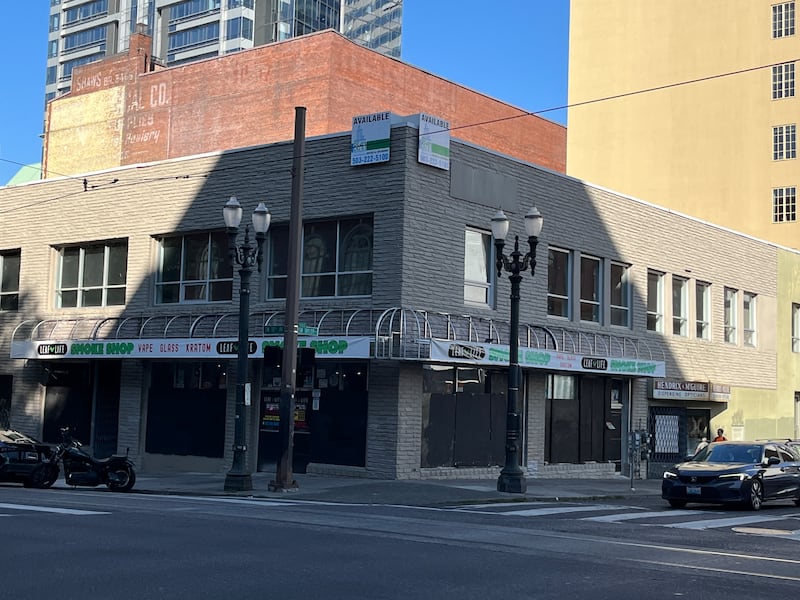
The Clover Club (923 SW 10th Ave.)
In the book, Libby spends time describing WW’s former newsroom on Southwest 10th Avenue, which is now vacant second-floor office space across from the Central Library. There, still-green reporter Nigel Jaquiss used to buttonhole sources by keeping his eyes out the window. “I would know when somebody had lost their job because they’d be at the library,” he told Libby in an interview published in the book.
But a block south of this is a less-remembered landmark, where Hendrix & McGuire Optical now does business. The tiny Clover Club was where a young singer and dancer named Sammy Davis Jr. got his first standing gig, in a musical trio alongside his father. “I believe Sammy Davis Jr. was performing in Portland when he got a cable from Frank Sinatra inviting him to join him,” Libby told me.
“OPEN CAPITOL THEATER NEW YORK NEXT MONTH,” the telegram apparently read. “FRANK SINATRA SHOW. THREE WEEKS. $1250 PER. DETAILS FOLLOW.”
That arrived in 1947. And so long, Portland.
The Ritz-Carlton (900 SW Washington St.)
Libby doesn’t care about the fancy glass towers of the Ritz-Carlton, completed in 2024. His book instead lovingly describes the popular 10th and Alder food cart pod that the hotel controversially replaced—a bustling town square of international foods that arguably defined Portland’s downtown for a generation of residents and visitors. The pod was the birthplace of more than one restaurant, including Nong’s Khao Man Gai.
“I love the idea that food carts are architecture just as important as our fanciest building, if not more so,” Libby said. “I love that a repurposed mail truck that’s held together with duct tape can be more valuable to our cultural fabric than this extremely expensive tower of condos.”
SEE IT: Brian Libby appears in conversation with art writer (and WW contributor) Richard Speer at Powell’s City of Books, 1005 W Burnside St., 800-878-7323, powells.com. 7 pm Thursday, Sept. 15. Free.