Skip to main content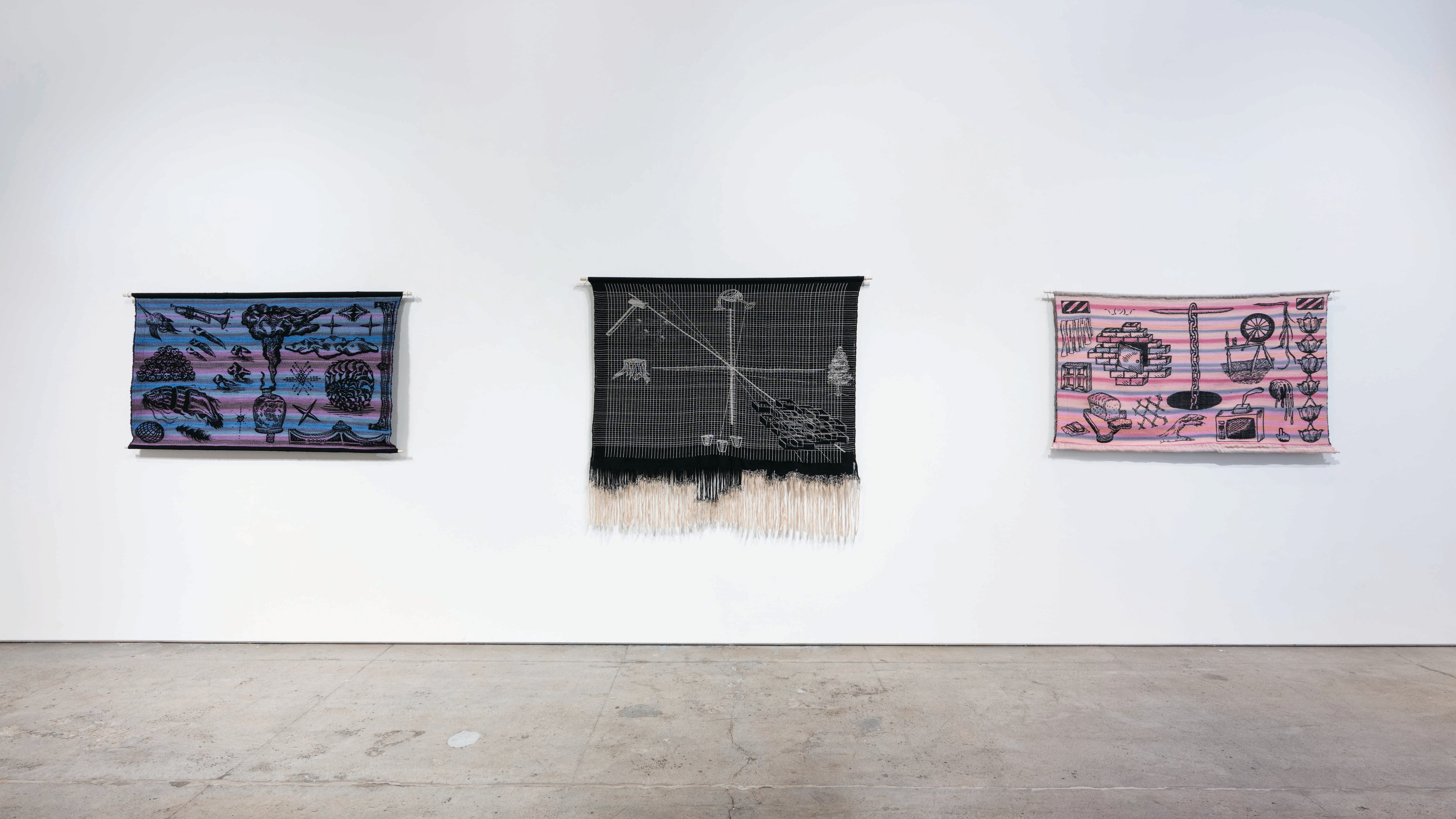
Many Portland TextileX Month events address textile art straightforwardly. Taking up this year’s theme, “Layers of Resilience,” from the craft and industrial perspective, they let the materials themselves tell their long and diverse histories. Downtown, vintage shop Poubelle & Marshall is hosting an exhibition of rescued and reworked textiles. Fiber artist Helen Kennedy is giving a lecture titled “The Resilience of Wool.” But Contemporary Textiles, a group exhibition at Elizabeth Leach Gallery, represents a kind of experimental capsule, stretching the possibilities of fiber arts in the fine arts space.
For some, the fiber arts represent a community—a communal practice to gather around, as well as a rich history of traditions handed down from one generation to another. For others, textiles embody the act of creation, world-building and collective imagination. The works in Contemporary Textiles pull at both ends of the spectrum, leveraging heirloom materials and techniques to explore the cultural histories and emotions embedded within.
On view through Halloween, the show puts works by six artists—MK Guth, Elizabeth Hohimer, Ellen Lesperance, Mary Ann Peters, Vo Vo and Anna Von Mertens—into rich conversation.
At the outermost bounds is Lesperance, a Portland artist whose dizzyingly detailed knit patterns involve no fibers at all. Her 10-color lithograph XOXOX (All Day), for example, weaves together the primary colors of daylight (i.e., red, green and blue) in repeating geometric iterations reminiscent of Fair Isle knit patterns. Where they overlap, novel colors and connections mimic hues the eye captures throughout the day.
Though Lesperance relies on pencil, ink and paint to work her magic, her work pays homage to the meticulous process of making knit garments by hand—a practice humans have observed practically since the dawn of time. At the same time, through material experimentation, her work pulls textile art into the present.
On an adjoining wall, New Hampshire artist Anna Von Mertens’ A sunrise you might see, not unlike the one I saw yesterday (September 19, 2007 and September 19, 2082), works a similar magic onto a hand-dyed cotton canvas of sorts. Sweeping diagonal stitches mimic the motion of star patterns from the dates in the title, and Mertens’ color gradient captures the glow on the horizon just before sunrise, in all its marigold glory. While hers is perhaps the most conventional textile artwork in the room (it’s recognizable as an elegantly minimal quilt), it captured my attention longest and, as the gallery describes, perfectly “materializes the act of stargazing.”
Austin artist Elizabeth Hohimer’s Totem 12 represents the materials-gathering aspect of textiles, juxtaposing the dry sweep of a Texas field with the cool severity of, perhaps, industrial machinery. Bundles of agave fiber stack to make a tidy column, like a group of hay-colored broom heads, which dangles beneath a small steel shelf. Atop the shelf, a metal ball balances improbably.
Nearby, Portland and Coeur d’Alene, Idaho, artist MK Guth’s braided fabric tapestries—3:42 AM and Black Hole—recall the tedious but familiar process of braiding hair. By interlocking long braids with tightly knit buds, the artist renders a roiling sea of matte black charmeuse ribbons. The craftsmanship required to complete a work of this complexity and scale prevents the naive “I could make that” critique of abstract art, but more interesting is how Guth’s work opens the notion of abstraction in the textile arts. How representational can any depiction of a black hole be?
What Guth makes abstract, Vo Vo translates not into language but into symbology. In the Portland artist’s triad of blanketlike tapestries, each hung at eye level, the Layers of Resilience theme is brought clearly into focus. Sign of the Times (Doom Doom) leans into symbols of violence, death and anxiety—a pile of skulls, a forewarning trumpet—to visualize the dread that permeates many of our lives. Practice Information Hygiene presents a kind of lexicon for escape, healing and social change—an open window, freshly sliced bread. Co-opting a graphic style often associated with colonialist and imperialist imagery, Vo Vo interacts directly with the viewer, sustaining a conversation through both the rich connotations of the materials and representational imagery.
The centerpiece of the show, to my mind, is Seattle artist Mary Ann Peters’ wall-sized installation, impossible monument (the threads that bind), which melts off the wall and spills onto the floor. Because it employs fabric—silk, silk pods, silk threads—it meets the necessary qualifications to be included in an exhibition titled Contemporary Textiles; however, it seems to me less like textile art and more like an intervention.
You basically have to step over it to enter the room, which delights me to no end. Because of the history and heritage impossible monument gestures toward (female silk workers in Lebanon) and the political context the work addresses (as I write this, Israel continues attacks on southern Lebanon), this kind of intervention feels appropriate.
From a decorative wooden frame near the ceiling, a sheet of glycerin resembling a partition or wall blisters and oozes, as if a destructive fire has just been put out. Out of the bottom of a tapestry, reams of colorful silk gush like a chemical spill. There is nothing straightforward about it.
SEE IT: Contemporary Textiles at Elizabeth Leach Gallery, 417 NW 9th Ave., 503-224-0521, elizabethleach.com. 10:30 am–5:30 pm Tuesday–Saturday; through Oct. 31. Free.