Skip to main content
The phrase “female money spread” was coined, in jest, to describe a social media photo of one’s Sephora haul. Imagine a half-dozen candy shades of eyeshadow or Kylie Lip Kits fanned in a palm like cash. More recently, the trend has shifted to antiques. The female money spread du jour is an Instagram carousel of tastefully tarnished wares: gilded handheld mirrors, porcelain cups, celluloid Soviet-era toys, ivory brushes, and so on. The trinkets are rarely in situ. That’s hardly the point. Instead, these delicate objects of another time are set against a neutral background to emphasize their patina, their rarity, their thing-ness. The point is to forge a symbolic link to the past. The point is to live vicariously—time travel, even—through inanimate objects. It’s a fantasy, sure, but a nice one.
The female money spread can illustrate the mind of a young person online in the 21st century, which at times gropes for an idealized version of the 19th. The Japanese artist Tomoya Matsuzaki, whose first solo show in the United States is currently at Adams and Ollman gallery, has a way of transporting you to both at once.
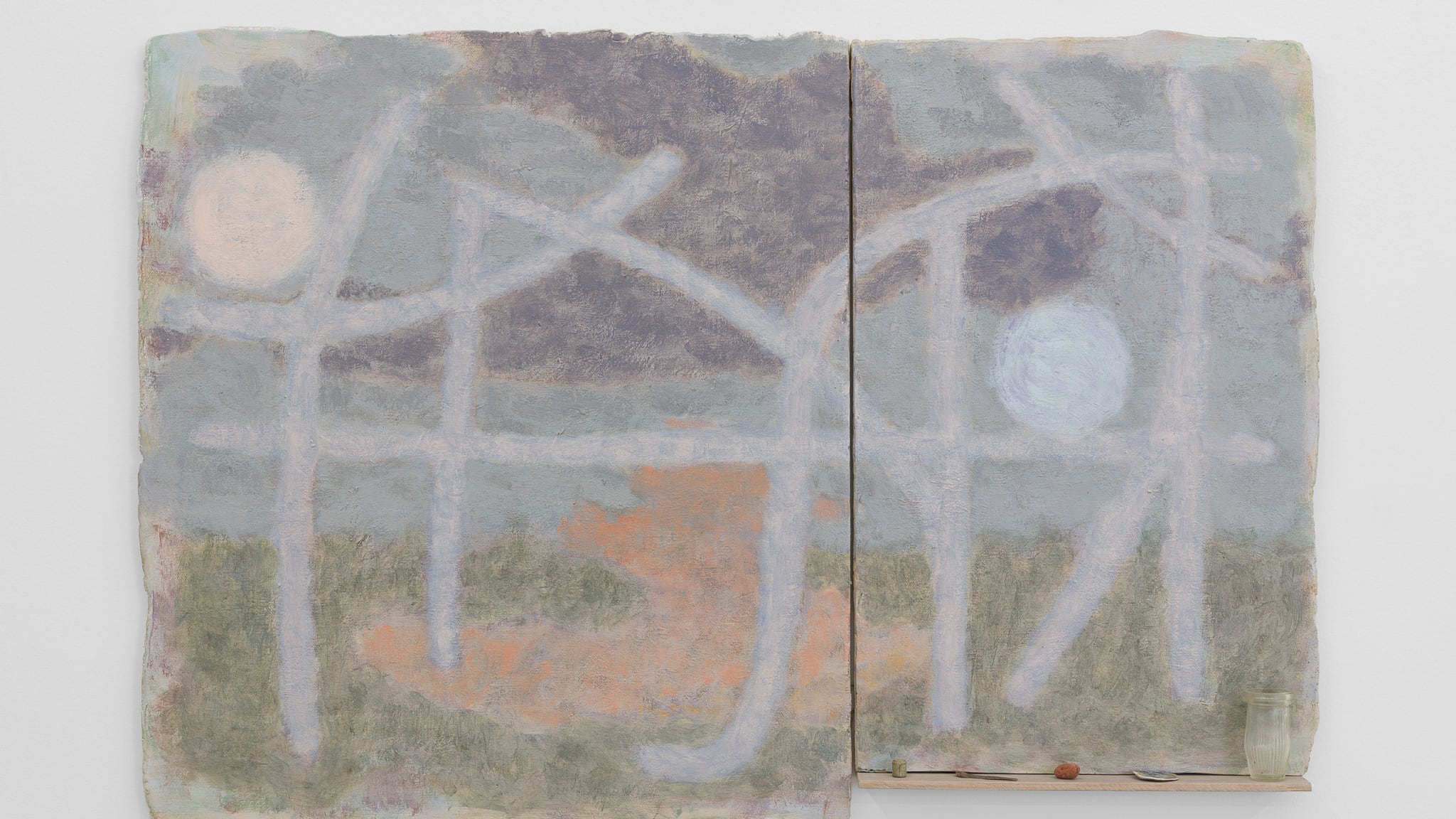
Many of Matsuzaki’s atmospheric oil paintings juxtapose fuzzy abstractions with palm-sized trinkets, some of which trace to 19th century London. His little oddities—clay pipes, shells, glass bottles, mineral aggregates and pieces of hardware—sit on shelves extended from the bottom edge of the paintings.
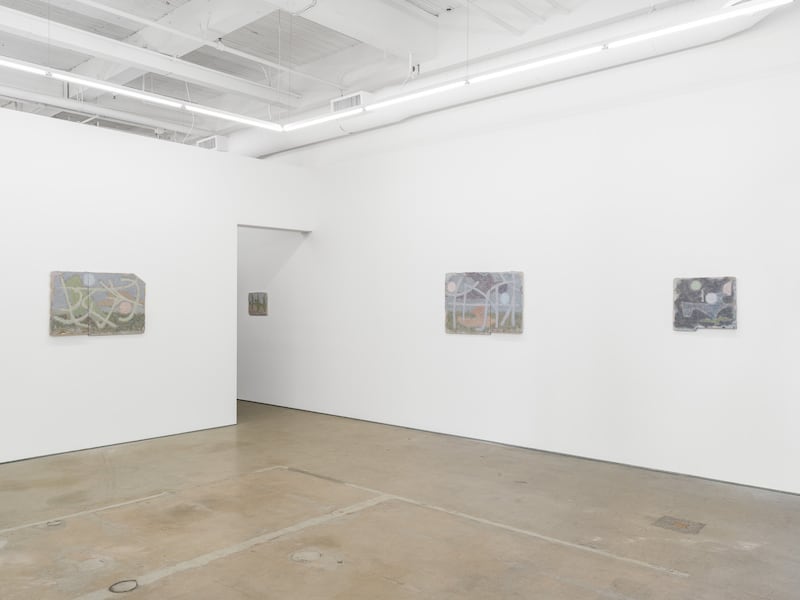
At first glance, the vignettes provide the sedative effect of swiping through a “female money spread.” Several of the irregularly shaped resin panels are hung in satisfyingly asymmetric pairs, and all are painted in with comfortingly chalky pastel colors. But there’s more to dig into here. These aren’t palliative social media posts.
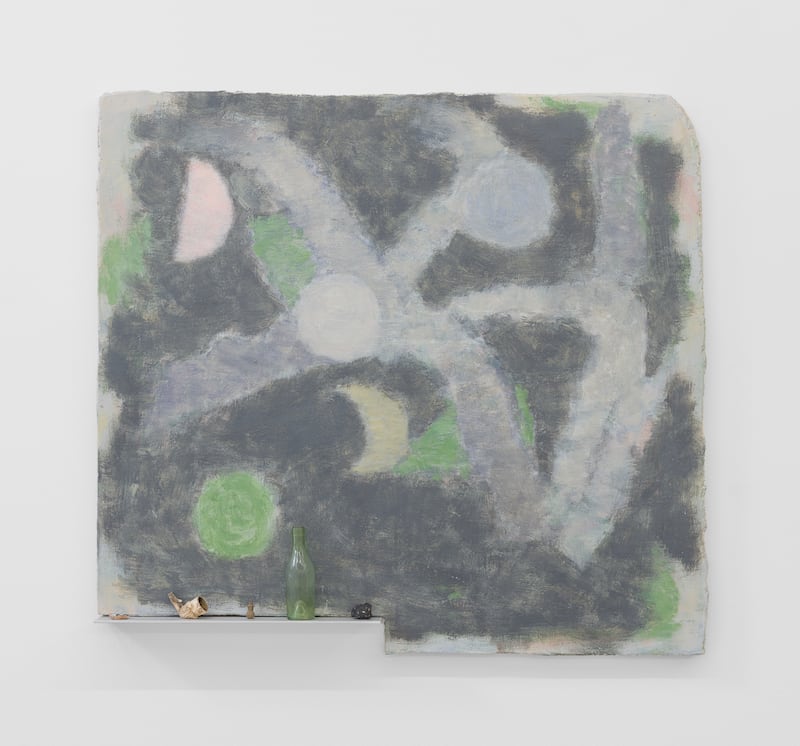
Remnant (umbra), one of the smaller and darker paintings of the set, has a thin aluminum shelf notched across its base. On it: a tiny green glass bottle, an ornately carved pipe, a pottery shard, a speckled metamorphic rock and, possibly, an earthenware bead. The painting seems to reflect the color and shape of each, but something more nebulous makes the grouping feel inarguably coherent.
Matsuzaki collects most of the objects in his assemblages through a process called mudlarking, meaning he pulls them out of London’s River Thames. Londoners have been scavenging the river’s edge at low tide since before the 19th century. Originally, it was a way for the poor to scrounge up quick cash. Matsuzaki has been mudlarking for more than a decade, but he’s seen the river’s shore transform as the pastime gained rampant popularity during COVID.
He was mudlarking before it was cool, sure, but, either way, Matsuzaki is no trendy historical fetishist. In an interview produced to accompany this show, the artist emphasized that he’s primarily interested in “the moment of encounter.” While the objects’ history interests him, and it may even later inform the painting, it’s somewhat anecdotal. Instead, Matsuzaki foregrounds the objects’ formal qualities—shapes, textures and hues, as well as a blurrier quality you might call their presence.
Matsuzaki’s curated shelves are not shortcuts to beauty or meaning. They don’t hinge on mythology, real or imagined, as a carousel of Instagram photos might. He is not making any kind of money spread. He is bottling the feeling of looking at one. The objects become something else in his hands, and it’s that shift, that encounter, that’s indefinitely prolonged in the paintings.
Somewhat ironically, it’s in the paintings that lack a shelf of reference objects that this focus on first impressions comes through strongest. Straw yellow branches crosshatch much of Untitled (estuary), a small single-panel painting. A gray orb nestles into the space where two branches meet, an illusion of forced perspective perhaps, like the moon getting caught in a tree. Beyond that is a shadowed landscape to wander. I don’t notice the absence of objects as much as I suspect they are there, in a sense, just out of view.
Another painting, Bascule (dawn), complicates the idea. Its objects appear to complete the picture. A colorless glass bottle, clouded with scratches from tumbling along the bottom of the river; an orange stone; a stick; a mussel shell worn to waxy suppleness—at a certain distance, the thingness of each object loses focus. The shallow wooden ledge on which the objects rest all but disappears. No longer do they have identities like “bottle” or “bone.” They are brown, oblong, and porous. In other words, they become mere contributions to a balanced arrangement of discernable parts. They are, in fact, not a female money spread at all. They are a painting.
SEE IT: Tomoya Matsuzaki at Adams and Ollman, 418 NW 8th Ave., 503-724-0684, adamsandollman.com. 11 am–5 pm Wednesday–Saturday, through Nov. 21; through mid-December by appointment. Free.