Skip to main content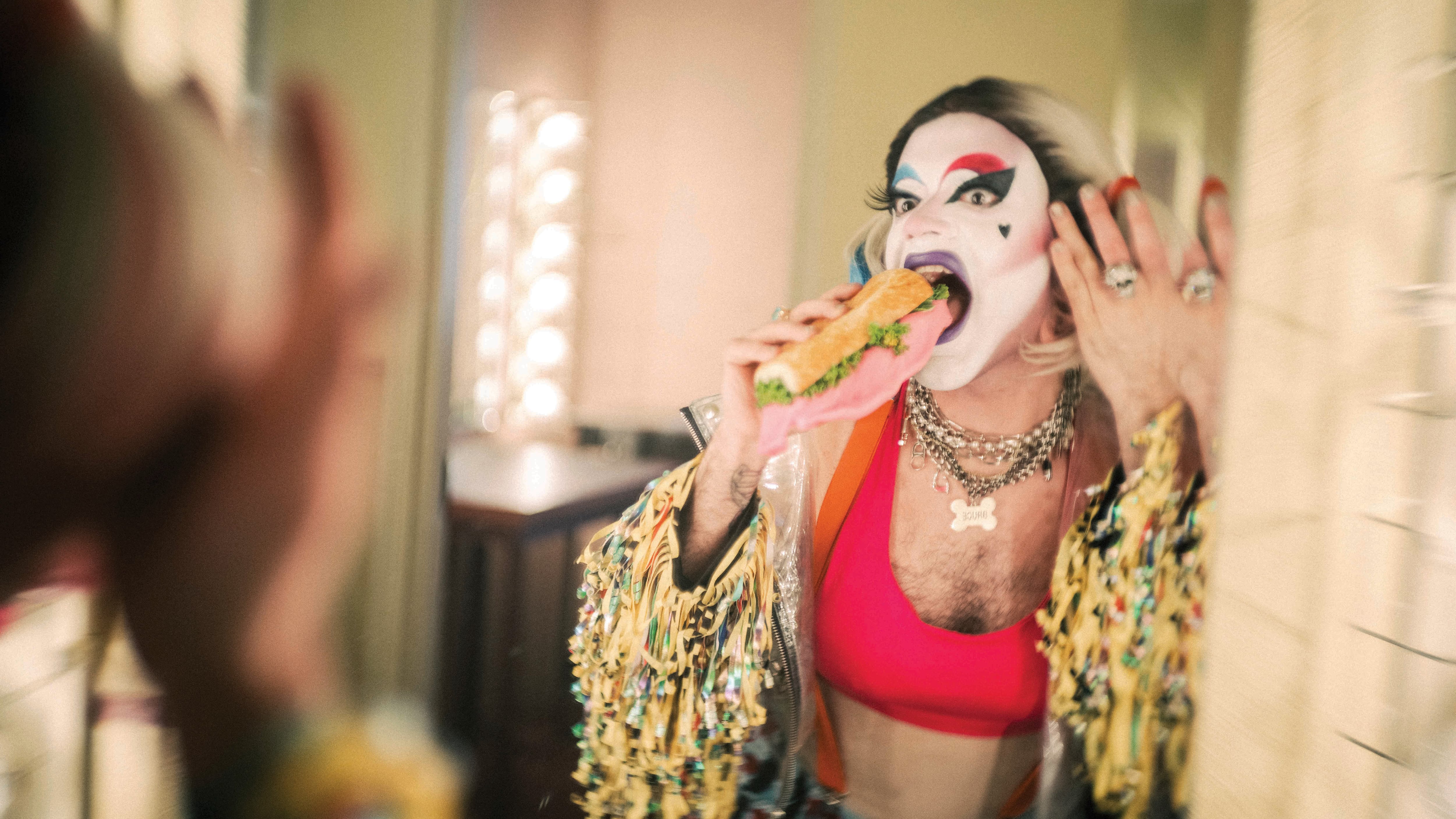
After more than 15 years of razor-sharp cultural commentary, Carla Rossi is retired.
This doesn’t mean Anthony Hudson is putting his most famous creation in her crypt for all eternity: Hudson will still perform programming duties at the Hollywood Theatre, but Queer Horror—a long-running and locally beloved movie night with a prefilm drag show—is effectively over.
“You know how everybody is unbearable, and we all talk about our nervous systems, but we don’t know anything about science or what that means? I’m one of those people now, and my nervous system has been punishing me,” Hudson says. “As much as I love drag, as much as I love Carla, it is just not what I want to be doing right now, as the world melts and white billionaires destroy civilization. But another part is, I always told myself I wouldn’t keep painting on the clown face once it was time to start taping my skin up like [Real Housewives of Salt Lake City cast member] Lisa Barlow pre-Season 6, and now that I’ve finally reached that point, it’s time to put away the clown nose.”
It’s been a long time coming. During the pandemic, Hudson realized how deeply he was burnt out on Rossi’s time-intensive performances, which included writing, character preparation and, oftentimes, video production: Each performance took roughly two months of work to execute.
These performances have ranged from five-minute to one-hour short acts—like bar gigs, Queer Horror intros, or the Tomorrow Theater’s Ask Dr. Carla drag improv series (which will continue in a very limited capacity)—to full theatrical productions such as the critically acclaimed Looking for Tiger Lily, the Gwyneth Paltrow parody Gloop with Pepper Pepper or the Clown Down series.
“Delia Deetz—RIP to Catherine O’Hara, one of our greatest actors of all time—has been my favorite artist my entire life, and coming back from Venice and seeing Beetlejuice Beetlejuice, there’s this great scene where Delia shows her new gallery work, and she’s no longer doing sculpture, and she says, ‘I was not getting enough nourishment from the sculpture alone,’” Hudson says. “As I watched that in the theater, I just started crying because it felt like permission as an artist to try different forms like Delia is.”
Hudson was part of Jeffrey Gibson’s history-making delegation of all-Native American artists representing the United States, for the first time in almost a century, at the 2024 Venice Biennale. Hudson accidentally fell off of one of Gibson’s sculptures while activating it as Rossi, dressed as Tomb Raider’s Lara Croft. Hudson says that moment was an endpoint for Rossi, after experiencing such a fulfilling career high and then literally falling off of it. He wishes Rossi’s last performance had been last spring, when Rossi took The Clusstinance (a Rossi-branded spoof of the titular goop from The Substance), married internet folk hero Luigi Mangione, murdered billionaires, and “created a more just future” while spewing blood on a man.
“Carla will never die. Carla is like [Child’s Play’s] Chucky. She always comes back, she’s always going to keep coming back,” Hudson says. “Drag is a whole part of how I think, it’s how I understand things creatively, it’s a massive part of that, but it’s also something that I need to take a step away from…This is Carla’s quinceañera year if she really wants to hold up to appropriation.”
Grief is another factor in Rossi’s retirement. Hudson lost two close friends last year, within a week of each other: David Eckard, a visual artist and Pacific Northwest College of the Arts professor who collaborated with Hudson on Clown Down and succumbed to cancer complications; and Norah Horwitz, a fellow PNCA alumna who died in a Virginia prison while on trial for the murder of her father. Horwitz was one of Hudson’s nightlife contemporaries in the 2010s drag scene, and drew art for his early theatrical shows. The Virginia Beach Correctional Center ruled her death a suicide.
“This is a time of massive change. With the pandemic, we had a chance to really shift things, and we went right back to the way things were, only made a hundred times worse, and this could be the time to change. I’m putting down my clown cap and putting on my general cap,” Hudson says. “Losing those two friends, collaborators and inspirations really made me do some soul searching and think, ‘You know, it’s time for a change, since they’re not here anymore.’”
While the Rossi character is retiring, Hudson is not. Far from it, in fact. His first book Lamp Back: Plays and Other Grievances, is set to publish this fall with Northwestern University Press. Lamp Back starts with a new work about a white woman misunderstanding land acknowledgments and offers a lamp to all Native American tribes; the book also includes scripts for Rossi-related shows, including Tiger Lily, work performed at the Portland Art Museum, and a show about being doxxed by QAnon following a 2018 drag time story hour.
“Looking at this decade of my work Lamp Back collects, you see the throughline of what happens to a young DIY artist as they start getting more and more brutalized by nonprofits in the arts industrial complex,” Hudson says.
Jan Has Empathy is a new play Hudson wrote, which will premiere as a double feature this fall alongside fellow Siletz playwright Amber Kay Ball’s Finding BigFoot. The playwrights met in New York at “an Indian taco bar” for the Reflections of Native Voices theater festival. Jan Has Empathy follows a white woman who learns from a DNA test that she has more Neanderthal heritage than 99% of the population. An influx of new funding forced Hudson and Ball to postpone the plays from their planned spring debut in order to readjust their budgets.
“Are we really going to save theater with Shakespeare, with Little Women and works that have been shown and presented to death?” Hudson says. “There are 70,000 Natives here in this Portland region, and they do not get to see any work that reflects themselves in it, so it feels like a no-brainer to support new local talent…Look at what Cole [Escola] did with Oh, Mary! and what a cultural phenomenon that has become. That show should not have slayed as hard as it did on Broadway. Taylor Mac could not crack Broadway, and all it took was Cole being drunk and making cum jokes as Mary Todd Lincoln to give Broadway one of its most refreshing, vital smashes in years. Regionally, we need to be doing the same thing. Every theater in Portland is so proud to do their land acknowledgments and mispronounce Siletz and Grand Ronde and Kalapuya, and yet not one of them has reached out to me or Amber about presenting work with them.”
Until then, a touring art exhibition Hudson co-curated with Felix Furby—Transgressors, dedicated to transgender, nonbinary and Two-Spirit identity—will be on view at Lewis & Clark College through March 13 before moving to Corvallis and Newport.
Transgressors debuted in 2024 at Chachalu Museum and Cultural Center in Grand Ronde, launched in response to the federal government’s persecution of trans people and the misinformed beliefs about them that many people hold. Gibson is among the 10 artists featured in Transgressors, which includes emerging artists like Steph Littlebird and Lehuauakea.
“We wanted to create a show that shows queerness and transness aren’t criminal identities, they’re cultural ones, and we’re presenting this all through an Indigi-queer lens,” Hudson says. “It’s an exciting, affirming way to celebrate that the land is trans, and the fact that these artists and these identities are here, and there’s no stopping them or us.”
Hudson appeared in the found-footage horror film Hiding Henry, while Rossi is immortalized in former WW contributor Thom Hilton’s film Matinee Baby. Hudson also hopes to expand his photo portraiture practice, finish his memoir by the end of this year, and work on video-based art that doesn’t involve pasty makeup.
“People will still get to see me scream onstage about whiteness,” Hudson says. “I just don’t need clown armor to do it anymore.”