Skip to main content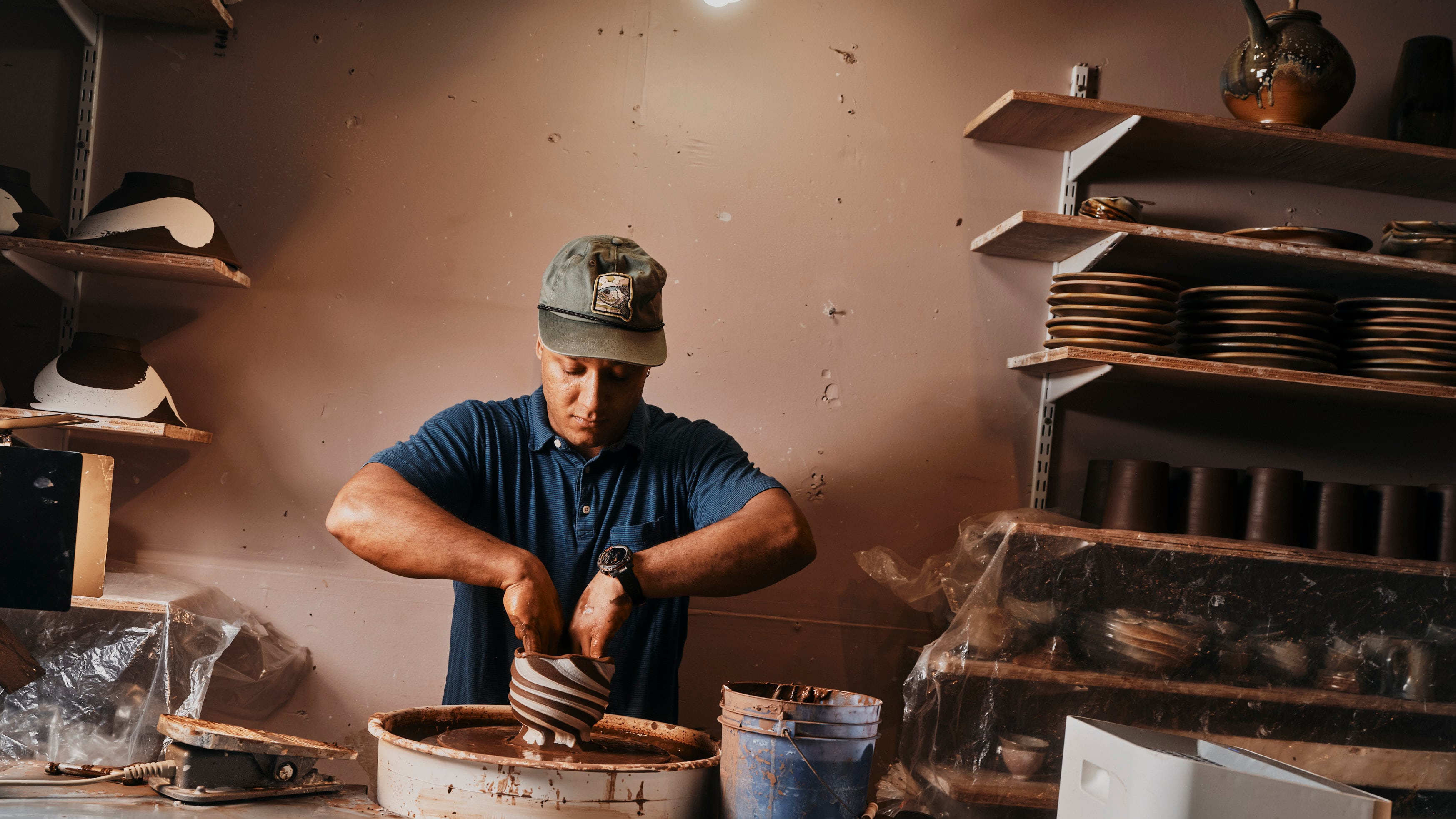
Dwayne Sackey took his first clay class in fifth grade, making a gorilla piggy bank that he kept in his room for years.
He stayed creative in other ways—he was interested in clothing and street art—but always wanted to try pottery. In high school, Sackey found a potter’s wheel underneath his grandparents’ house that an uncle of his had used, so he decided to bring it inside and try using it.
“I tried and failed miserably. It was very depressing,” Sackey tells Nester.
Sackey was born and raised in the Bay Area of California, and as a senior at Berkeley High School, he was able to get into a clay class and try throwing pots a second time.
“I loved it, and it was really fun, and I really kind of was hooked with clay,” Sackey says.
But he also grew up loving the outdoors; he regularly backpacked with his parents and attended a backpacking camp every summer as a child. After graduating from high school, Sackey went to work at the same camp and considered a career in outdoor education; he moved to Santa Cruz and spent winters making ceramics and summers carving spoons and backpacking.
In 2016, Sackey moved to Portland to enroll in Mt. Hood Community College’s wilderness leadership and experiential education program. But the call to create remained just as strong.
“They also had wood kilns—wood-fired pottery kilns—which I was really excited about,” Sackey says. “So it was kind of a double draw, and so I did both.”
Sackey later became part of the last graduating class at OCAC before the institution closed. Following two internships at area ceramics studios, and an apprenticeship with Portland potter Chris Baskin, Sackey is now a full-time potter.
Sackey divides his time between teaching and throwing pots; he has potter’s wheels in both the garage and the living room of his Southeast Portland apartment. He fires his work at a kiln in Northeast Portland, and when he spoke with Nester in February, Sackey was working to open a community pottery studio, Alberta Clayworks, on Northeast Alberta Street.
In 2020, Sackey began selling pottery, including a series of “Black Lives Matter” mugs, at the BIPOC makers markets that popped up that year. Gradually, he says, he decided to transition to selling his work online. He gets some income from monetized TikTok and Instagram videos—and says he’d probably make more if he wanted to spend his time making videos.
I would probably be making twice as much money if I just spent half as much time behind the wheel, but I need pottery. I feel like it really brings me to center, and it helps me. It’s almost like time traveling, sitting behind the wheel.
The physicality of the work, he says, reminds him of skateboarding, which he grew up doing: “You are forced to learn how to trust your intuition because a lot of times like, things aren’t planned and the consequences are high and you’re moving fast. I just, I love that,” Sackey says. I love being in that state where I feel like I could trust myself, my body and my mind in tandem.”
During a February visit to Sackey’s home (which he shares with two dogs, Shino and Ziggy), the shelves of his workspace were lined with a set of newly fired plates made on commission—he rarely takes commissions, he says, but is open to custom work if the price and product are right—as well as mugs, vases and pitchers.
Sackey tends to work in earthy, muted tones: Greens, browns, beiges and dusty blues show up a lot. Some of that, he says, is because he spends so much time outdoors and takes inspiration from nature.
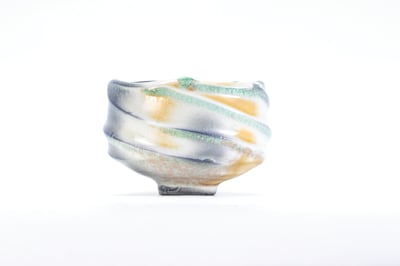
“I think I am very much kind of like a vessel, in a way, and whatever I fill myself with is going to be what I’m full of, and obviously things do stick more than others,” Sackey says. “You know, I have integrity, but I try to fill myself with things that I’m excited about. And so, a lot of times, nature is just a great way for me to feel good.”
But nature isn’t Sackey’s sole inspiration: One shelf is lined with mugs reading “Fuck ICE” and “Abolish ICE” in a variety of fonts.
“What’s going on right now is definitely pretty on my mind, and so it’s coming out in my art, with ICE kind of coming in and killing people and deporting people and just terrorizing us,” Sackey says. “So I’m definitely feeling strongly about that, and I think that’s coming out of my art.”
Find Sackey’s work: Dwaynesackey.com | @dwaynesackey
Make It: Ceramics
When Dwayne Sackey spoke with Nester, he was in the process of opening a community pottery studio, Alberta Clayworks (albertaclayworks.com), on Northeast Alberta Street. That effort was still in progress as this issue went into production. But there are several other ways to learn about clay in Portland—including both hand building (creating forms using your hands rather than a wheel) and pottery (which uses a wheel).
Art School PDX offers crash courses for those looking to try throwing pots for the first time (including date-night courses where they can try pottery with a partner, family member or pal at their side) as well as classes on producing a specific item (recent offerings include a casserole dish class and a St. Patrick’s Day class where participants paint their own beer steins). On top of those one-off classes, Art School offers multiweek courses that go deeper on pottery wheel techniques, as well as classes where you can make a dinnerware or tea set, and classes on topics like yoga for makers as well as healthy hands classes, lest one incur just as many repetitive stress injuries from stress-relieving hobbies as from one’s day job. One-off classes start at $30 for painting-only classes and $80 for potter’s wheel crash courses; most multiweek classes run about $500. Art School PDX also offers memberships starting at $250 a month, which come with unlimited studio time and reduced class prices along with other perks. 1020 NW 18th Ave., artschoolpdx.com.
Past Lives Makerspace, an expansive 26,000-square-foot workshop in the Hosford-Abernethy neighborhood, offers pottery and ceramics classes—such as Wheel Throwing 101 classes for $65. Past Lives’ ceramics program also offers classes for makers looking to walk away with something specific; you can learn make your own sushi set (a plate, soy sauce bowl and chopstick rest) for $55, or a cup for $49. Memberships start at $200 a month; private studio spaces are available to rent for $3.75 per square foot. 2808 SE 9th Ave., pastlives.space. Open 24 hours.
Nester, Makers Edition Magazine is free, distributed all over Portland, and can be found at these locations. Love Nester? Save the date for NestFest, where we bring the magazine to life at an event in Fall of 2026.