Skip to main content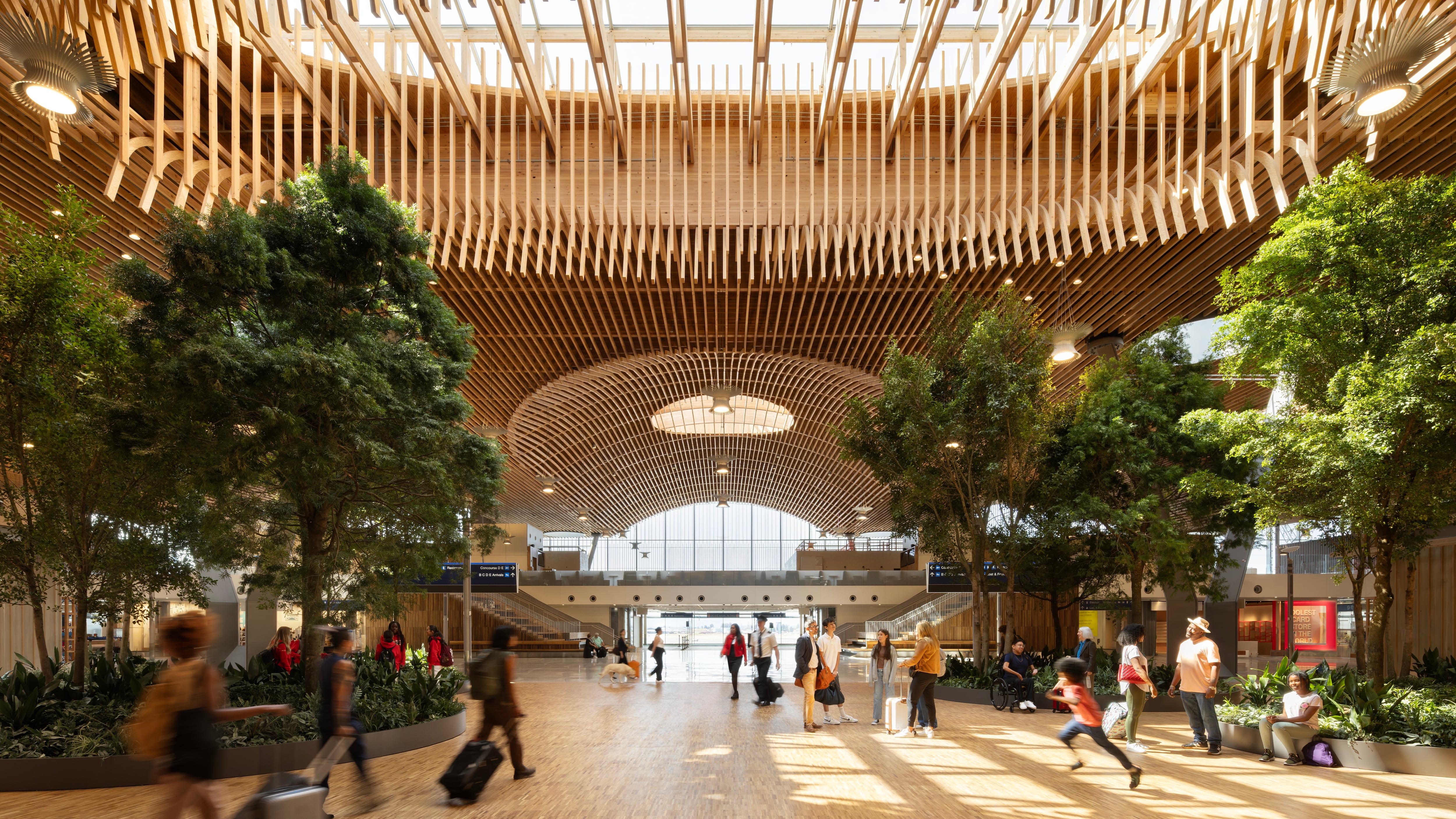
The maze of construction walls have officially lifted and the next iteration of Portland International Airport is complete. After 11 years of planning and phased construction, the Port of Portland wrapped up Oregon’s largest public infrastructure project to date on Tuesday, June 30—$2.15 billion later.
According to the Port of Portland, the remodel and modernization, which was funded primarily by the airlines that use it and a few federal grants, strengthened the airport’s seismic resistance, cut down its carbon footprint, and doubled its potential visitor capacity.
But most attention has gone to the renovation’s cultural ties, and its ambition to be “the local-est airport yet.” Taglines aside, it is full of local shops and restaurants, from established giants like Columbia Sportswear and Powell’s Books to newer local companies like Blue Star Donuts and Straightaway Cocktails. Last month, Portland distillery Freeland Spirits opened an airport bar, setting up next to Grassa and Sizzle Pie as the last piece of PDX’s North Convention Hall.
The airport also recently launched a pop-up program, in which local businesses (currently ECOVIBE and Mikiko Mochi Donuts) can apply for one-year residencies in the pre-security terminal.
According to the Port of Portland, $274 million of the project’s budget went toward local businesses.
“From the beginning, our north star was a new PDX that reflects our values and the people and places that make this region special,” Port of Portland executive director Curtis Robinhold said in a press release. “The final result is a world-class airport unlike any other, shaped by local hands, local ideas, and local pride.”
The remodel includes new exit lanes for flyers, more restrooms (including gender neutral options pre- and post-security), and over 70 live trees and 7,500 plants, as well as an art program currently showcasing 21 artworks, eight of which are a part of its permanent collection.
The building’s design was primarily inspired by Pacific Northwest forests, an idea that echoes in the project’s sustainability efforts. All of the wood used for the fan-favorite timber roof was sourced within 300 miles of Portland, the first construction project of this scale to do so. Seventy-three percent of wood was sourced from landowners who are Forest Stewardship Council–certified, a verification process that deems forestry practices environmentally responsible.
The airport is also now heated and cooled through the ground rather than the air thanks to “geothermal heat pumps,” gadgets designed to cut the fossil fuel use for the whole building by 95%, according to the Port of Portland. While the geothermal pumps cost more, they last longer and are more efficient than a typical air-conditioning or heating system.