Skip to main content
When you arrive at Washington’s Swift Reservoir, the cheery camp host hands you a welcome pack that includes handy instructions on how to poop properly in the woods.
It’s a potent reminder of just how remote you can get camping with an inflatable kayak a mere 90 minutes north of Portland.
Owned by local power company PacifiCorp, Swift (Swift Forest Camp, 280 Road, Cougar, Wash., 801-280-3233, pacificorp.com/community/recreation/washington.html) and nearby Yale Reservoir (5701 Lewis River Road, Ariel, Wash., 801-280-3233) open briefly to the public in the summer months between Memorial Day and Labor Day. Both of these large, scenic lakes offer camping dispersed along their shores accessible only by boat.
Though the campsites are technically free, they charge $15 for overnight parking, plus an $8 third-party service charge to book online. To keep crowds sparse, you’re allowed to visit only twice in the same year.
I had blindly reserved Site 10 on a small island named Sensi for the first week of June last year because who wouldn’t want to camp on an island? It’s about half a mile long, and you could throw a stone across the width—if it weren’t so thickly forested, that is. The west side of Sensi is a 100-foot eroding sandy cliff, chaotic at the water’s edge with rocks and sun-bleached timber. Discovering such a great habitat for trapping crawfish, I spent three nights there.
I used to be into hiking and backpacking, but that all changed after snapping up a Sevylor inflatable kayak for free on Craigslist a decade ago. Once you start floating your gear to camp—plus all the other attendant fun perks of having a boat—you begin to conflate time spent outdoors with time on the water. My last backpacking trip was in 2020.
To be clear, absolute beginners probably shouldn’t be rushing to Swift Reservoir this summer. I first developed my skills with that free kayak on calm local waters such as Blue Lake, the Smith and Bybee Wetlands, and Estacada Lake. Over the years I steadily upgraded to newer kayaks.
When you hear the words “inflatable kayak,” you probably think of a bulbous sag-bag that shifts direction with every paddle stroke. Admittedly, that’s how my Sevylor maneuvered, before I added an optional skeg, which helped a bit. But rapid advancements in modern drop-stitch technology allows today’s inflatables to bust through dangerous Class V whitewater rapids yet still fit into a backpack and store neatly in a closet.
“Drop stitch” refers to an inflatable that can hold any shape thanks to the interior support of millions of threads, like the armature inside a bronze statue. Instead of being balloonlike, today’s high-pressure drop-stitch inflatables can be engineered into sharp angles that are not only rigid enough to stand on, but can safely smash against rocks and chutes.
Standup paddleboards, or SUPs, were the mass market debut of drop-stitch tech starting around 2009. They were a kind of proof-of-concept using the simplest design form possible—despite being filled with air, a SUP could magically support the full standing weight of a person.
Soon enough, hull enclosures were developed that turned the basic paddleboard into a hard-floor kayak. This eliminated the butt sag, one of the reasons inflatable boats are notorious for poor speed and maneuverability. The first full drop-stitch, or FDS, kayak—meaning the entire boat is sculpted from drop stitch rather than only the floor—was the sleek Sea Eagle Razorlite, released in 2016, marking the beginning of a new era in inflatables.
What I’m trying to convey with this drop-stitch history lesson is that inflatable kayaking no longer means a customized pool toy useful only on calm water. And you no longer need a truck or a car with special mounts to strap a 10-foot boat on top—a boat that also requires weather-protected storage space at home.
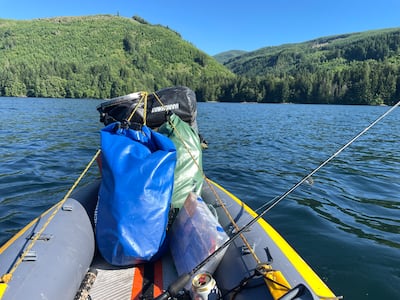
Inflatables are great for people living in apartments and great for spontaneity. It’s no big deal to keep a folded inflatable in the trunk of your car to grab a couple of hours of paddling after work whenever you’re in the mood. And as with any rapidly changing tech, early adopters buying the latest high-end FDS kayak mean there’s a steady supply of older boats for sale on Craigslist and Facebook Marketplace. There’s no better time to get into kayaking at any price point you’re comfortable with.
When you start kayak camping, your outdoor world widens to include boat-in-only sites that you never knew existed. It’s quite likely that one of your favorite developed lake campgrounds has official (or unofficial) campsites scattered around the lake or on islands, reachable only from the water.
For sure, boating down rivers is a thrill. You can cover a lot of miles, it’s physically easier, and for added kicks there are options with rapids. But the logistics of kayaking a river are kind of a pain. You need two people, you need two cars, and you’ll have to backtrack twice—first taking two cars to the end point, leaving one, driving back to your starting point, doing the trip, then shuttling back to the starting point yet again. And forget about a solo river trip on anything but water slow enough to allow you to paddle back upstream.
However, all within two hours of Portland, we’re lucky to have a number of both smaller lakes with dispersed boat-in sites, as well as some giant lake options for multiday expedition-style adventures without the logistical headache of traversing a river.
Take for instance Washington’s Riffe Lake—it’s 23 miles long with a shoreline circumference of 52 miles. That’s a whole lot of paddling and camping. I’ve spent days there in a cycle of paddle-camp-paddle-camp (and fish-fish-fish). Depending on the size of the lake, the wind and waves can be fierce, offering a challenging excursion depending on how far into the middle you plot your course. But there’s always the calmer, safer option of paddling close to the shore.
Each of the big Washington reservoirs owned by PacifiCorp and Tacoma Power—such as Riffe, Swift, Yale, Rimrock and Alder—have their own rules on accessibility, fires, dispersed camping and overnight parking, so be sure to research each one. For example, while Alder allows dispersed camping around the lake, it doesn’t have any overnight parking, so you have to pay for a tent site ($25–$35 depending on the season) in order to leave your car and launch your boat. Alternatively, some enterprising locals living nearby offer their own overnight parking lots in the yard—look for the signs. Some lakes don’t expressly forbid dispersed camping, but the power companies also don’t promote it on their websites.
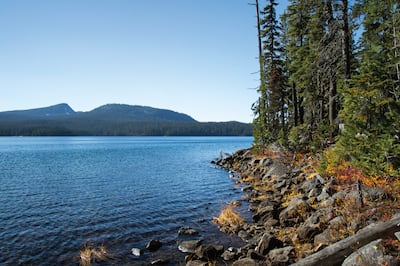
In Oregon, some great kayaking trips closer to Portland include Waldo Lake (three hours away), which has very deep, pristine waters and is home to more than 50 dispersed sites scattered around its 22-mile circumference. Detroit Lake also has many dispersed sites around its 32 miles of shoreline, as well as 22 sites on Piety Island, available on a first-come, first-served basis. Green Peter Lake has multiple dispersed sites on the south shore as well as island camping, with reservations required.
Numerous smaller Oregon lakes don’t offer the same long shorelines for exploration, but still have campsites accessible only by boat, such as Cultus Lake and Timothy Lake on Mount Hood. And don’t forget about our own backyard—camping is allowed on three of the Columbia River islands—Reed Island, Sand Island and Government Island, where Lewis and Clark camped on Nov. 3, 1805, before naming it Diamond Island.
With kayak camping, the most important piece of gear is a dry bag, or even multiple bags, ideally color-coded for convenience. The second is a hammock rather than a tent. Not only do water levels vary seasonally, but terrain around rivers and lakes—especially reservoirs created by damming a valley—can be too steep for a tent, or thick with mud and brush.
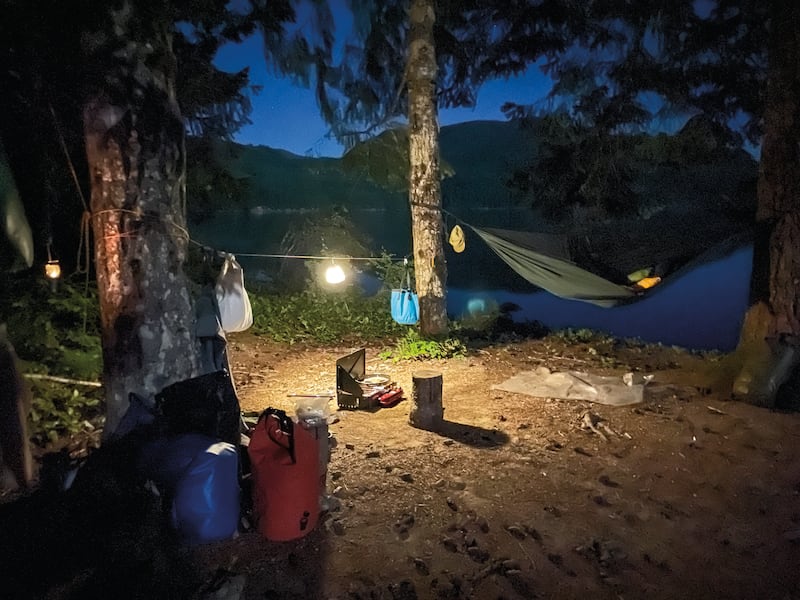
Some nights I’ve slept suspended between two trees, swinging blissfully over a 60-degree drop, the serenity punctuated only by a piece of kit rolling down and hitting the water. D’oh! The lesson: Always be sure to secure your gear.
This story is part of Oregon Summer Magazine, our annual guide to refreshing destinations, cool escapes, and the best ways to stay hydrated all summer long. See more stories from Oregon Summer Magazine here, or check this map to see where you can pick up a free copy of the magazine.