Skip to main content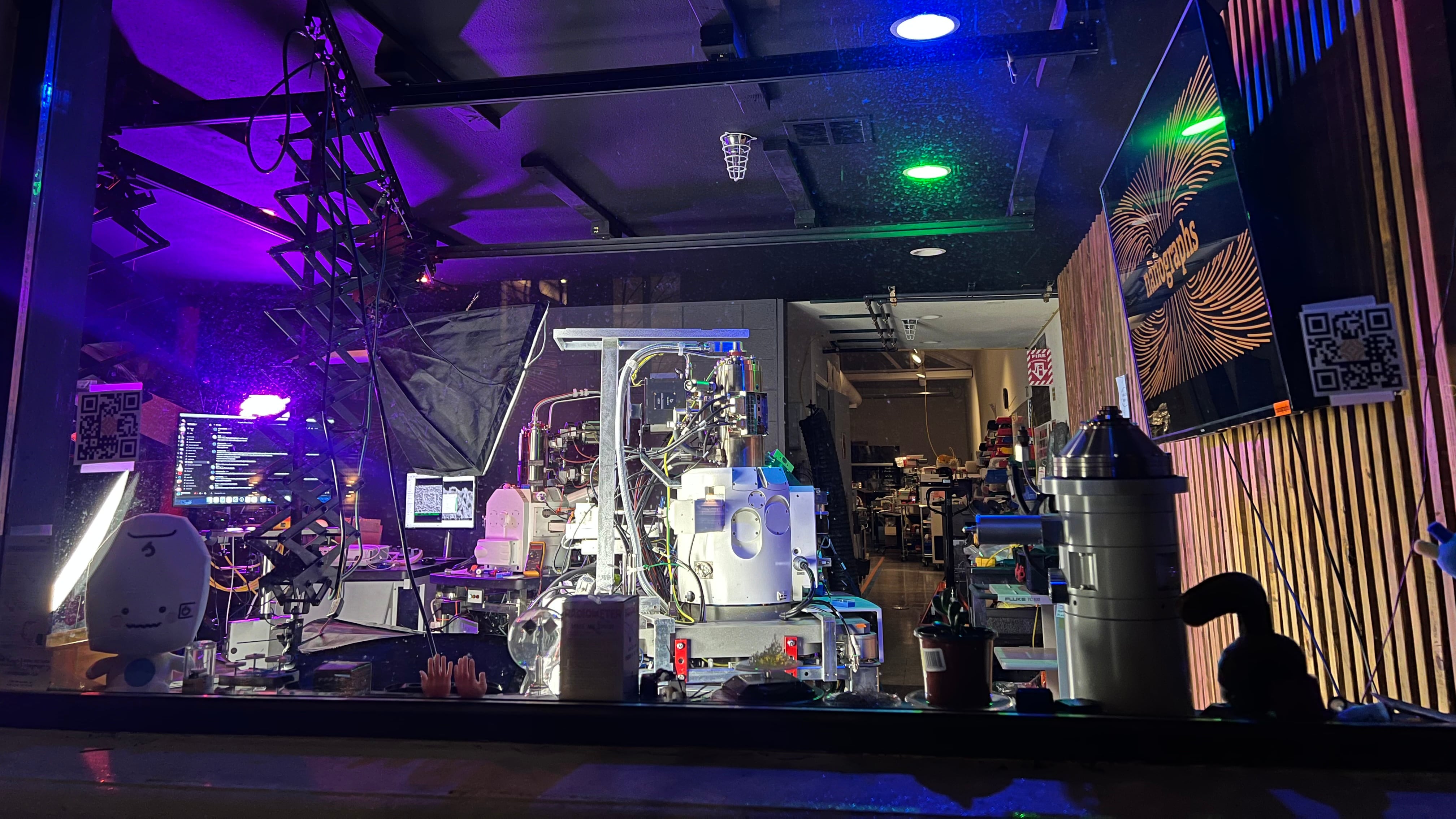
Along a sleepy stretch of Northwest Portland’s Alphabet District best known for hot yoga and warm beer, passersby are inevitably drawn to the confounding midblock tableau teased behind picture windows that have never known curtains.
Curious observers wouldn’t assume the gleaming, metallic, vaguely sinister towers represent state-of-the-art electron microscopy. Strangers peeping Nanographs’ electron microscope warehouse, which is next door to WW’s offices, would more likely think the space serves as the pop-up lair of a mad scientist on proper meds or a photography studio specializing in mainframe boudoir shots.
“Then, a small subset of people immediately recognize these machines and know what they can do,” laughs Nanographs proprietor Adam McCombs (instagram.com/nanographs), “and they’re really confused!”
Electron microscopes are capable of magnifying up to 50 million times what the human eye can see, allowing scientists to observe samples at the atomic level.
After relocating to Portland, widely considered the global hub for electron microscopes over the past few decades, McCombs, 27, found a kindred spirit lingering ’round the longtime playground of sainted exhibit designer, Gravitram inventor and godfather of OMSI Shab Levy. Nanographs began leasing a third of this 6,000-square-foot space shortly before Levy’s death in 2023.
Nearly all of Levy’s daunting archive of unexplained gadgets and ineffable designs remains untouched, and a familiar tendency to spike scientific precision with flourishes of whimsy is still very much alive in the ginormous workshop. While McCombs only met a declining Levy once, their passion projects betray like-minded spirits driven by their hunger to learn how things work yet most fulfilled when able to teach.
Along with the relatively state-of-the-art machines from Nanographs’ academic and industrial clients, its HQ teems with Reagan-era technology abandoned by corporate labs for negligibly improved iterations. McCombs says the difficulties most users have adapting early-’80s microscopy lies not in the microscopes’ rough but reliable electron manipulation; it’s their computerized accessories that fail to capture an image.
Formerly, those begging McCombs’ assistance in repurposing the vintage devices were forced to take pix from Polaroids if they wanted a lasting image. But he recently tweaked an open-source interface that makes digital captures possible, and makes the tech in his layer widely accessible to the public. Or, as McCombs would explain, “it makes the electron beam dance however they wish!”
See the rest of Willamette Week’s Best of Portland 2026 here!