Skip to main content
“Every time I do this, it reminds me why I don’t do it.”
It’s 10 am the day before an estate sale, and Gary Germer—Portland’s estate sale czar and the face of appraisals in town—is cleaning teacups with a rag. He’s in his own front yard in Laurelhurst. A series of pop-up tents are set up to protect thousands of dollars of art, furniture, home goods and knickknacks for sale.
He holds up an English “chintzwear” tea cup densely patterned with florals, marked $32.
“Ladies were stabbing each other in the neck for this stuff in the 1990s, early 2000s,” he says. “Now, they don’t care that much.”
But this isn’t a real Gary Germer estate sale, the kind people line up for hours in advance, the kind he is known for. A Gary Germer estate sale falls somewhere on the secondhand sales spectrum between a garage sale and a Sotheby’s auction.
An estate sale is what happens when a matriarch or patriarch dies or needs to downsize to a smaller home or assisted living, and the family hires a company to deal with all the lamps and side tables and art and china that the kids don’t want. Over the course of a few days, the public is welcome to peruse the house and see the items in situ, where they are priced to sell. “We try to make it look as much like Nordstrom as we can,” Germer says.
The estate sales Germer runs are typically the domain of the rich. His clients are the kinds of families who fight over passing down the Multnomah Athletic Club membership or figuring out who inherits the Black Butte house.
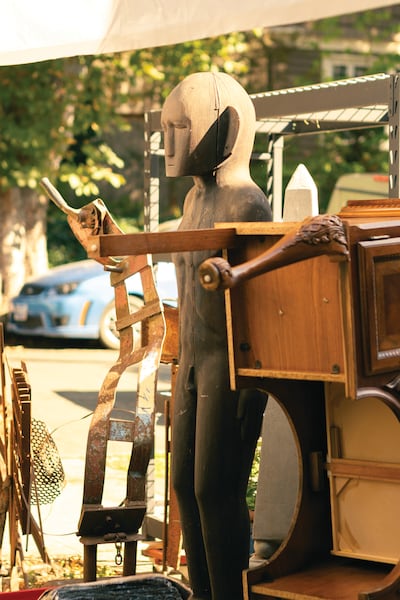
But on Sept. 3, Germer—all 6-foot-five inches and “300 and plenty” pounds of him, he says—is perched on a stool polishing chintzwear at his annual warehouse sale, held to declutter his inventory. He hates how it’s weather-dependent (he could have brought several more truckloads over from the warehouse on Northeast 28th Avenue but was thwarted by a strange week of late-summer rain), how the neighborhood band of feral cats try to sleep on the furniture, how there is no tidy system for entry like at a typical Gary Germer sale.
This is slumming it, and Gary Germer & Associates is not particularly known for slumming it.
Germer, 69, has been working full time in Portland estates since 1986. He’s known for his storefront on North Broadway, a brick building with a bright red door just east of the Broadway Bridge, and for his frequent spots on local television news programs—KPTV’s Good Day Oregon, KATU’s AM Northwest—appraising Portlanders’ finery. Half of his business is appraisals and the other half is presiding over about 10 estate sales a year. Gross sales over a weekend can reach $250,000; Germer’s typical commission is 35%. He sets the order of shoppers by handing out playing cards with numbers written on them at 9 am sharp on the first day of the sale.
Germer’s been through one big industry upheaval already, with the advent of eBay in the late 1990s, and says he’s facing another one now, with AI and Google Lens making formal appraisals less necessary. (He says AI is right about an item’s provenance and value about 70% of the time, and guesses it will probably be just about perfect in two years.) But he feels confident that the industry will always have a place for him and similar companies. AI can’t do the physical work of setting up an estate sale—moving the furniture, making everything look nice, tagging it and hand-selling it. Besides, he’s actually in the people business.
“Half of what we do is psychology,” Germer says.
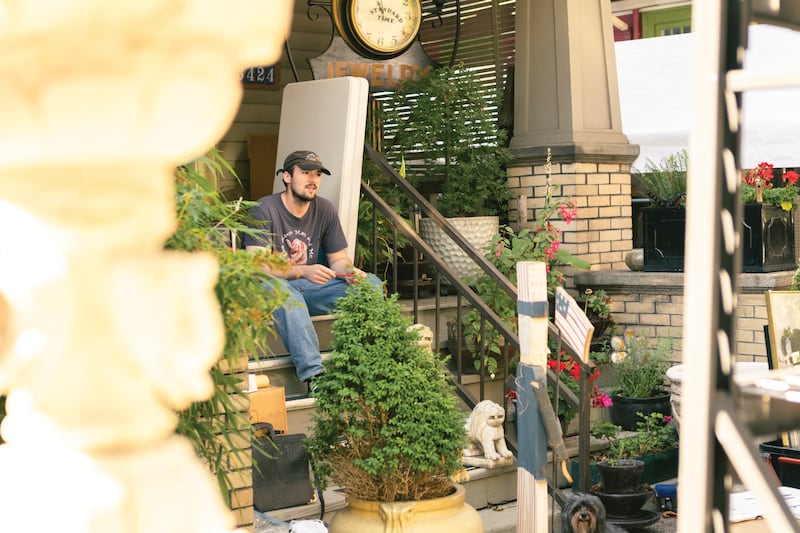
For decades, families accumulated and treasured china, crystal, flatware and, yes, chintzwear to pass down to their children. Today, these antiques are more often seen as the kind of thing you might wonder about for a moment while wandering around a junk shop.
“The thing I’m hearing constantly is, ‘My kids don’t want anything,’” Germer says. “So all these things they’ve saved—their china, their crystal, all the things that meant you were in the middle class, that you’ve made it? Now it’s meaningless, and I get to be the bearer of that at least twice a week.”
Germer grew up in a religious Jehovah’s Witness family in Vancouver, Wash. He studied art and business at a variety of local colleges, such as Pacific Northwest College of Art and Portland State University, but never matriculated. He learned the secondhand trade through his ex-wife’s family, who were junk dealers. That marriage lasted 20 years, but the career has been lifelong.
His employee Zachary James, 26, grew up working flea markets with his parents on the East Coast. Germer reminds him of a lot of the characters he met at New York City markets as a kid.
“It’s a scatterbrained business, but he’s also super professional,” James says.
James is pretty clear-eyed about the tawdry edges of the business. The word “vulture” tends to come up—people picking over the remains of someone’s home.
“It can be really sad. But, also, it’s bittersweet. I mean, you sell their stuff and then they make money for their family and generations to come. So, I don’t know. It’s weird. It’s a very layered business.”

In 2019, Germer sold the West Hills estate of the late Gwyneth Gamble Booth, a philanthropist and journalist who was the first woman to serve on Portland General Electric’s board of directors. Booth was a well-known collector of art, Japanese and Chinese pottery, and Christmas decor. The cleanout of the home was overwhelming and took a year, says her daughter, Elizabeth Gamble Caldwell.
“The one thing I learned through that whole process is that the value that you’ve attached to something is different than the reality of what the piece is going to sell for,” Gamble Caldwell says. “And Gary’s really good at telling you that. He does that in a very nice way.”
The wait to get into her mother’s estate sale was four and a half hours long. (Germer had to hold a separate sale for the Christmas decorations two months later). It was one of the biggest sales of Germer’s career, and that’s after the family had taken what they wanted, donated the library to a university, and sold a bunch of pieces through the Los Angeles auction house Bonham’s.
In 2018, he settled the estate of Roger and Laura Meier, heirs of the Meier & Frank Company. Laura Meier died earlier this year, but eight years ago she was downsizing out of her West Hills home. It was an exquisite collection of Tiffany flatware, porcelain, antique furniture, Fortuny Italian drapes and more. But handling the family with care took priority, Germer says.
“I remember telling Mrs. Meier, ‘Look, this is such an elegant home. I want you to know that if I seem indifferent, I’m not. I’m trying to be respectful that this is your home that you’re closing out. Because inside I’m a starving little meth monkey who wants everything, and I’m trying not to look like it.’ She thought that was really funny.”