Skip to main content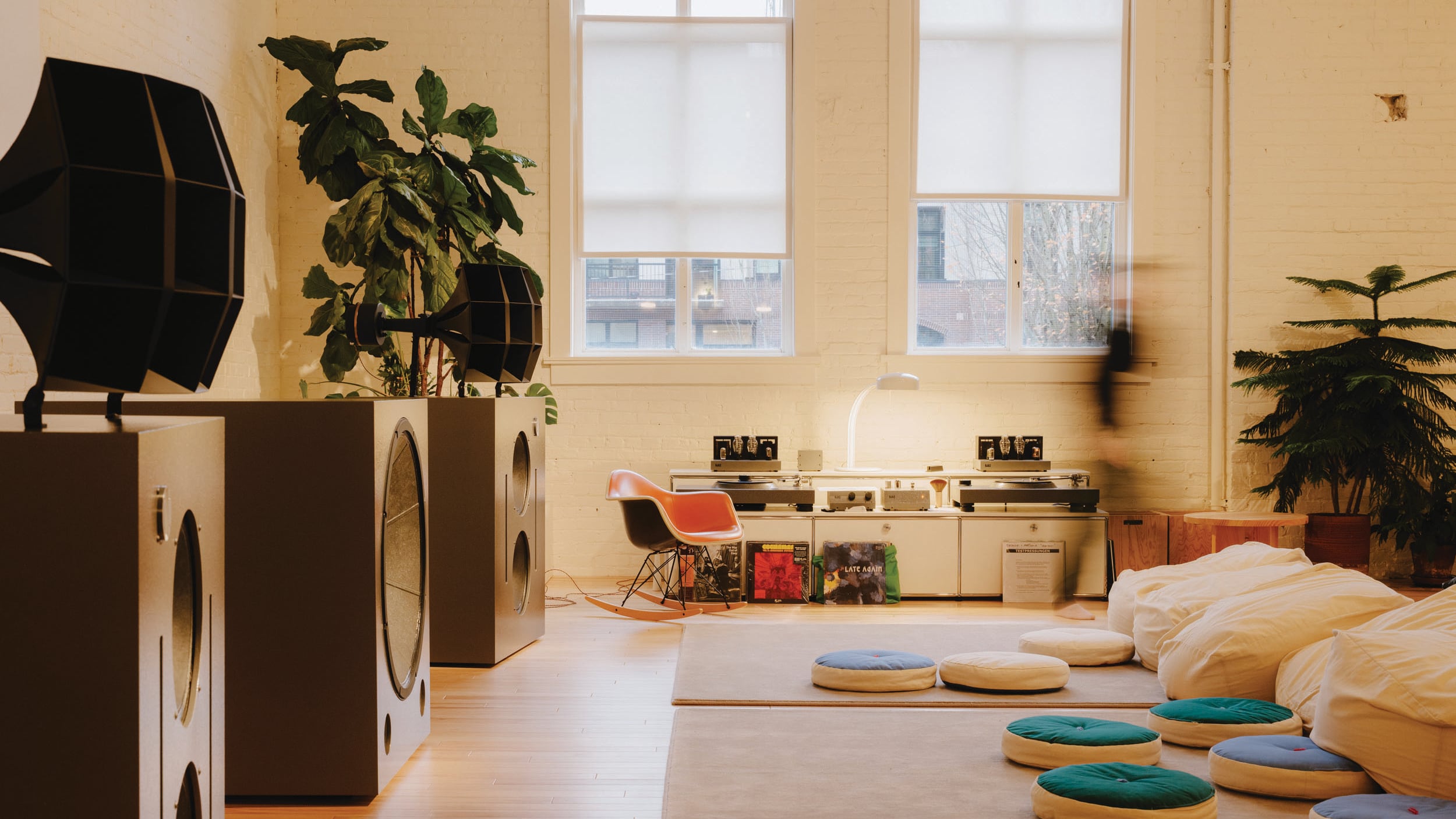
Mono Space is an art gallery devoted not just to listening to music, but preserving its culture. It’s a third space with some commercial elements—a tea bar, a merch rack, and record shop pop-ups—but they’re not the point. Located in an expansive, renovated Pearl District warehouse storage unit, Mono Space opened in June featuring both ticketed listening sessions and open gallery hours. There’s plenty of furniture where people can get cozy, be it on beanbag-style chairs and couches or on pad chairs atop bleacher-style wood boxes, but once the music starts, there’s no talking. There’s social time carved out, especially at the end to release the emotions stirred by high-fidelity vinyl played on a fully customized speaker system, but staying in the moment with music is Mono Space’s mission.
“Coming out of pandemic times, a couple of different signals were being received. One is that people are looking for ways to have more engagement person to person, like collective exchange. People are trying to go to a live podcast or [the art gallery] Hopscotch, or they’re going out to concerts in huge numbers after being exhausted from being at home on their screens, so I was feeling that,” Hooge says. “The other signal that was really strong for me during the pandemic was going really deep on music discovery at home, collecting vinyl, and tinkering with DIY hi-fi stuff…I want more people to be able to engage with this type of hi-fi system and it’s not super accessible.”
Founder JD Hooge and creative director Steph Lanning want Mono Space to attract not only audiophiles, but anyone who wants to appreciate music and the act of being still with it. Around 50 people at a time can fit into the listening lounge, and they have to be buzzed in for open gallery hours and private events. Streaming and digitization have changed music fans’ listening habits, especially in the United States. The U.S.’s pivot to digital music over analog left a glut of vinyl-related technology available. Japan developed a whole subculture devoted to listening to music, and as both records and CDs prove popular to Gen Z—who did not grow up with physical media—the U.S. is starting to follow the trend again.
“I don’t drink alcohol, I don’t want to own a bar, I don’t want to really go to a bar,” Hooge says. “I’m more interested in what an art gallery looks like for music. Everyone knows how to behave in an art gallery: ‘Let’s go appreciate and have reverence for art on a pedestal with nice lighting,’ but music is flattened to little squares on our phones and this algorithmic background noise that we’re not really paying attention to. We’re listening to more music than ever, but we’re not actually paying attention to what we’re listening to, who created it, or how it was created and how many people were involved and what’s the lineage.”
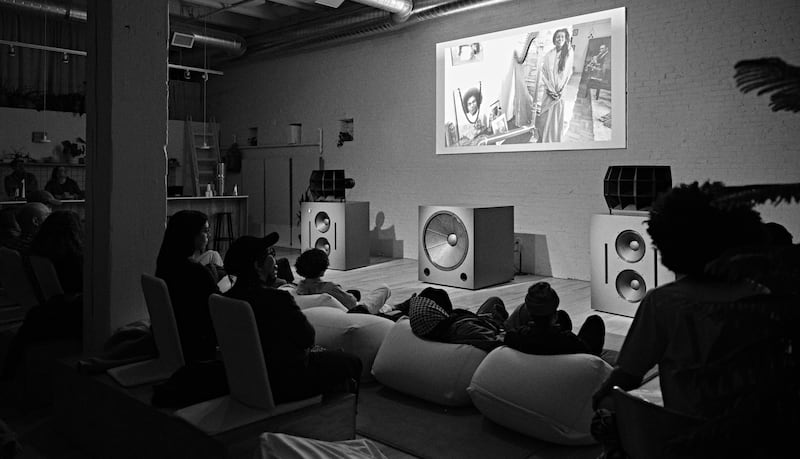
Devon Turnbull, a music engineer and “sound sculptor” based in New York, designed Mono Space’s speaker system to resemble century-old speakers using vacuum tubes up to 50 years old. Even with the rise of listening bars around Portland like Decibel, Sonder and Wax Social, there’s likely no sound system like Mono Space’s anywhere else in the world, let alone in Portland. Hooge says the only comparable systems Turnbull built are in New York or London. His clients include fashion houses like Supreme, Off-White and Louis Vuitton, so Turnbull’s sound systems are a luxury of their own.
“Coming into this space and experiencing it for me is what really—‘Oh my gosh, this is an incredibly special experience,’ and being amongst people having a communal listening experience being in front of this system, it is something that, you have this feeling like, ‘This is something I’ve been longing for for so long that I didn’t even know I had been longing for it,’” Lanning says. “It’s meditative, there’s a spirituality behind it, and it just feels like something that’s really needed and important.”
The speakers are so big that when Mono Space was renovated from a bare-bones, unfinished room that holes had to be cut in the walls to get the pieces inside. Hooge is not eager to cart them out anytime soon. That’s to say, Hooge and Lanning pledge that Mono Space is here to stay for the foreseeable future.
“It feels to us like a portal to a different environment or atmosphere where you can leave some of the outside world behind,” Hooge says. “Not necessarily escape it all, but maybe it even helps you integrate some of the stuff that’s happening out there into the rest of the things going on in your life.”
Along with its ticketed events, which include two sold-out nights to hear Frank Ocean’s 2012 debut album, Channel Orange, that saw its first vinyl release last year, Mono Space supports itself with a membership program. Members are afforded exclusive access to additional listening sessions and can request programming across the gallery’s roughly two-month seasons. Guest curators are invited to pick records during gallery hours. Experimental jazz musician Omari Jazz will host one such session in March, while other Portland musicians have hosted record release events. Even out-of-towners like Questlove have stopped in to hear specific records on Mono Space’s setup.
“He listened to D’Angelo recordings from Voodoo that he was in the room for when D’Angelo was playing, and he was like, ‘I’ve just never heard it like this before,’” Hooge says.
Hooge chose two tracks to demonstrate Mono Space’s system during a recent visit: “Hunter,” the first track from Björk’s 1997 album Homogenic, and “Improvisation for Coughs and a Cell Phone” by German composer Nils Frahm. With woody-sweet incense burning and lights lowered to allow natural sunlight to dominate the gallery, Turnbull’s speakers infuse the recordings with a rare liveliness. Frahm’s arrangement includes ambient noise from the audience (hence its title), and in a nearly empty gallery, those quiet natural sounds made the space feel more full. On “Hunter,” every layer of Björk’s song felt as if it had enough room to stretch out and be appreciated as an individual part rather than a compressed whole. Hearing the songs in such high fidelity proved surprisingly emotional, causing tears to well unexpectedly in this writer’s eyes.
“I see executives in here curled up in a ball in a fetal position for a couple of hours just completely feeling safe to do that,” Hooge says. “Clearly, it’s helpful for people to be in here and co-regulated around this one activity.”
Even though Mono Space’s mission is to focus only on music, the fact that it’s located in the Pearl District—a neighborhood still associated with visual art and the First Thursday art walk—makes Hooge hopeful that patrons will broaden their musical as well as visual horizons.
“Hi-fi doesn’t have to be this stereotypical audiophile thing, it can be very affordable,” he says. “You can use technology from 100 years ago that’s easily accessible. Our system is low power—not that this specific system is very accessible to the average consumer, but the technology behind it is.”
HEAR IT: Mono Space, 608 NW 13th Ave., 971-242-8295, mono-space.org. Free noon–5 pm on select Saturdays.