Skip to main content
Want to roll a grenade into holiday conversations in Portland? Bring up the “doom loop.”
At WW, we’ve decided it’s the term of the year. In the strictest definition, a doom loop starts when remote work frees people from commuting downtown. Office buildings tumble in value, shrinking property tax collection. Restaurants and stores that rely on the lunchtime trade go out of business. Foot traffic suffers.
The decline in government revenue means services get cut—like police and social work—so crime increases along with the number of homeless people per capita downtown. More people opt to work at home, many out of fear, and a kind of tornado spins into being, silent and unseen, but capable of great devastation.
That’s how Columbia University professor Stijn Van Nieuwerburgh, whom The New York Times called the “prophet of urban doom,” defined such loops in a 2022 research paper. The Portland Metro Chamber affixed the term to the city in February in its annual report on the local economy, irking local officials. City Council President Elana Pirtle-Guiney called the report “incomplete.” Mayor Keith Wilson exhorted Portlanders to pivot toward “boom loop thinking.”
Metro Chamber president Andrew Hoan approved the doom loop designation. Critics often paint Hoan as a boardroom scold who cares only about business to the detriment of disadvantaged Portlanders in need of more social services. Others wonder how a guy who’s supposed to boost Portland’s fortunes could trash it with what amounts to a (pretty wonky) slur.
Hoan stands by his message. In a long interview with WW at the Metro Chamber’s 14th-floor offices overlooking a muddy Willamette River, Hoan predicted it would take 10 years for Portland to exit the doom loop. And that’s not all bad news, he says.
“I look at it as the greatest opportunity we’ve ever had,” Hoan says. “It means we are allowed to do mechanized sacred-cow slaughter. Line them up and start lopping off heads. We’ve got to get it together. And it’s just not one sacred cow, it’s the whole flipping herd.”

With Hoan beating the doom loop drum even louder, it’s likely the term will continue to drive the debate about Portland’s future, as he intends. Just in time, this month brought more evidence that such a loop may exist and that some Portland politicians may be in denial about it.
On Dec. 15, the Morgan, a landmarked, eight-story building in the heart of downtown, sold for $6 million in cash, or $40 a square foot. Eight years ago, it fetched $27.6 million, or $184 a square foot. That decline is what doom loops are made of. Last year, Morgan’s owners paid $271,472.36 in property taxes on an assessed value of $13.6 million.
For complicated reasons (“Tower of Terror,” WW, Oct. 29), assessed values don’t automatically crater after such a fire sale. But it’s very likely that taxes from the Morgan Building, which pay for municipal services like police, fire and schools, will tumble.
Plenty of other people disagree with Hoan and the doom loopers, and some facts about tax collection in Multnomah County support them. Most importantly, residential properties account for 61.5% of all property tax revenue, and home prices are holding up, so far.
An old Oregon tax law aimed at keeping payments low as real property values soared (until recently) is also easing the pain, ironically. Measure 50, passed in 1997, lowered the assessed values (the amount that’s taxed) on Oregon properties to 90% of their 1995–96 real market values (what someone would pay for them) and capped increases at just 3% a year.
As a result, most property owners are paying property taxes based on bargain assessments, and real market values would have to fall a ton before tax collections did. That’s why, despite the crappy commercial real estate market, Multnomah County property tax collections, excluding one-time gains, actually rose 2.5% in the fiscal year that ended June 30.
“The vast majority of properties in Multnomah County are going up by 3%, as you would expect them to,” says Multnomah County economist Jeff Renfro. “We have a small number of high-value office buildings that are creating a drag on property tax growth. To see an actual decline in tax revenues, we’d have to see a significant decline in residential values.”
Another key measure looks less rosy. Deteriorating city services, a necessary ingredient for doom looping, are upon us. Police response times, the lowering of which Portland voters regularly rank as one of their highest priorities, are “catastrophically high,” Hoan says. On average, police responded to high-priority calls in just 6.8 minutes back in November 2012. This November, people waited an average 22.8 minutes, a police dashboard shows.
Bianca Youngers, who owns Binks Bar on Northeast Alberta Street, knows something about degraded police response. Late on many summer nights, groups of people (who are not customers) drink in the street, rev their cars, and flash guns, she says.
“They’re beating people up on the streets, beating people up in our bar,” Youngers says. “We call the cops all the time. Nobody comes.”
On its website, the Portland Police Bureau says the North Precinct’s Neighborhood Response Team, which deals with street-level drug dealing, theft, assaults and shootings, “is impacted by the staffing shortage and is only operational part time.”
The situation has Youngers, a die-hard Portland fan, fretting a doom loop.
“Everybody knows that you can just steal anything, and take anything, and do anything,” she says. “Everybody knows that nobody is coming.”
It’s not clear if Portland’s government takes such concerns seriously. A day after the Morgan Building sold for less than some houses in Lake Oswego, City Councilor Mitch Green offered the council’s Arts and Economy Committee a “sneak preview” of his proposal to ban the “sale or provision of certain force-fed poultry products, aka foie gras.”
Councilor Olivia Clark protested (along with most commenters on Reddit, where a video clip went wild), asking that the matter be postponed. “Why would we spend time on foie gras?” she asked. “I don’t think that’s a high priority for the city.”
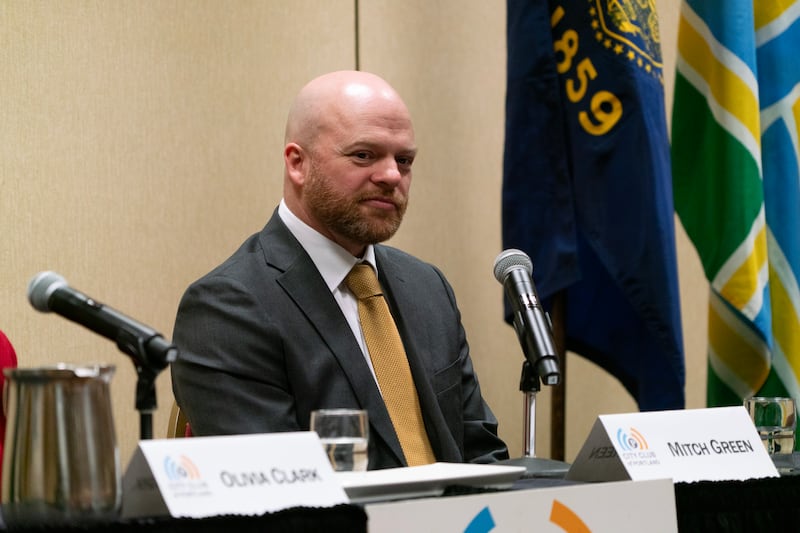
Earlier this year, Green was a doom loop doubter. When the Metro Chamber’s report came out in February, Green told the Portland Tribune it merely described the threat of one.
“We have reason for optimism as we’re seeing some leading indicators that point toward recovery and growth, but it remains important for leaders to understand the urgency of the threat as we head into the budget cycle and think about priorities,” Green said.
Green didn’t return an email seeking comment for this story.
Hoan has a theory why Portland has responded poorly to the confluence of COVID, downtown riots, and work-from-home. The city hasn’t faced a crisis like this since the timber industry collapsed in the 1980s. But Portland and much of the state were saved by Intel Corp., which set up billion-dollar fabrication plants, drawn by cheap water and power.
“At the moment we lost the thing that defined us economically, semiconductors fell from the sky,” Hoan says. “We didn’t work for it. We didn’t plan for it.”
When other cities, like Pittsburgh, lost their biggest industry (steel, in this case), leaders had to find replacements. A company with a near-magical product didn’t show up and build billion-dollar fabricating plants on the banks of the Allegheny River.
In July, the Metro Chamber brought one of the architects of Pittsburgh’s renewal to town to talk about how they recovered from 18% unemployment and an exodus of 250,000 people. Among other things, Pittsburgh formed an alliance with surrounding counties to get enough votes in the state legislature to win dollars that would have gone to Philadelphia.
“Every single year, we have to do something dramatic,” Hoan says. “Anybody who’s under the illusion that this is a quick turnaround needs to get over that really quickly and start acting as if this was the pandemic that we were all born to live through.”