Skip to main content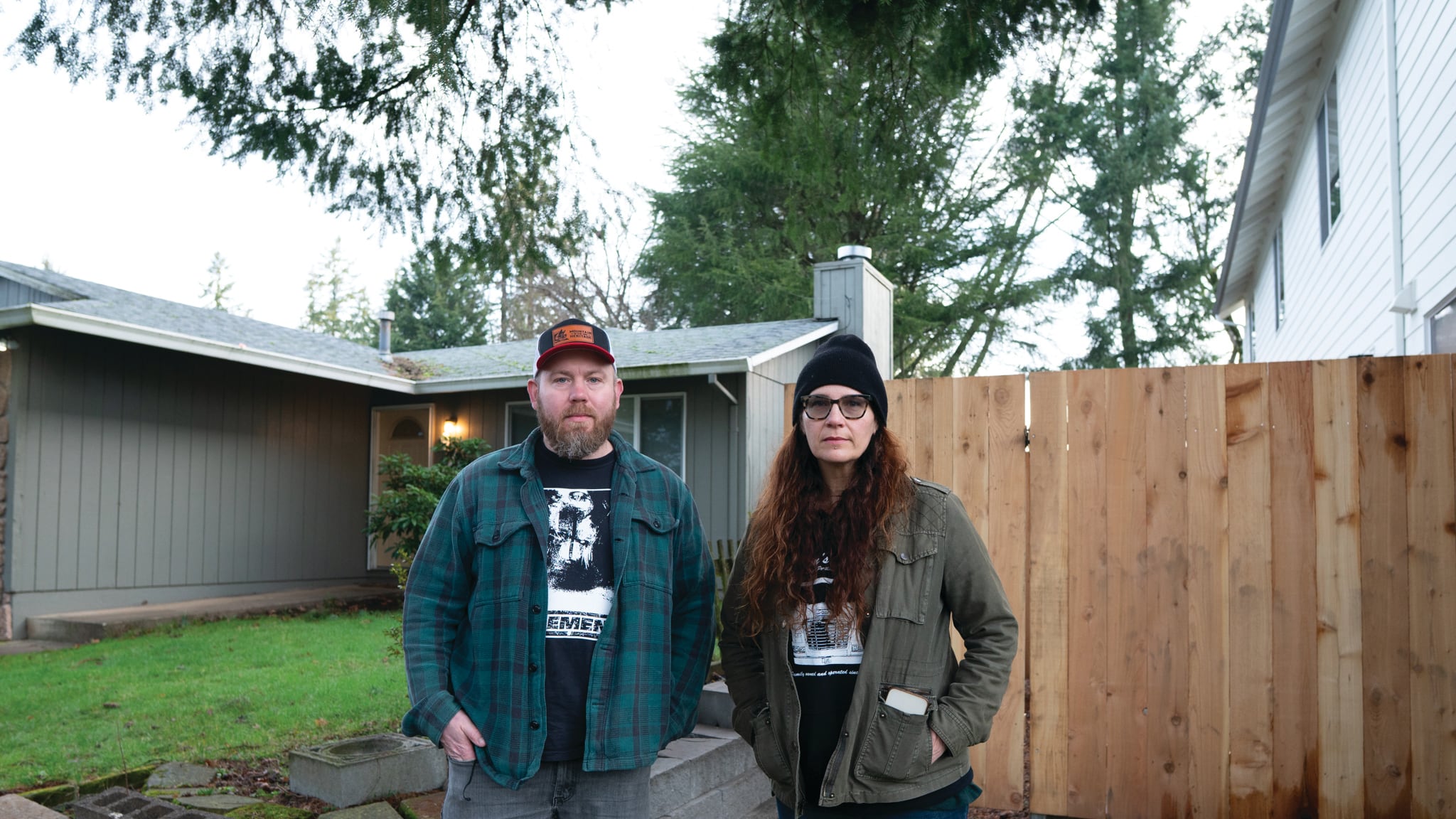
In her 2022 campaign for governor, Tina Kotek vowed to make homes rise from the ground across Oregon and drive down the high housing costs plaguing the state.
It wasn’t a new issue for Kotek. As speaker of the Oregon House of Representatives, she championed a bill in 2019 that eliminated single-family zoning restrictions in cities and larger towns, and allowed duplexes on single-family lots in smaller ones. Last year, she signed bills permitting duplexes, triplexes and cottage clusters on urban unincorporated lands.
The new laws are working. Drive around most any Portland neighborhood, and you’ll see tall, skinny houses standing two or three abreast on lots that once had just one house.
But squeezing the new dwellings, narrow though they may be, into Portland neighborhoods isn’t always easy. Vlad Kovtun, a partner at Aker Development, has done hundreds of infill projects. Sometimes the neighbors applaud him for helping to alleviate the housing shortage. Other times, they complain that putting in a fourplex will bring more traffic, more cars to park, and more noisy trash bins rolling around.
“We’re either welcomed as saviors or we’re shunned,” Kovtun says.
But Kovtun has never seen anything like what’s happening on Southwest 54th Avenue, just off Taylors Ferry Road in the Ashcreek neighborhood, where he bought a dilapidated house with a hole in the roof and lots of rot—the kind of property that’s ripe to tear down and replace.
He thought it was on a standard 50-by-100-foot lot. Far from it. Kovtun stumbled into a developer’s nightmare, complete with a weird sliver of land too narrow for any use, and thorny questions about where its property lines were. Kovtun also encountered a neighbor—an engineer with exceptional technical abilities—who was not willing to let the matter slide.
As developers cut small city blocks into smaller ones for infill housing, they run the risk of stepping into the same survey sludge that Kovtun has. More likely are fights over parking and views obscured by tall, narrow houses. But those are simple by comparison, Kovtun says.
“It’s not easy doing infill development,” he says.
On Southwest 54th Avenue in Portland, that’s an understatement.
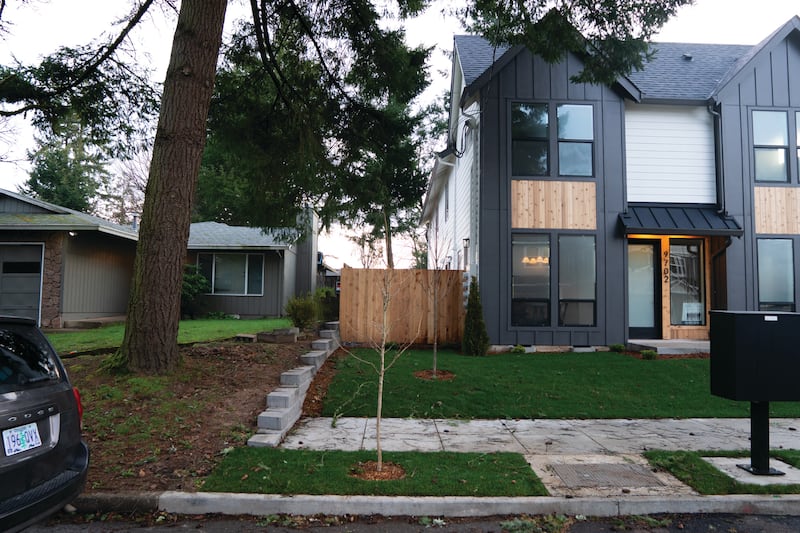
This seven-month drama began in August, when Kovtun was looking at Portlandmaps.com, the go-to site for property details. He’d looked up his lot before, but this time he noticed a narrow parcel of land just north of the one where he’d poured a foundation and commenced framing. To him, the sliver seemed to be encroaching on the property to the north, so he called the owner, Tyra Grove, and left a message, thinking she might want to buy it and protect her “setback,” the minimum distance required between a house and its property lines.
“It was just a friendly neighborhood gesture,” Kovtun says.
Grove and her husband, Joe Wilson, an engineer who designs machines to test high-performance products like bicycle frames and gears, feared the worst. If the sliver was north of the property line, it would cut off a chunk of her lot, bringing the new development even closer to a home she rented out.
“I said, ‘Buy the thing, you don’t want them building up to your fence,’” Wilson says.
So Grove snapped up the sliver for $1,500. Wilson, a soft-spoken Virginian who spends summers fishing in Alaska, wanted to know if the odd lot really was slashing off a chunk of his wife’s property.
Figuring out property boundaries requires digging through old surveys on file at the county and digging through actual dirt to find metal stakes put in the ground by past surveyors. Being an engineer, Wilson, 44, felt like he was up to the job.
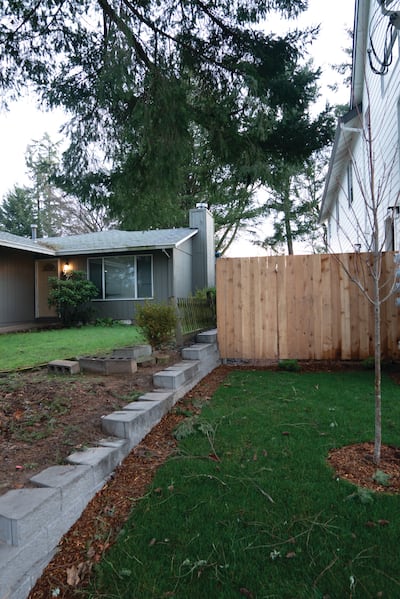
After two weeks of research, he found evidence that the sliver wasn’t shaving off the southern edge of his wife’s property. Rather, it was cutting a long rectangle off the land under the fourplex, where Kovtun had put four small patios and a fence.
Wilson did what he felt any good engineer would. He went out and rented a Trimble RTS673 electronic surveying tool for $518. The benchmark survey pin for the neighborhood (a numbered, bronze disk set in concrete by the county) was in the middle of Taylors Ferry Road. Undaunted by traffic, he recruited a friend to manage it while he set up the survey tripod and took measurements.
To be safe, Wilson hired a new surveyor, out of Vancouver, Wash., to check his work. He became more convinced than ever that multiple surveyors had gotten the property lines wrong. In particular, Wilson’s suspicions centered on Multnomah County Surveyor Jim Clayton, who’s been in the $144,000-a-year position since 2010.
The locals, Wilson decided, could not be trusted. “I felt like I had to go outside of Multnomah County,” he says.
(Multnomah County spokesman Denis Theriault says Clayton did everything required of him. He “received, reviewed and filed a plat boundary survey prepared by a licensed land surveyor relating to the subject property,” Theriault said in a statement.)
Distilling the hours and hours of amateur sleuthing and surveying he’d done, Wilson determined the problem started with a survey done in 1976, which, according to Wilson, used faulty monumentation—the physical markers that define property lines.
Surveyors who came along years later failed to note the change, and the error propagated itself through later surveys until 1985, when an owner on the block hired Carleton Coffey to survey his property. Among other problems, Coffey determined that the sliver of land in question was cutting into the lot where the fourplex now stands, not the one now owned by Grove. A Multnomah County circuit judge said Coffey’s survey was correct.
Wilson presented the court decision to Clayton and Toby Bolden, the surveyor for Aker Development who had put the sliver north of the property line, contrary to Coffey. It is fair to say that both men have become exasperated with Wilson at times. When Wilson said that all the available information indicated that Bolden had made an error, Bolden bristled.
“I don’t have a lot of time to sit here and listen to someone disparage my work,” Bolden said, in a recording Wilson made of the call. “Surveying isn’t about just data. Otherwise, my job would be replaced by a bunch of minimum-wage techs. This is a professional job, and it takes years of understanding evidence, and rules of evidence, and history.”
Such bona fides do not impress Wilson. He says Bolden and Clayton haven’t shown him any data that would discredit the Coffey survey or the court’s decision. He also wonders why Clayton, as the Multnomah County surveyor, isn’t more interested in fixing Block 38 of Ashcreek, where nine blocks are bedeviled by the same error he’s discovered. On a call with Wilson, Clayton himself called the block “a mess.”
A bigger mess will come if the city of Portland decides to extend Southwest Brugger Street two blocks to the east, where it is now just a path through trees in the public right of way. With fourplexes increasing density, it’s a possibility, Wilson says.
The more immediate question is what drives Wilson’s obsession with the property lines. Surveyors and title experts who aren’t involved in the skirmish on Southwest 54th ask if Wilson is trying to shake down Kovtun by proving that Aker Development has built patios and a fence on the sliver of land now owned by Wilson’s wife.
Wilson says the matter will likely end in some sort of settlement, but that’s not what motivates him. Instead, he seems spurred to spend time and money (about $17,000, so far) by a sense that he has been insulted by authorities who won’t acknowledge that an amateur found an error in their work.
“I don’t wake up in the morning excited to get on my hands and knees in the middle of Taylors Ferry Road to figure out something that other people are paid taxpayer money to do,” Wilson says. “If someone can show me data proving that I’m wrong, I’m willing to walk away.”
Until then, the fight is likely to continue. Four new housing units have risen on Southwest 54th Avenue. Four units closer to the governor’s goal. But if surveys and egos cloud title to the lot under the new fourplex, Kovtun’s Aker Development would have huge hurdles to selling them, and Kotek’s campaign for more housing would lose what looked like a small, but surefire win.