Skip to main content
In recent weeks, WW has reported extensively on the struggles of Home Forward, Portland’s housing authority, which owns about 7,000 affordable apartment units across the city and provides housing assistance vouchers to many more low-income Portlanders.
Among our findings was that it took an average of 185 days for Home Forward to fill an empty unit in 2025, despite long waitlists across its properties (“Home Alone,” WW, Feb. 18). That number stands in contrast to the homelessness crisis that local elected officials say is their top priority to relieve.
A closer look at Home Forward’s books, however, shows that when units stand empty, they not only fail to shelter people sleeping outside, they make it harder for the agency to pay back its lenders.
Home Forward finances much of the construction of new affordable housing with loans. It then must pay back those loans with rent collected from tenants and federal subsidies that augment those rents.
At a number of its properties, Home Forward is not collecting enough revenue either to pay off the buildings’ annual debts or to fund its operating expenses, forcing the agency to make interagency loans to properties that aren’t generating enough revenue. As a result, its real estate portfolio is moving dangerously close to financial distress.
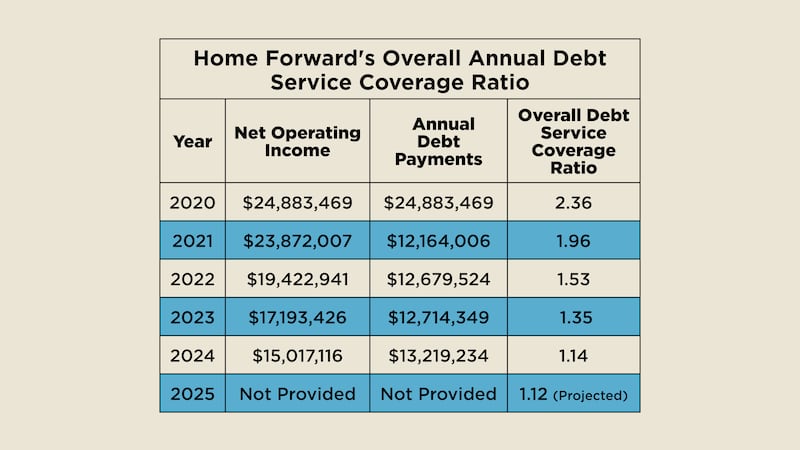
Data provided by Home Forward shows the agency’s overall debt service coverage ratio in 2024 —a measurement of its ability to pay off its debts—was 1.14. A ratio of 1.1 is breaking even, meaning the properties are bringing in just enough revenue to pay off debt.
The 2024 number is a steep decline from Home Forward’s debt service coverage ratio of 2.36 in 2020 (see table below). In other words, Home Forward had twice what it needed to cover its debts just five years ago—and now that number has fallen by half.
Margaret Van Vliet, who served as deputy executive director at Home Forward from 2000 to 2008, and then went on to serve as director of the Portland Housing Bureau from 2009 to 2011, calls that a “precipitous decline.”
“This huge drop in DSCRs is worrisome,” Van Vliet says. “It’s no secret that our affordable housing stock faces financial challenges from many sources. The question is, how are property owners reacting? Many costs are outside their control, but there certainly are ways to mitigate the downward spiral.”
Most lenders require, at a minimum, a DSCR of 1.1 or 1.15. (Not all Home Forward properties carry debt, and not all the buildings that do have debt have a minimum DSCR required by lenders. But rent revenues from all properties—debt or no debt—are used to pay down debt across the portfolio.) That means Home Forward is inching closer to being unable to make all of its building debt payments on time. Home Forward spokesman Rylee Ahnen says the agency projects its DSCR for 2025 across its portfolio will be 1.12, though that number is not yet finalized.
In the agency’s proposed budget for 2026, it estimates its portfolio will bring in $32.5 million in rent revenue (not including tax credit buildings) and will forgo only $2.5 million in rent due to vacancies. But the rent revenue figure assumes two aspirational goals: first, that Home Forward will keep occupancy rates at or above 94% and, second, that “most tenants are regularly paying their rent.”
Nothing in Home Forward’s recent track record suggests either of those things will happen.
Home Forward is an unusual agency, neither fish nor fowl. It receives much of its funding from the U.S. Department of Housing and Urban Development, and the nine members of its board of directors must be confirmed by the Portland City Council. But the board independently approves the agency’s budget and has operated in recent years with little scrutiny or oversight by city officials.
That matters because when the agency’s performance or operations are called into question, there’s no clear way the city can step in and demand answers.
Phil Keisling, former Oregon secretary of state and onetime director of Portland State University’s Center for Public Policy from 2010 to 2019, says Home Forward is in dire need of a performance audit.
“The broad outline [of its operations] suggests a very large and critical public agency that’s in desperate need of a thorough performance audit years ago,” Keisling says, “and could especially benefit from one now.”
Such an audit could examine the cash Home Forward is moving around to cover properties that can’t cover their expenses alone. Last year, the agency had to make 20 interagency loans to cover expenses at struggling properties. Loans included a $505,926 transfer to The Yards, an affordable building on Northwest Naito Parkway, $483,472 to the Louisa Flowers building in the Lloyd District, and $649,202 to the Pearl Court apartments in the Pearl District.
Home Forward’s Ahnen says the plummeting DSCRs are due to the agency spending more money on tenant services and other operating costs—like rising insurance premiums—and unpredictable rent payments, which in turn leave less cash to cover debt payments. (Tenants across Home Forward buildings tell WW that their calls for increased security and safety measures feel mostly unanswered. Home Forward, meanwhile, has said it’s increased efforts to keep the buildings safe, secure and functioning.)
“Given our public service mission, we reinvest property income in programs and services to support residents,” Ahnen says. “In recent years, as these supports and other operating costs like insurance have increased, and as we have seen challenges with tenants unable to pay their rent, we’ve seen reduced debt coverage ratios.”
Like Ahnen said, rent revenues are an important part of the equation. The agency says 3,335 tenants at the close of last year were more than 30 days delinquent on their rent. Given that the agency’s affordable housing portfolio comprises roughly 7,000 units, that figure is staggering; it means almost half of tenants weren’t paying rent on time.
In addition, Home Forward says it forwent $8.4 million in rent revenues across all of its properties in 2025 attributable to vacancies. That much lost rent, coupled with 3,335 delinquent renters as of late last year, is “clearly a troubling situation,” says Steve Rudman, who served as Home Forward’s executive director from 2001 to 2014.
(As WW reported last year, the agency had a 14% vacancy rate across its affordable buildings in November 2025. By December, that rate had dropped modestly to 11%.)
To be sure, Home Forward’s stewardship of affordable units is just one piece of its broader housing strategy. And it’s also not the only part of the agency’s operations causing financial woes.
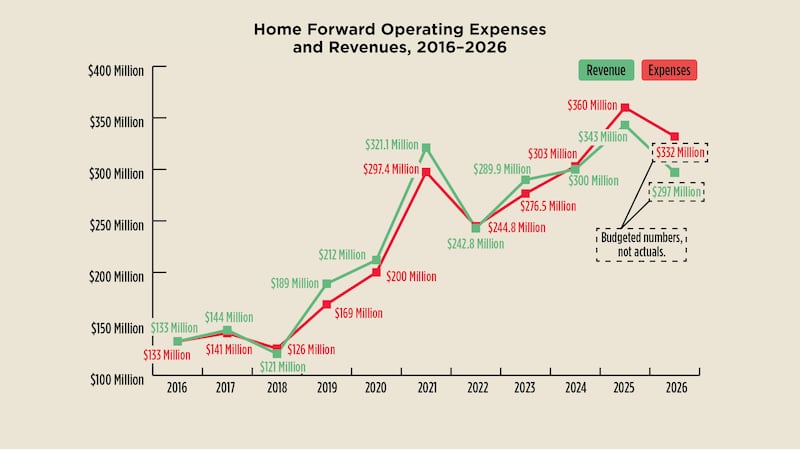
About two-thirds of Home Forward’s operating revenue in any given year comes from HUD, primarily in the form of rental assistance vouchers. Federal funding for vouchers, the agency says, is expected to remain relatively flat while the cost of providing those vouchers has dramatically increased. That’s a large reason why Home Forward says its budget is an estimated $30 million in the red in the current fiscal year (see graph above).
Ahnen says such woes are not unique to Home Forward; they affect housing agencies across the country.
Among other cost-saving measures, the agency froze all salaries for its top executives in 2026, meaning that none of its four top executives—the CEO, the chief operating officer, the chief financial officer, or the chief people and culture officer—received a raise this year.
But even without a current year raise, what those four executives make seems to contrast with the agency’s financial performance.
Ivory Mathews, Home Forward’s CEO, came to the agency in 2022 from a housing authority in South Carolina. That year, her salary was $215,001. In 2023, her salary jumped to $253,242, and then again in 2024 to $321,635. In 2025, it rose again to $342,849. (That doesn’t include benefits and other compensation.) It represents a 59% increase in salary in a span of just three years.
Kandy Sage, the agency’s chief financial officer, jumped from making $155,318 in 2022 to $247,699 in 2025—a 59% increase in just three years.
Ian Davie, the chief operating officer, went from making $157,351 in 2022 to $264,445 in 2025, a 68% increase. And Kitty Miller, the agency’s chief people and culture officer, jumped from making $157,351 in 2022 to $274,070 in 2025, a 74% increase.
Ahnen says the salary jumps are partially a result of a 2023 market and pay equity study undertaken by the agency after which Home Forward decided to raise its base wage for every employee to $30.96 an hour.
The agency defends the salaries, reasoning that Home Forward’s leaders have managed to steer a difficult course and serve a record number of low-income Portlanders even as federal funding becomes less certain.
“Staff compensation and resident safety aren’t competing priorities,” Ahnen says. “Both are essential to ensuring we can fulfill our long-term mission and provide stable housing for our community.”