Skip to main content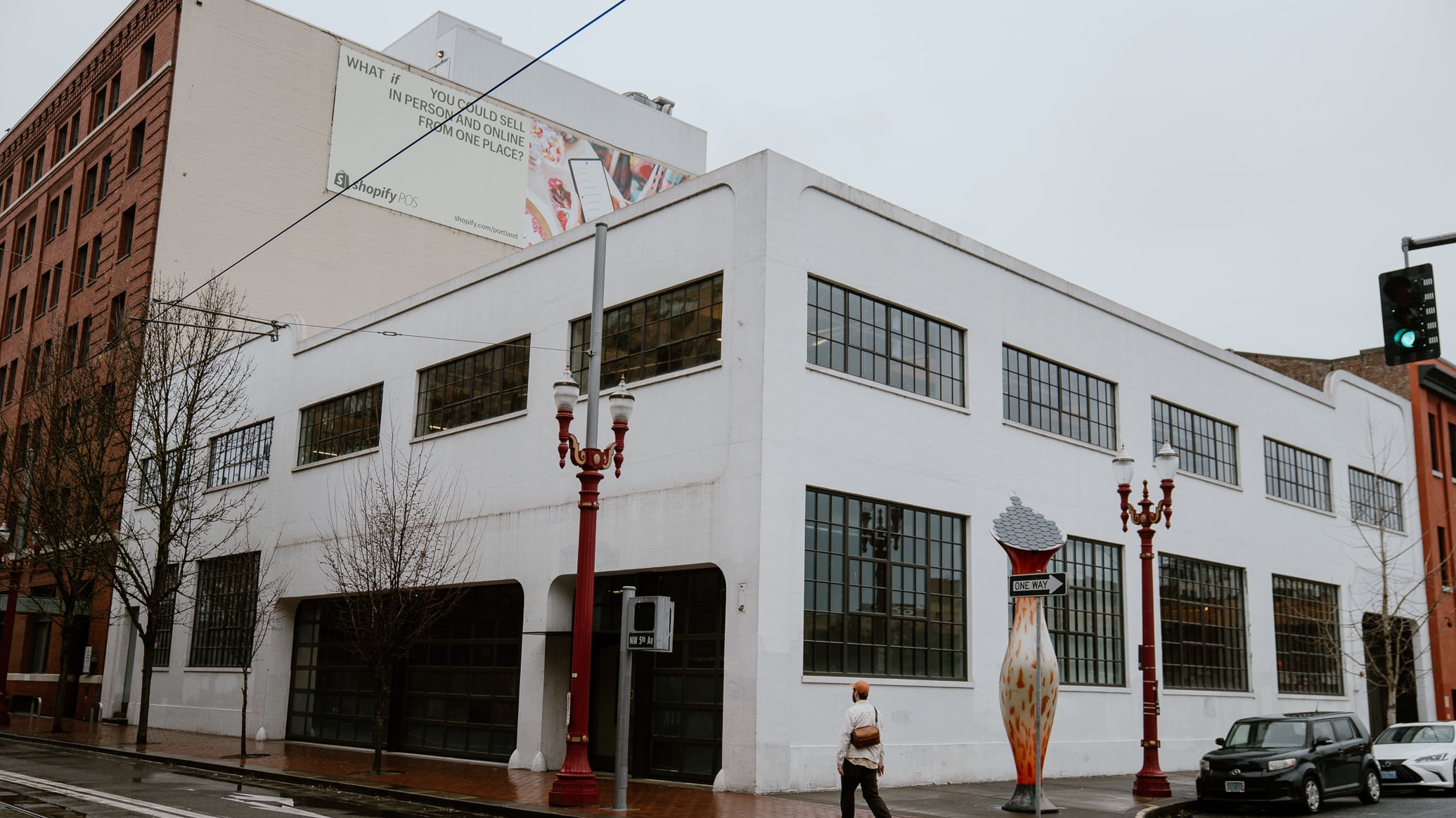
An ambitious shoe manufacturing initiative in the city’s beleaguered Old Town neighborhood appears dead, a little more than a year after it secured a $7 million loan from Prosper Portland and a $2 million grant from the Oregon Legislature.
Prosper Portland told The Oregonian last week that the shoe incubator, Made in Old Town, wouldn’t be moving forward. It’s not clear what exactly that means—including whether Prosper will repossess the buildings that contained the project propped up by taxpayer money.
“It is disappointing this effort will not move forward,” Cornell Wesley, executive director of Prosper, said in a statement to WW. “Prosper Portland believes the borrower no longer appears to have a viable business strategy.”
Leaders of Made in Old Town sold a vision of a nine-building campus in the heart of Old Town, where homeless services are clustered and small businesses have steadily closed since the pandemic, citing crime and a vanishing customer base. MiOT’s leaders—a collection of former athletic apparel executives and local entrepreneurs—described a buzzing campus that would bring industry, creativity, big ideas and money to the neighborhood, helping to lift it out of its distress.
That was enough to persuade Prosper, the city’s economic development agency, to approve a $7 million loan to purchase two buildings, with terms that flouted its own guidelines for commercial loans, written just 11 months before. WW first reported that red flag in February 2025.
Now, after months of signs the project was floundering, it appears dead.
Prosper spokesman Shawn Uhlman tells WW that the agency “will now work with our board of commissioners and MiOT leadership on next steps,” adding that “at this point, all options, including assuming ownership of the property, are available to us and will be considered.”
While Made in Old Town did not respond to WW’s request for comment, the project’s board said in a March 12 LinkedIn post that tariffs and “global economic uncertainty and market volatility have created an operating environment none of us anticipated.”
“We’re not going to sugarcoat it,” the board wrote. “Today, the future of Made in Old Town is far from certain. But as a team, our focus on supporting Portland and the industry we love is unwavering.”
A series of WW stories over the past year revealed how the project’s leaders made lofty and dubious promises to state and local elected officials to secure money to purchase a headquarters in Old Town, only to repeatedly fall short of delivering on those pledges.
Here is a timeline of WW’s reporting on the project:
March 2024: The Legislature approves a $2 million grant for Made in Old Town, a subsidy widely greeted with hosannas in the press.
Soon, the first troubling sign appears: Gov. Tina Kotek considers vetoing the grant, and only agrees to sign it after receiving a pledge from Made in Old Town that the project would secure $800,000 in matching funds from sources other than the state.
April 10, 2024: In a letter to Kotek, obtained by WW, Jonathan Cohen, one of the project’s principals, and his wife, Jessie Burke, chair of the Old Town Community Association, writes that the OTCA “acts as a fiscal sponsor for the MiOT project, providing financial controls, accountability, and reporting” and includes other sources of funding for the project.
Among the funding sources listed: $750,000 from the Portland Clean Energy Fund and a $700,000 loan from Prosper. But at the time, the project had secured no such funds. In fact, it would never receive any PCEF dollars.
October 2024: The regional government Metro rejects a request from MiOT for a $662,000 planning grant.
Among its reasons, according to Metro’s Oct. 22 rejection letter, obtained by WW at the time: “Applicant did not demonstrate demand for industry cluster in this area”; no proof of financial feasibility; “unproven and unsubstantiated” proof of project progress; and Made in Old Town is “an unknown entity.” (Also in 2024, WW found that Made in Old Town had unsuccessfully sought $25 million from PCEF.)
Metro noted that $320,000 of the money would be paid to a consulting firm called Field States to draw up the plans. Field States is an urban planning firm founded by Matthew Claudel, who at that time was one of the principals of MiOT, joining Cohen and others in convincing local officials that it would transform Old Town.
Another $66,000 would have gone to a second contractor, Equity Development Lab. That’s a consulting company owned by Cohen.
February 2025: The Prosper Portland board unanimously approves a $7 million loan for MiOT despite the loan being of a higher amount, for a longer duration, and at a lower interest rate than the agency’s own guidelines suggested was prudent.
Critics, including a city councilor, said the loan was highly speculative and demonstrated a lack of due diligence by Prosper.
“A loan on those speculative terms, with no business plan as far as I can tell, it’s basically the city saying, ‘We don’t expect the money to ever come back,’” said Councilor Mitch Green at the time.
The $7 million loan helped MiOT pay $6.9 million for two buildings at 208 and 234 NW 5th Ave., which the project’s leaders said would be the headquarters and flagship of their eventual nine-building campus. The two buildings, however, had recently been appraised at $3.8 million—putting Prosper’s loan-to-value ratio at 182%. Prosper justified the loan to WW, saying at the time that it approved the loan under the expectation that MiOT would find $4.4 million in additional funding needed to complete improvements to the buildings that would raise the value to $13.8 million.
MiOT also told Prosper that it had eight letters of intent from interested tenants.
The Prosper board asked no questions why MiOT would pay nearly double a building’s appraised value, but documents obtained by WW show that Cohen wrote in an email to Prosper staff earlier that month that to backtrack on its initial offer to the seller would be regarded as “bad faith.”
March 2025: Made in Old Town purchases the Mason Ehrman Building and Annex for $6.9 million, mostly using taxpayer dollars from the Prosper loan.
That same month, the project unlocked the remaining $800,000 of its $2 million state grant. Just two months before that, WW informed Kotek that MiOT was using part of a $7 million loan from Prosper Portland—more taxpayer dollars—as its matching funds to unlock the remainder of the state’s grant.
The governor was unhappy. Basically, the project’s principals were leveraging public funds from one government to unlock public funds from another. At the time, Kotek spokeswoman Elisabeth Shepard said in a statement to WW: “The governor expects recipients of taxpayer dollars to come to the state in good faith with viable projects that bring direct benefits to the public, and to meet the conditions set by the state in order to authorize funds. To date, this standard has not been met.”
Yet one month later, in March, Kotek agreed to release the remaining portion of the state grant. According to the state, the matching funds MiOT came up with to unlock the state money were projected lease payments of $1.4 million, to be made by a tenant of the Mason Ehrman Building, which Made in Old Town had not yet purchased.
Though the state released the remaining funds, Kotek’s team appeared irked by one key detail: that MiOT listed a $4.4 million “unsecured” state grant as a funding source for the project, specifically to help finance the building improvements Prosper had stipulated in its loan agreement.
“If it is true that this clause is part of the loan agreement,” wrote Vince Porter, a deputy chief of staff for Kotek, “we have serious reservations about accepting the Prosper loan as proof of raising matching funds. It’s important to note that there is not $4.4 million for this project in the governor’s recommended budget.”
December 2025: WW reports Made in Old Town is in material default of the loan terms laid out by Prosper because it failed to secure $5.7 million in additional funding needed to build out manufacturing and office spaces in the Mason Ehrman buildings.
But Prosper maintained its support for the project.
“Although MiOT did not achieve its original financing target by June 30, they are current on their loan payments to Prosper Portland,” Uhlman said in a statement at the time. “MiOT has also moved forward with site work, marketing, and business plan development using non-Prosper Portland funding and their personal efforts.”
Meanwhile, MiOT declined to answer questions about how large of a financing gap remained, how many tenants were actually in the buildings, and how the project was progressing.
February 2026: Made in Old Town’s short-lived executive director, Liz Rodgers, abruptly resigns.
Rodgers, a former longtime Nike executive, had been at the startup for mere months before calling it quits. She does not respond to a request for comment, and neither does Made in Old Town.
March 2026: The Oregonian reports Prosper Portland has finally declared the project DOA.
Prosper stops short of describing its next steps, but Wesley says repossession of the Mason Ehrman buildings is on the table as one recourse.
“One of Prosper Portland’s key roles is to support projects that serve multiple objectives. MiOT fundamentally met those criteria. A project focused on one of the city’s key industries, footwear and apparel, that simultaneously seeks to enhance the Old Town neighborhood is something worthy of support,” Wesley said. “While there was clear potential for success based on the industry expertise working on Made in Old Town, it is apparent several factors ultimately contributed to its closure; not the least of which were the headwinds faced by the footwear industry and economic uncertainty.”
Neither MiOT nor Cohen responded to a request for comment by press deadline. Nor did Kotek.
Green, however, says he’s glad he expressed skepticism.
“There is a role for subsidy in economic development, but when public money is at stake, there needs to be a high bar for scrutiny,” he says. “Going forward, I hope Prosper learns from this failed venture and subjects future proposals to a more rigorous standard with particular emphasis on ensuring there are no clear conflicts of interest.”