Skip to main content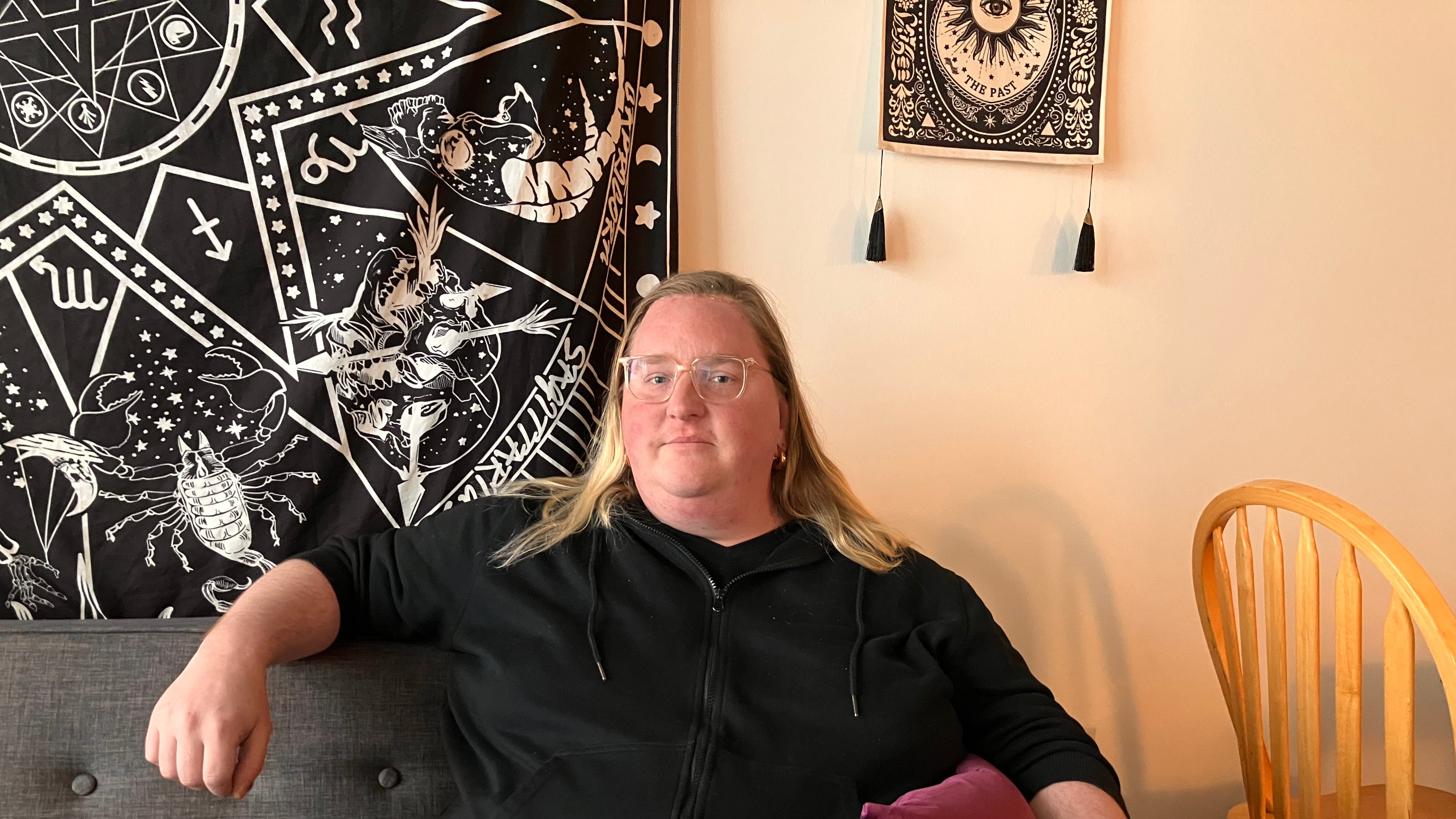
On a recent afternoon, Vivian used the toe of her boot to nudge loose a soggy doormat wedged in the back door of her apartment building. Her guess: It was placed there to keep the door open for outsiders to make their way into the building, where she says drug use and dealing are commonplace.
Vivian lives in the Louisa Flowers, a 240-unit affordable apartment building in the Lloyd District. It’s one of the newer buildings opened by Home Forward, the city of Portland’s housing authority. It’s restricted to tenants making 60% or less of the area median income.
Home Forward touted the Louisa Flowers as the largest apartment building constructed in the city in the past half century. It’s energy efficient and transit-oriented. In 2021, it won an Architizer A+ Award for best-designed public housing building.
And yet the reality on the ground makes such accolades sound hollow.
Strangers come in and out in twos or threes to ride the elevators to one of the 12 floors, either to use or buy drugs, tenants say. Sometimes they wheel in carts filled with goods; no one checks whether they’re tenants or not. The stairwell reeks of urine. As of November, 84 of the 240 units lay vacant.
Vivian, who asked to be identified by her first name only, has lived here for six years. She came to the Louisa Flowers in 2020, still suffering from a meth addiction after being homeless on the streets of the Bay Area. This is where she got clean.
Her apartment these days is neat and steeped in the smell of woody incense. She’s been happy here, for the most part, but the building feels less safe than it used to.
“It’s really snowballed,” Vivian says. “There’s trash everywhere. The stairwells have been a mess, full of poop, trash and pee. Some days we have a drug market going on on the corner of our building and people actively smoking fentanyl. I think they’re getting it in here.”
Tenants have described the same issues to WW in several Home Forward buildings: a permissive culture that allows other tenants’ bad behavior to go unaddressed.
This newspaper previously reported how Home Forward in 2022 loosened its criminal screening requirements for prospective tenants. Put simply, Home Forward lowered the barrier to entry.
Documents newly examined by WW show Home Forward later that same year surrendered one of its tools to address dangerous behavior in its buildings. Its board greatly narrowed the circumstances under which the agency would terminate rent assistance for a tenant using a federal voucher to pay rent.
The policy change, passed with little public attention, bucked the standard federal guidelines. Among the changes, it raises the bar for terminating rent assistance from suspicion or arrest for a drug crime to a felony conviction for drug distribution. It raises the same bar for violent criminal activity so that only a felony conviction would warrant termination.
In effect, Home Forward allowed more people with histories of violent or chaotic behavior into its buildings, then made it more difficult to penalize them should something go wrong. The upshot for tenants like Vivian: No matter how often they report drug dealing in their building, Home Forward can’t cut off rent assistance for a suspected dealer—unless that tenant is convicted of a felony and will be absent from the unit for more than 60 days due to incarceration, or if they have a project-based voucher and are evicted.
The agency changed its policy in the name of racial justice, even though the data it used to justify the change showed that white people, in most cases, made up a disproportionately large share of the tenants who violated the terms of their rent assistance under the previous policy.
The results of the policy change are difficult to quantify. For one thing, the number of involuntary terminations has not changed significantly—it was small to begin with.
Also, Home Forward doesn’t seem to know much more about the policy’s results. WW first raised questions to the agency on March 19. Chief operating officer Ian Davie says Home Forward has yet to study the effects since its board passed the policy—though in February it hired a consultant to begin assessing what happened.
In a statement, Home Forward’s board of commissioners stood by the policy.
“At its core, the role of a housing authority is to provide housing and help people stay housed. This policy change reflects that commitment. We know that for many households, a loss of assistance can quickly lead to instability or even homelessness, often over issues that could be resolved with the right support,” the board said. “By addressing subsidy terminations, we are taking a more thoughtful, case-by-case approach that prioritizes stability, fairness, and accountability.”

From July 2020 to July 2021, Home Forward convened a work group to consider changes to the agency’s termination policy. The policy applies to more than 10,000 tenants receiving project- and tenant-based housing vouchers funded by the U.S. Department of Housing and Urban Development that flow through local housing authorities like Home Forward. Voucher-holders live in both Home Forward-owned and private-market units.
The project was led by Home Forward’s policy director at the time, Taylor Smiley Wolfe. She convened four Home Forward staffers, three of the housing authority’s tenants, and three facilitators, including equity consultants.
What the work group came back with were sweeping policy changes that bucked the blanket standards imposed by HUD on when a housing authority—there are around 3,000 across the country—should terminate a tenant’s rent assistance for bad behavior.
Until then, Home Forward for the most part used HUD’s standard policy for housing authorities. For drug and alcohol use, for example, an agency would “terminate a family’s assistance if any household member, guest, or any other person on the property under the tenant’s control is currently engaged in any illegal use of a drug, or has a pattern of alcohol abuse or illegal drug use that interferes with the health, safety, or right to peaceful enjoyment of the premises by other residents.” (The agency noted at the time that it usually opted not to terminate assistance for drug or alcohol use alone, despite its policy saying it would.) The same went for violent criminal activity and drug dealing. The old policy said Home Forward would consider “all credible evidence,” including arrests, convictions or evictions for such behaviors.
The work group suggested a different path: Home Forward should scrap the use of a “preponderance of evidence standard” when determining if someone was dealing drugs inside a building or engaged in violent criminal activity. Instead, it would consider a felony conviction (paired with absence from a unit for more than 60 days due to incarceration) as the only grounds for termination. The work group wrote that “the only way to determine whether a violent crime occurred is if there is a conviction for the crime.”
The work group determined HUD’s standard was “not fair” because the “Supreme Court has ruled on arrests not being sufficient information to prove guilt of an individual—it’s not fair for public housing authorities to have more power in determining guilt than the justice system.”
The workgroup said that central to its discussion was scrapping the old ways of criminalizing addiction, and noted that “a service and support driven approach to people with drug and alcohol abuse challenges was recently supported by the general public in Multnomah County, where there was overwhelming support for Measure 110 in the 2020 election.” (See story, page 8.)
Home Forward’s board approved the changes in November 2022, effective immediately.
The agency also received approval from HUD to make additional reforms that took effect in 2024. Among them: Home Forward will not terminate a tenant’s rent assistance if they’re evicted. (This doesn’t apply to project-based voucher holders, since the subsidy is tied to the unit itself.) “Eviction and lease enforcement is a landlord/tenant issue,” Home Forward wrote in a 2024 planning document. “Home Forward’s mission is to shelter people.”
The work group didn’t stop there. It also implored the board to ask HUD to make sweeping changes to its overall termination policy for all housing authorities across the country, including reexamining the lifetime ban if someone had been found guilty of manufacturing meth inside public housing, and asked that HUD “only allow terminations for felony convictions” for criminal and drug-related behavior.
Minutes from a November 2022 board meeting show that Smiley Wolfe “added that we are the first housing authority to put together a policy with an equity lens.” Smiley Wolfe now works as a deputy chief of staff for Gov. Tina Kotek.
The policy work group used rent assistance termination data between January 2018 and April 2020 to build its recommendations. It focused specifically on racial disparities.
But the data, curiously, didn’t clearly show the racial disparities the work group said the new policy was meant to fix. In fact, it found that tenants of color were less likely than white tenants to have assistance terminated for any reason.
The data, provided in Home Forward board documents, reveals a few important things.
First, terminations initiated by Home Forward were already rare. In the 27-month sample period, 1,667 terminations occurred among 12,865 voucher holders. But a vanishingly small portion of those terminations were for behavior. Only 11 terminations were for drug or alcohol use, and only 10 were due to criminal activity. Most terminations occurred because a tenant died or formally chose to leave the program or there were other paperwork issues.
White tenants were proportionally overrepresented in both overall terminations and ones for bad behavior. Eight of the 10 tenants terminated for criminal activity were white, whereas white people represented only 57% of voucher holders. Tenants who were white, identified as two or more races, or were Native American were overrepresented in terminations based on drug or alcohol use. Black, Native American and Asian tenants were overrepresented in terminations based on sustained absence from a unit.
Still, though the data showed that white tenants were overrepresented in most termination categories, “the work group discussed the way systemic racism in the criminal justice system disproportionately harms Black and brown people.”
So what were the results of the policy change? Davie, Home Forward’s COO, says that since the new policy took effect more than three years ago, the agency has terminated the rent assistance of 20 tenants for criminal activity. He adds that “average subsidy terminations have remained constant with pre-pandemic levels, and we do not see in the data a link between policy changes and property impacts.”
Davie says the agency has not conducted a study of the effects of its new termination policy, but in February “began working with a policy researcher to conduct an evaluation on our rent assistance termination policy reform.”
To be sure, terminating rent assistance is not the only way Home Forward or one of its contracted managers or building owners may rein in bad behavior. Eviction for lease violations is another tool Home Forward and its partners may use to kick someone out—such violations include drug use, drug dealing or criminal behavior—though, according to spokesman Rylee Ahnen, “the majority of eviction actions are related to nonpayment of rent,” not drug dealing or other criminal activity.
Even so, the agency’s eviction policy is unclear. The agency did not provide documents to WW by press deadline, but did it say that “property managers are expected to use their discretion while ensuring compliance to the lease,” and Davie wrote: “For tenant-based voucher holders who reside in Home Forward housing, we will proceed with an eviction for criminal or violent behaviors that impact community safety.”
At the Louisa Flowers, 59 tenants are Home Forward voucher holders. Vivian, for her part, wishes Home Forward and the property manager, Pinehurst Management, did more to punish bad behavior. When Vivian was still addicted and living in affordable housing, she says she only learned what she couldn’t do when she tried to push boundaries.
“I learned what my limits were real quick when I got violations for my behavior,” Vivian says. “You pretty quickly adapt to that and you tone it down, or you don’t and it costs you your housing.”