Skip to main content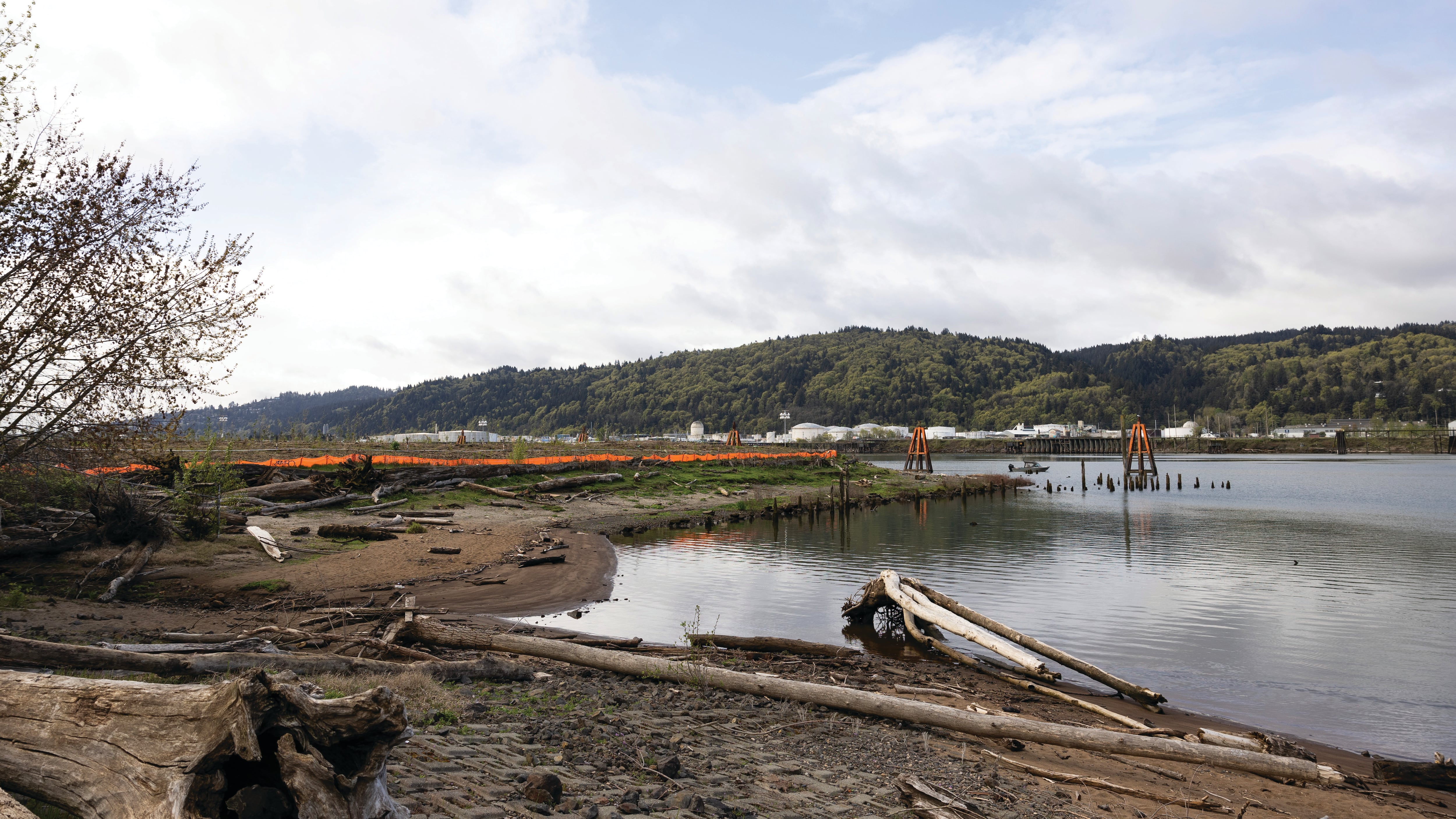
Location: McCormick & Baxter Superfund site, 6900 N Edgewater St.
Amenities now: Clean land (finally), riparian forest, wildflowers
Amenities later: Interpretive gardens, exhibition buildings with native plant displays, a 10-acre public greenway
Champions: The nonprofit Portland Botanical Gardens
When planting a garden, typically you want to start with clean soil. By that standard, the site of the defunct McCormick & Baxter Creosoting Co. doesn’t jump off the page as fertile ground.
Creosote is good for preserving wood. So McCormick & Baxter soaked railroad ties in it for 40-odd years on a lowland below the University of Portland. Creosote is bad in just about every other way. A pesticide distilled from wood or coal, it causes skin and scrotum cancer, burns eyes and mouths, and poisons shellfish. Touch it for too long and you’ll start convulsing, pass out and maybe die. It’s also very hard to remove once it seeps into the groundwater from a holding tank. Which it did.
That level of toxic filth is why the McCormick & Baxter property was named a Superfund site in 1994, six years before the rest of the Portland Harbor. The creosoting company went bankrupt, so taxpayers had to foot the $70 million bill for cleaning out 59 acres of land. For years, it was Portland’s version of Area X in Annihilation—a quarantine zone that hosted magnificent wildflower blooms each spring.
It’s actually been clean since 2005, but in a provisional kind of way: Somebody has to keep an eye on the wells and caps that the U.S. Environmental Protection Agency and the Oregon Department of Environmental Quality used to seal off the contaminated dirt.
Enter Sean Hogan. The former curator of the University of California Botanical Garden at Berkeley, he returned to his hometown in 1996 to found Cistus Design Nursery on Sauvie Island. Since then, he’s been looking for a site to open a botanical conservatory to rival gardens in Denver, Atlanta and Brooklyn, says Matt Taylor, executive director of the Portland Botanical Gardens nonprofit.
“The goal was to have it in the city,” Taylor tells WW. “This really was one of the only large sites available. We understand how special it is.”
Last year, Portland Botanical Gardens negotiated a prospective purchaser agreement with DEQ; the agency is now reviewing public comment. In its most recent presentation to the department, Portland Botanical Gardens described a display of plants from “every ecoregion in the Pacific Northwest,” another exhibition of comparable plants from similar environments around the world, plus a vast meadow and sculpture garden for events. A research garden would test which plants thrive as the local climate changes. These would be ticketed attractions, but the nonprofit would also look after a public, 10-acre stretch of the Willamette Greenway along the shore.
“Our rough timeline is three to five years to complete the greenway and to have what we call the foundational garden started,” Taylor says. “And then it’s an ongoing process. Gardens really don’t grow that fast.”
When WW examined the potential sale in 2024, several environmental groups, including Willamette Riverkeeper and the Bird Alliance of Oregon, had their own ambitions for the site and were unimpressed by Hogan’s idea (“Action Park,” WW, April 30, 2024). Taylor says those objections have faded as PBG explained the vision.
Cassie Cohen, executive director of the Portland Harbor Community Coalition, says she remains “healthily skeptical” of the plan. “They’re in a visioning phase,” she tells WW. “Do they actually deliver on all the promises?”
The larger hurdle is money. To buy the site, the public agencies demand $2.4 million up front—“we have pledges of exactly that amount,” Taylor says—plus a $3 million reserve fund to ensure the site is properly managed. Portland Botanical Gardens is looking to private donors and foundations for that money. From there, expenses multiply. On the low end, Taylor says, building a conservatory costs $10 million. But it could be 10 times that figure.
“Something like the Atlanta Botanical Gardens, they are building a new entrance, and it’s $125 million,” he says. “In Portland, I’m not saying that everybody’s ready for that. [Gardens] can be more about the plants, which are generally the least expensive parts.”
Chance this will ever happen: 4
The idea makes way more sense than it seemed to at first blush. But it’s a lot of money. And there’s a pretty high bar for purchasing the site—as there should be, given what lies under it. A plant lover with deep pockets will need to step up.