Skip to main content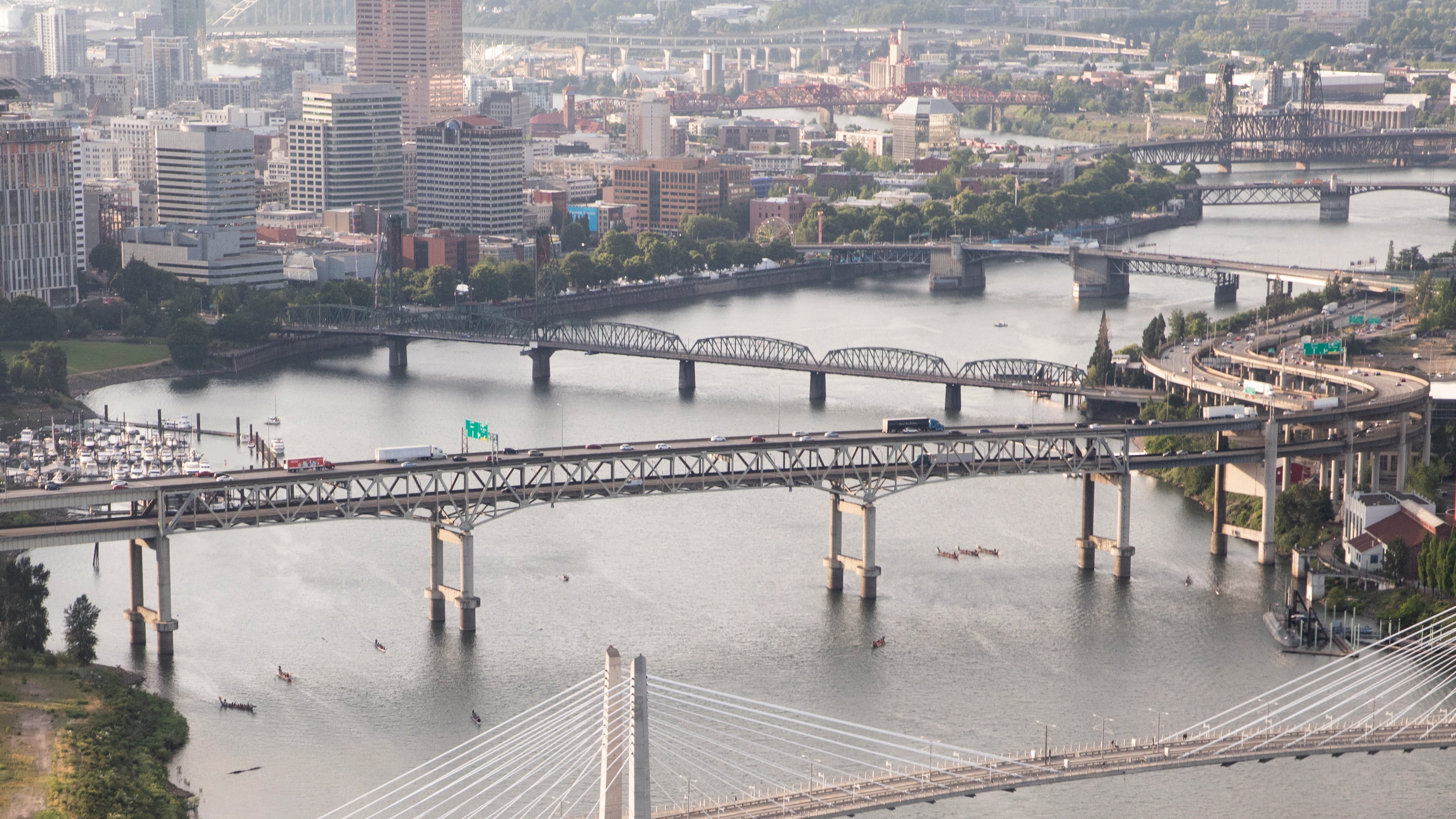
Location: A ferry from Cathedral Park to RiverPlace
Amenities: Two ferry docks, one electric ferry
Champions: Friends of Frog Ferry
Passenger ferries have many advantages. They might come in handy when the Big One strikes. Unlike road or rail, the river requires no upkeep. Plus, ferries are delightful. The “ride quality,” as urban planners say, simply can’t be beat.
And yet designing a functional passenger ferry system has its challenges. For example, just because there is a shore doesn’t mean a ferry can go there: Perhaps it’s not deep enough, or it’s a favored spawning zone for Chinooks. It’s hard to project ridership. And as Mike Gougherty, planning director for the San Francisco Bay Ferry, notes, keeping up marine infrastructure isn’t so simple either. “Whenever somebody gets a windfall, the first thing their accountant says is ‘Don’t buy a boat,’” Gougherty acknowledges. “You know, you’re kind of violating that.”
One could go on. But suffice it to say that several hundred nautical miles up the western seaboard from Gougherty, Susan Bladholm, the persistent executive director of an initiative to get an electric ferry on the Willamette River—accessible to the public for little more than the price of a TriMet ticket—tells WW that over the eight or so years she and her collaborators have pushed for this project, they have consulted legions of experts and analyzed scores of model systems, from Boston to Brisbane.
In short, she says, they’ve thought all this stuff through.
A longtime marketing director at the Port of Portland and Business Oregon, Bladholm estimates the Frog Ferry team and its associates have completed some $40 million in such pro bono or “low bono” work, with a few hundred thousand dollars of taxpayer funds in the mix.
But now, she says, the time has come for the public to throw down: Specifically, she’s seeking $10 million from the Oregon Legislature in 2027, and $10 million from the Portland Clean Energy Community Benefits Fund—which has amassed hundreds of millions of dollars in recent years through a voter-approved 1% tax on large retailers’ gross receipts. And another $2 million locally.
That money, Bladholm says, is enough to get the boat, build the docks, and run the subsidized pilot ferry through its incubation phase for a few years between Southwest Portland’s RiverPlace dock and St. Johns. (The grander vision is for ferry service to extend from Oregon City to Vancouver, Wash.; that’s a lot more expensive.)
Time was, $22 million might not have been so tough to wrangle. Indeed, as Bladholm laments, she was pining for TriMet or the Portland Bureau of Transportation to fully embrace the project years ago, when federal dollars for this kind of project flowed like honey. “We missed out on all of it here in Portland,” she says. “All these other ferry markets across the nation are getting this money.”
Now, at least during the lean times of Trump 2.0, we’re probably on our own. But Bladholm says she has some lawmakers in her corner, and that public demand remains strong. “People often say, ‘Oh, please put a stop here. My daughter lives here,’” Bladholm says. But she says she and the Frog Ferry brain trust outsourced route modeling to research firm ECOnorthwest, and remained agnostic themselves about the route. “We don’t get into that,” Bladholm says. “It’s: ‘What’s the greatest service for our community?’”
Chance this will ever happen: 6.5
Bladholm says the Frog Ferry team’s funding plan could put an operational boat on the water by 2028. But given that lawmakers are struggling to sustain basic road upkeep right now—and that Metro made no mention of the ferry in its 2023-2028 regional transit plan—this timeframe is probably tight. That said, in the medium term Frog Ferry could well come to fruition, though it will likely need a champion or two in government to see it through.