Skip to main content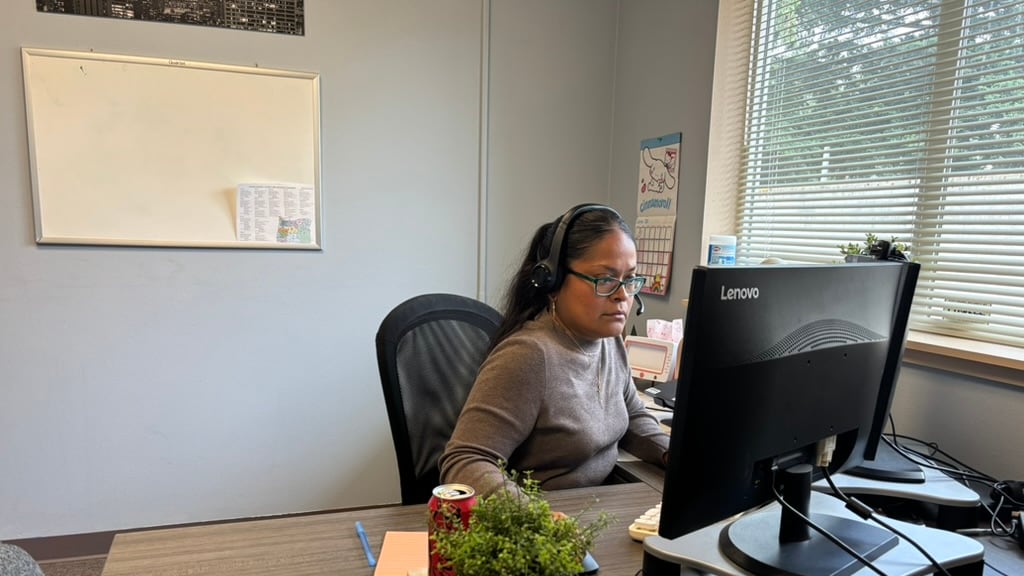
A background in recruiting and retail—selling shoes at Vans, and women’s clothing at Loft and Ann Taylor—prepped Aline Robles, a public benefit specialist for the Oregon Department of Human Services for the client-relations aspects of her work. But in the past three years and four months, she has also become something of a wizard in a drier realm: among the arcana of federally run, state-administered programs—SNAP, TANF, ERDC, OHP—with all their acronyms and ever-changing rules and prohibitions.
This is because she spends much of her days talking with everyday people to figure out if they are due some help on the taxpayer dime. The calls are mostly cordial. “Have I been cursed at before?” she says. “I have.” But she chalks this up to frustration—from hunger, or having to deal with multiple staff. “Who wouldn’t be frustrated?” she wonders. “I would be pissed off too.”
It is tempting to ask Robles her personal views on questions such as: Who should be getting benefits but is getting screwed? Or: How many people are screwing taxpayers in turn? Yet she demurs. She learned early on to be strait-laced in her work. She tells WW: “You can ask any of my co-workers; I’m known to be the person that, if you ask me something, and you’re asking me with your opinion…I always say, ‘Did you read the policy?’”
Robles, of course, does not make “the policy.” This is the job of state and federal lawmakers and bureaucrats higher up the chain of command. But behind a Southeast 82nd Avenue gas station, in a nondescript office filled with cubicles and fluorescent light and a very modest break room, Robles’ job is to hand the policy down, whether she believes in it or not.
What you want to do versus what you’re authorized to do; it’s a tension, ODHS spokesman Jake Sunderland says, that in the public sector presents itself to conservative and communist alike.
For some, recent months have presented new trials. “The policy” has been changing quite a bit lately—and more so still in the months to come as new restrictions come online amid the nationwide rollout of Republicans’ One Big Beautiful Bill Act (“H.R.1,” for short), arguably the most significant change to the social safety net in a generation.
Some changes are subtle. Others are stark. But the upshot is, it’s harder for many people to get or remain on key government programs—and for some it’s now impossible. One example: Robles, a child of Mexican immigrants, says she was particularly passionate about a program that gave SNAP food benefits to legally permitted noncitizens like refugees. But an H.R.1 rule that arrived a few months ago banished this group from the program.
Still, Robles says she does what she can—referring clients, for example, to 211 or some other external resource. “Even if I don’t approve them for the benefits that we offer,” she says, “I can offer some sort of guidance of, ‘This is how this country functions.’”
H .R.1, the signature law of the second Trump administration, rewrites the U.S. welfare system in deep and sundry ways. Some parts, like new hurdles to Oregon Health Plan eligibility, are set to phase in months from now. But key SNAP changes have already kicked in.
In those first transitional weeks, Robin Saephan, the branch operations manager at the Southeast Portland office, says her team placed leaders near the front desks, on call to render aid if clients losing benefits got frustrated, and to help explain what might be done. “It’s a trauma, right?” she says. And yet many who lost out were prepared and understanding, she says. “It didn’t go as bad as we thought.”
A year has now passed since the earliest provisions of H.R.1 went into effect. In July 2025, ODHS says 767,556 Oregon residents received SNAP benefits. As of May, that figure had dropped to 705,225.
It is unclear how much this decline can be attributed to factors outside the law; it may at least partially mark a reversion to pre-pandemic norms. But what is sure, Sunderland says, is that since January, more than 25,000 Oregon residents have lost SNAP benefits for not meeting work requirements. Meanwhile, he says, more than 2,500 noncitizens here “with the awareness and permission of the federal government” lost their benefits too.
All told, $13 million less per month in SNAP benefits flows to low-income Oregonians than did a year ago. Put another way, tens of thousands of households that got an average $310 per month in food help now get zero.
It is not Robles’ job to come up with numbers like these—rather they are spat out by the Oregon ONE Eligibility determination program after she enters an array of information she’s gathered through interviews with clients.
Seen from the end of Robles and her colleagues, the ONE system operates on the basis of little modules, not unlike TurboTax, though with less color and happy encouragement at every step. (ONE has been in the news; a state auditor caught it generating some erroneous determinations not long ago). Robles begins her mornings with a daily calendar filled with scheduled client calls, which she then receives in her cubicle—though on the day of WW’s visit, she was booked a private side room so a reporter could better observe.
Speaking into a headset over a 30-minute chat with a client, Robles peppers in small talk as she inquires about household membership, demographics, disability, income, on down the line.
The ONE system really wants Robles to put people’s lives in many little boxes, so that it can then spit out a number of how much benefit that life deserves. Of course, the rub is that life, for many, does not really take the form of many little boxes, but rather of a slippery Joycean blur. Even defining a “household composition,” Robles notes, can be far more complicated than one might think.
Yet, after hanging up from her latest call, she tells WW she remains fundamentally “policy driven”—seeing no feasible alternative. She also wishes she could help more people; it was the search for more meaningful work that brought her to ODHS from Florida in 2023. Early training modules emphasized SNAP, whose rules make up the baseline for other programs, which in turn have their own idiosyncrasies (don’t get Robles started on eligibility requirements for long-term care.)
Gradually, she learned TANF and more. Another important thing Robles learned is to try not to judge. Asked if she encounters people who seem to be gaming the system—perhaps, say, putting off gainful employment in order to stay eligible for state funds—she said she can think of less than five examples in all her three-plus years at ODHS. “I do know what you’re talking about,” Robles says, but she calls it “surprisingly rare.” It’s a simple principle of economics: “The benefit amount is super low,” she says. “What are you going to do with $400? And that’s just for two people?”
She has another call soon. Some people do want to chat animatedly, discuss their life, their dreams, things of which they are proud. Others are more terse and businesslike, and Robles says she switches her tone accordingly. “If you just want to answer yes or no, and you have a busy day, and you’re giving me that sort of feedback by your answers to me, I will make it that,” she says. “As long as I get the answers to the questions, then we’re good.”